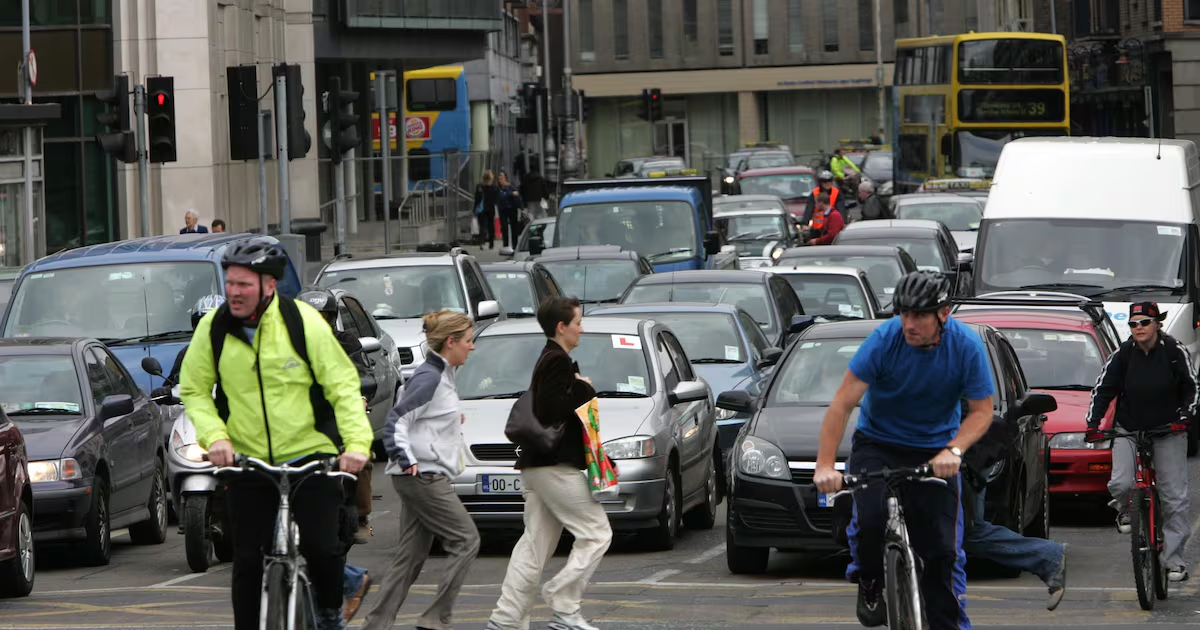
When my husband first moved to Ireland, he remarked how common it was to see drivers cram multiple cars through a fully red light. It wasn’t something I’d ever noticed; enculturation and all that, I suppose. A planned rollout of new detection cameras suggests this is increasingly a recognised problem. Rebranding “running reds” as the behaviour of true Fenians, I defended my people as appropriately suspicious of imposed restrictions, unwilling to blindly submit to the tyranny (and likely colonial machinations) of traffic law. It even seemed plausible that Ireland’s “pragmatic” approach might allow people to get the best out of the sequences, like in that Simpsons sketch where, seeing that vehicles move fastest through orange lights, Professor Frink proposes a reduction of the light range to just orange and red. As a cyclist now ferrying kids around, it’s easier to see automotive light-breaking for what it is. The most advantaged, dangerous and inefficient road users using the relative physical safety their vehicles afford them to steal an even greater share of road use.Cycling is gradually getting safer across Europe, but not as quickly as we might hope. While over the decade from 2014 to 2024 the rate of motorist deaths fell by 2 per cent a year, the same decrease in fatality for cyclists was just 0.5 per cent annually. Ireland’s cycling population is small, compared with the rest of Europe at least, and our low-ish fatality figures likely reflect cycling’s limited popularity here rather than a safe cycling environment.The risks cars pose to cyclists and pedestrians are worsening. A report from the New York Times last week showed how increasingly large cars with higher bonnets and bulkier frames make it harder for even attentive drivers to see potential victims, especially children. It also means that, if hit, the outcomes are worse. When struck by a car with a low bonnet, the victim typically suffers less critical damage and is flung up on to the comparatively soft car bonnet. When hit by a high bonnet, the damage tends to be more severe and the victim is regularly knocked back from the car, only to be immediately flattened under it.When challenged about the models that show these increased risks associated with newer designs, car companies emphasised their plan for cars to become safer by incorporating new technology aimed at avoiding pedestrians. Such systems automatically apply the brakes in response to detected pedestrians. This feels like just another instance of us being asked to put away very legitimate, concrete concerns and trust that the technology that will rescue us all is just around the corner.In general, Irish cars are smaller than their American counterparts, but anyone can see they’re getting bigger. The junction outside my daughter’s school is calamitous on this front. Cars trying to get out from the two minor roads on to the major ones routinely do little more than grimace while wilfully pushing their large “family” cars right into the pedestrian and cycle sequence that turns green as theirs goes red. Recently, one such driver beeped and shouted at a mother who had the temerity to move her cargo bike out to cross.Disdain for cyclists among motorists (and historically, horse-riders) is nothing new, and the history includes everything from a total ban on velocipedes in New York in the early 19th century to a series of targeted attempts to keep women off bicycles. Some of the imagery in the latter campaign is equal parts shocking and hilarious, including one 1908 poster entitled “The New Woman” which shows a woman dressed in red walking her bike out of a room while a harried-looking man stirs a pot while cradling a screeching infant. The history of cycling also provided many opportunities for women to demonstrate their physical ability in cultures that prized modesty and frailty. Beatrice Grimshaw, the women’s correspondent of the Irish Cyclist magazine, is notable for one such case in 1893. Brian Griffin wrote for History Ireland that she “set a world record for a 24-hour cycle by a woman by riding some 212 miles on a ‘Rover’ bicycle, beating the previous record by some five miles.” I’m sure Beatrice would be disappointed to see the results of the recent Transport Infrastructure Ireland survey which showed that “just 1.3 per cent of women’s trips are by bike”, and cited “aggressive driver behaviour and family responsibilities” as key issues.Yes, additional cycling infrastructure (especially cycle lanes) feels like a reduction of the space afforded to cars on the road, but this needs to be recognised in conjunction with the fact that cyclists take cars off the road and out of traffic jams. The National Transport Authority reports that walking, wheeling (travelling using wheeled mobility aids) and cycling take up to 660,000 cars off the road every day in Ireland’s five largest cities. Many people will always need to drive for various reasons, from accessibility to poor public transport infrastructure. But it might be helpful for motorists to remember when they are briefly annoyed by a cyclist doing something, they are usually simultaneously spared being frustrated by the same person at the helm of a more dangerous vehicle.Cyclists in Ireland deserve to feel safer – and that requires more than just beefed-up cycling infrastructure. Actual enforcement of traffic laws and a more Kantian individual approach to traffic lights and driver behaviour could go a long way to improving that.Clare Moriarty is a Research Ireland Enterprise Fellow, working at University College Dublin and the National Library of Ireland
Unthinkable: Irish drivers’ habit of ‘running reds’ is not a charming quirk
Cyclists in Ireland deserve to feel safer – and that requires more than just beefed-up cycling infrastructure
915 words~4 min read