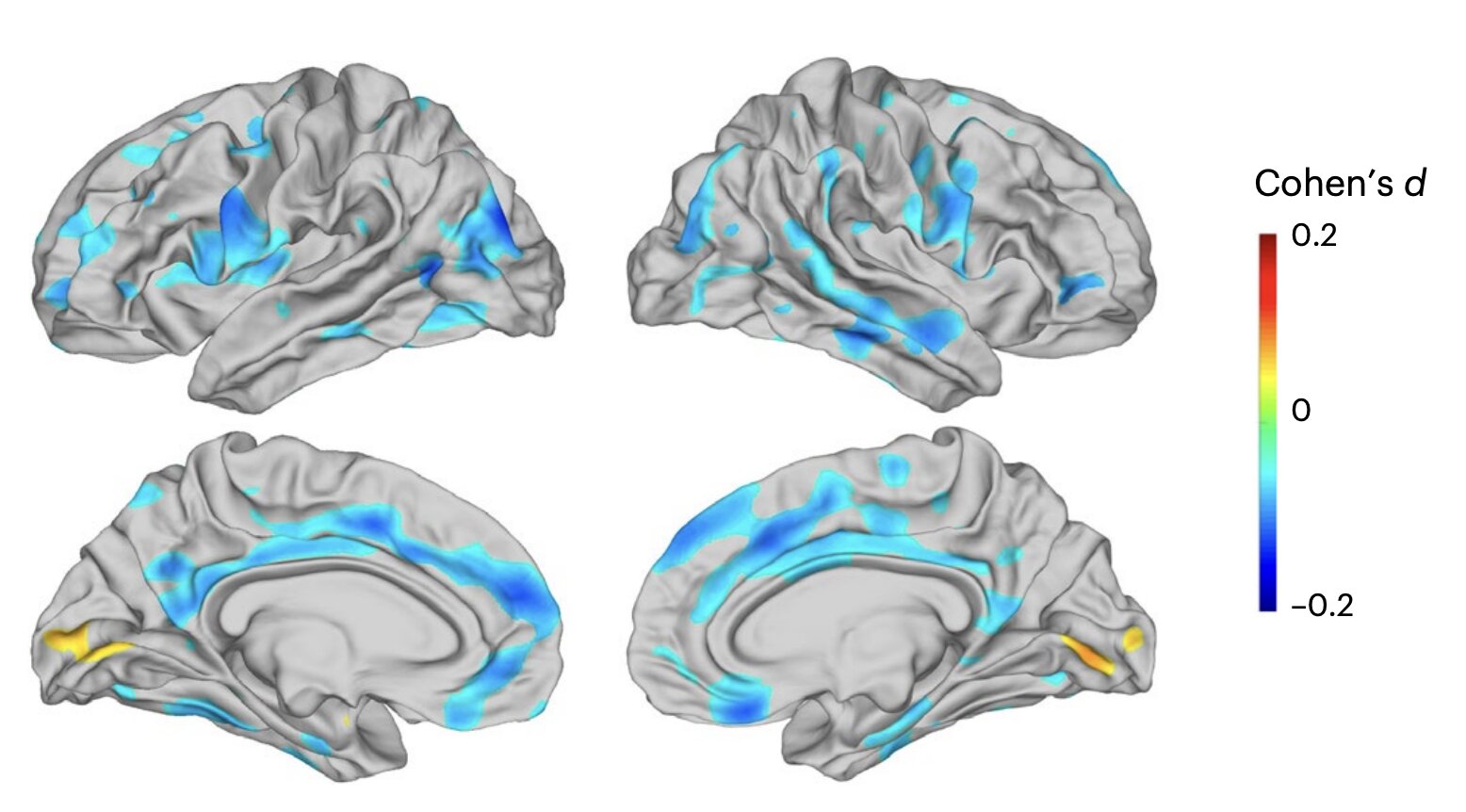
Cortical thickness differences between all patients with MDD and HCs (5,256 MDDs versus 6,320 HCs). The values represent Cohen's d (positive values indicate MDD > controls). Credit: Yan et al. (Nature Mental Health, 2026).
Major depressive disorder (MDD) is a psychiatric condition characterized by persistent feelings of sadness, a loss of interest in everyday activities, altered sleeping and/or eating patterns, low energy, and difficulty concentrating on tasks. While it is one of the most widespread mental health disorders worldwide, its unique neural and brain-related signatures have not yet been fully uncovered.
Recent studies have been trying to uncover differences in the structure of the brain associated with specific mental health disorders. This has mainly been done by analyzing brain scans collected from psychiatric patients using magnetic resonance imaging (MRI), a medical imaging technique that collects detailed images of specific organs using strong magnetic fields and radio waves.
Researchers at the Chinese Academy of Sciences and Vrije Universiteit Amsterdam recently performed a large-scale analysis of MRI scans collected from individuals diagnosed with depression and from people with no known mental health disorders. The results of their analysis, published in Nature Mental Health, unveiled differences in the structure of specific brain regions associated with depression, which appear to vary based on age, treatment stage, and medication use.