PC Mahalanobis’ most enduring gift was the science of the sample
| Photo Credit:
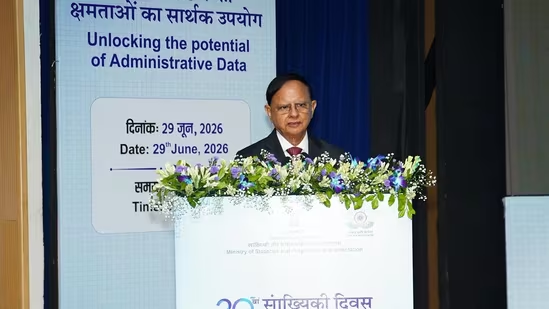
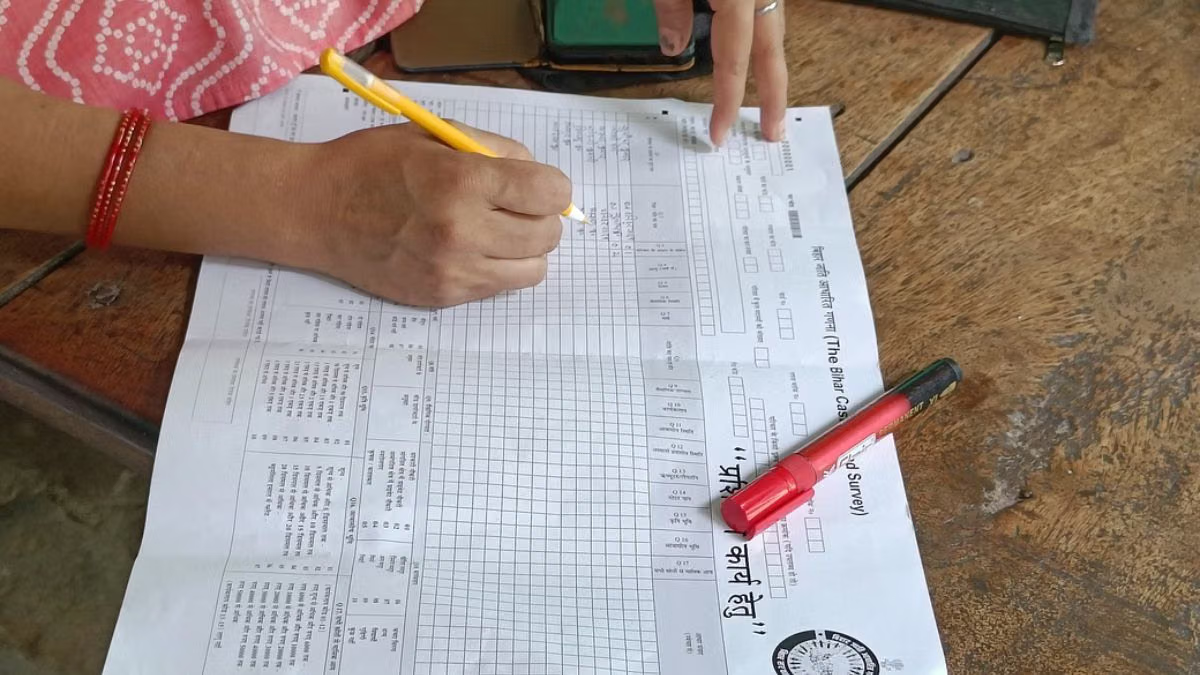
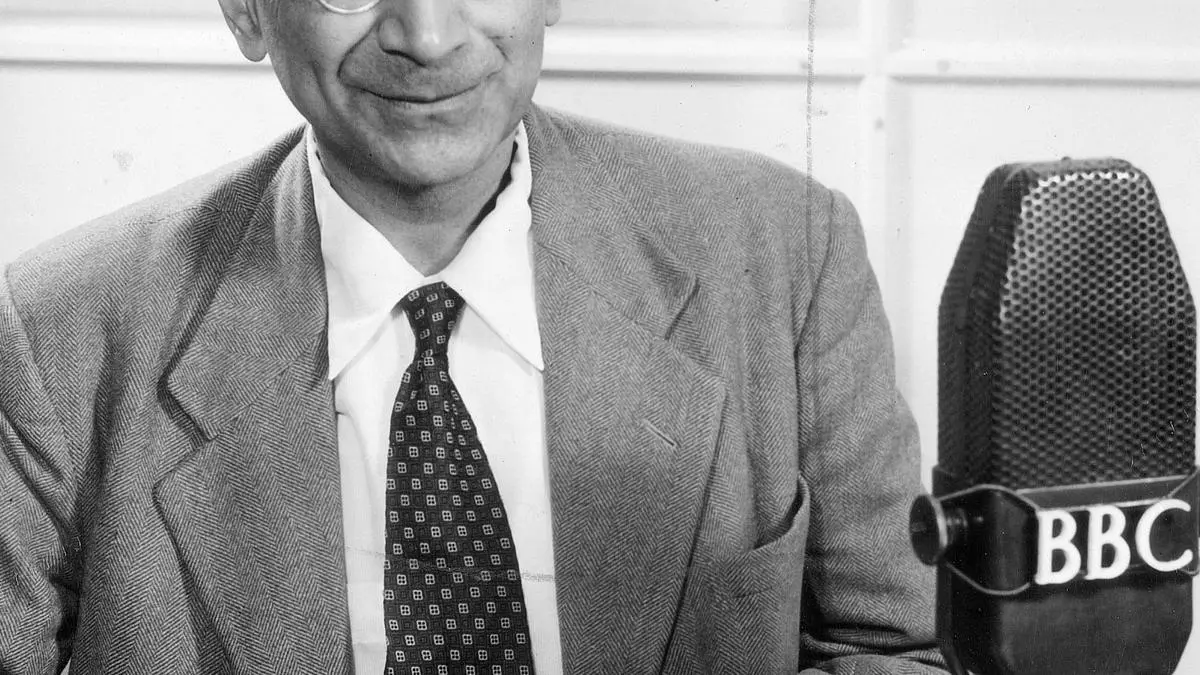
Every time we taste a spoonful to judge a whole pot of dal, or check a handful of grain to judge an entire sack, we are doing statistics without realising it — reading a small sample to understand a much larger whole. The man who turned that everyday instinct into a science for a nation was Prasanta Chandra Mahalanobis.As India marks his 133rd birth anniversary on June 29 — celebrated since 2007 as National Statistics Day — his idea feels more relevant than ever. In an age that runs on data and artificial intelligence, the statistician who taught India to find meaning in numbers remains its most modern thinker.The professorMahalanobis began as a physicist, teaching at Presidency College for more than three decades, before a growing fascination with statistics led him to found the Indian Statistical Institute (ISI) in 1931 — today an institution of national importance and global repute. He was physicist, statistician and economist at once, and the architect of India’s Second Five-Year Plan. As Professor CR. Rao remarked, “His major achievements were in fields in which he had no formal degrees.” His genius lay in putting statistics to work.After the great floods in Bengal and Odisha in the 1920s, his patient study of decades of rainfall showed that the remedy lay in better drainage, not higher embankments — advice that saved the exchequer crores and shaped the projects at Damodar and Hirakud.His study of community affinities produced the Mahalanobis distance, the D² statistic still used worldwide to measure how groups differ. For these achievements the nation honoured him with the Padma Vibhushan in 1968 and a commemorative stamp in 1993.The statistician-statesmanHis most enduring gift was the science of the sample. Asked whether Bengal’s jute acreage could be estimated without counting every field, Mahalanobis designed India’s first large-scale crop survey and proved that a small, well-planned sample could match a full count at a fraction of the cost.The result validated the power of sampling and led to the founding of the National Sample Survey (NSS) in 1950. Prof. Harold Hotelling judged that no sampling technique anywhere had matched the accuracy Mahalanobis achieved.The institutions he built were never meant to stand still. The first NSS round in 1950 used about 240 investigators and 1,800 sample villages; today’s rounds deploy thousands of field staff across some 25,000 villages and urban blocks, and surveys once held every five years now run yearly, producing quick monthly and quarterly estimates for a fast-moving economy.That foundation is doing remarkable work today. The recently released sixth National Family Health Survey (NFHS-6, 2023-24) is itself a child of the sampling revolution he led: instead of counting every household, it reads a carefully drawn sample of nearly seven lakh homes to portray the health of a billion people, carrying his method far beyond economics into health and nutrition. More striking still is a circle now closing.As Chairman of the National Income Committee in 1949, Mahalanobis was among the first to flag a basic weakness — India could not accurately measure what its people earned. More than 75 years on, that gap is being closed: in 2026 the National Statistics Office launched the country’s first full-scale National Household Income Survey, covering about 4.5 lakh households across every State and Union Territory and recording earnings directly rather than estimating them from spending.Alongside it, new annual surveys on household debt and investment, the labour force, the services sector and rural farm households are steadily filling old data gaps, while the base years of key indicators — GDP and the Index of Industrial Production to 2022-23, the Consumer Price Index to 2024 — have been refreshed to mirror today’s economy.In the age of AIHere his vision meets the newest frontier. Artificial intelligence is only as trustworthy as the data beneath it, and India’s pursuit of sovereign AI — models, computing power and datasets that are Indian-owned and Indian-governed — depends on having reliable, representative national data of its own.The statistical system is rising to meet that need. MoSPI’s eSankhyiki portal turns vast official data into a searchable, machine-readable resource anyone can query; a Sankhyiki AI Assistant on the ministry’s website now answers questions in plain language; and a new Model Context Protocol (MCP) server lets AI tools such as ChatGPT draw directly on authenticated government data to answer everyday questions.This is exactly what Mahalanobis spent his life building: a self-reliant statistical system, in the service of the nation’s own purposes.A nation, his life reminds us, grows not only by gathering data, but by using it wisely in the service of its people.Prasu is Deputy Director, Astitva and Meghal are Assistant Directors, MoSPI. Views are personalPublished on June 29, 2026