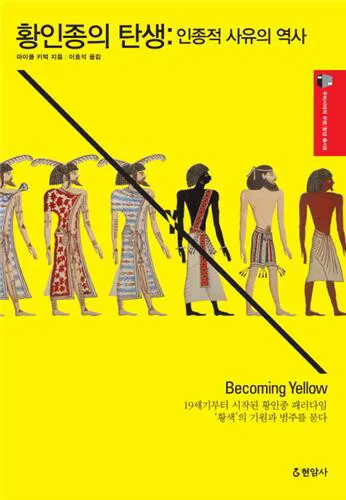
The cover of the Korean translation of “Becoming Yellow: A Short History of Racial Thinking
In “The Travels of Marco Polo,” the people of China are described as “white.” Records left by eighteenth century missionaries also report the skin color of Japanese and other East Asian people as clearly white. Yet in the nineteenth century, this perception quietly gave way to descriptions as “yellow.” In travel books, scientific discourse, and works of art, portrayals of East Asians began presenting them as having yellow skin. What happened in between?In his 2011 book “Becoming Yellow: A Short History of Racial Thinking,” National Taiwan University professor Michael Keevak delves deeply into the origins and history of how and why East Asians went from being seen as “white” to being classified as “yellow.”The first suspect implicated in applying the “yellow” label to East Asian faces is the famed Carl Linnaeus (1707-78). At first, Linnaeus used the Latin adjective “fuscus,” meaning “dark,” to describe the skin color of Asians. But in the tenth edition of his 1758-9 “Systema Naturae,” he specified it with the term “luridus,” meaning “light yellow” or “pale.”
” National Taiwan University professor Michael Keevak