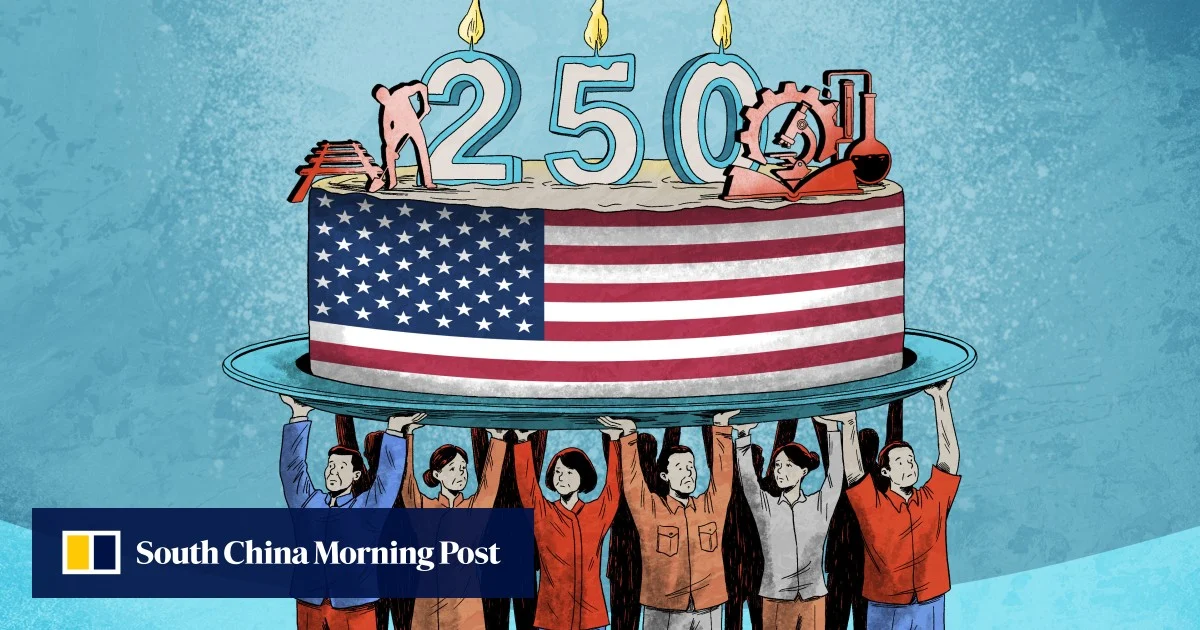
As the United States marks the 250th anniversary of its founding, it confronts a new world order dominated by its relationship with China. In this wide-ranging series, we examine the pressure points and possibilities in those ties, from hard tech to soft power. Here, Ling Xin and Meredith Chen look at how the fight against discrimination continues to this day.The rise of the United States to superpower status was fuelled by the untold millions of immigrants who arrived from foreign shores.Among them were the Chinese who crossed the Pacific in search of opportunity and a better life – only to become the builders of modern America, who remain too often forgotten and even excluded.One well-known photograph taken in 1869 to celebrate the completion of the Transcontinental Railroad showed a cheering crowd made up of entirely white faces. Meanwhile, Chinese workers, who made up as much as 90 per cent of the workforce and endured the most dangerous labour, were kept well away from the spotlight.Frank Wu, the president of Queens College, City University of New York, said Chinese-Americans had long been seen as “perpetual foreigners” whose achievements sparked suspicion from the very beginning.“The very success of Asian-Americans has been held against them,” he said, adding that since their arrival, fear had driven others to view their hard work not as a contribution to American progress but as “unfair competition”.“The more they do well in different domains, the more important it is to ensure they do not dominate politically or socially,” said Wu, a former chair of the Committee of 100, a New York-based non-profit organisation formed by prominent Chinese-Americans.
Why Chinese-American success stories still provoke prejudice and fear
Almost a century and a half has passed since the notorious Chinese Exclusion Act, but anti-Asian prejudice is still rife.
269 words~1 min read