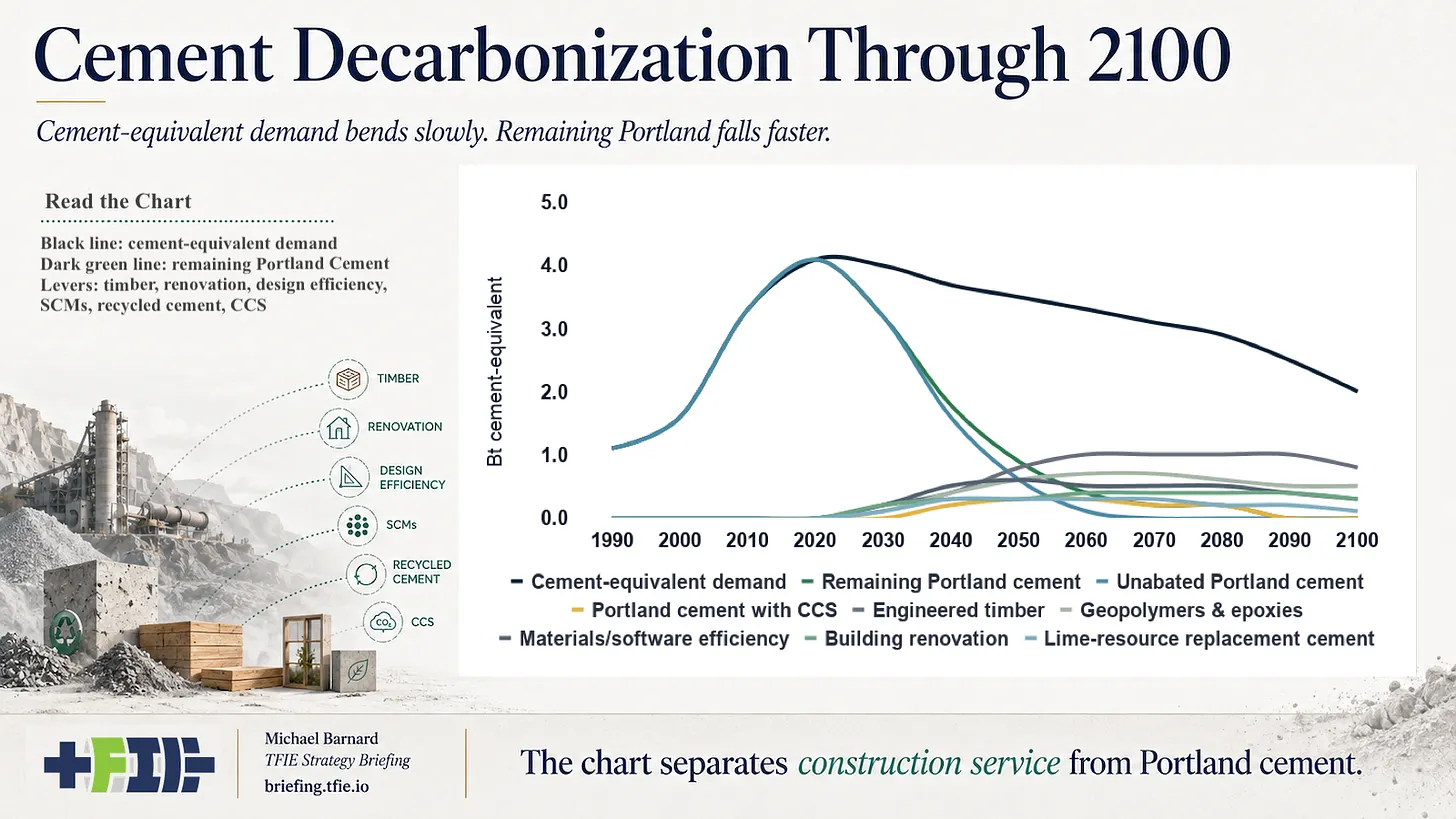
Cement decarbonization is a layered pathway: less Portland, lower clinker, better design, substitutes, recycling and selective CCS.
Support CleanTechnica's work through a Substack subscription or on Stripe.
Cement decarbonization attracts miracle stories. One company has a new binder. Another has a carbon-negative aggregate. Someone else has an electrochemical process, a hydrogen kiln, a low-carbon limestone route, a supplementary cementitious material, a recycled cement process or a carbon-capture retrofit. Some of these ideas are useful. Some will become real niches. A few may become meaningful industrial wedges. But the sector will not be decarbonized by one magic cement.
The first mistake is treating cement demand as fixed. Cement is not an end use. It is an input into buildings, roads, bridges, ports, tunnels, foundations, dams, industrial sites and other infrastructure. The useful question is not simply how to make today’s cement with lower emissions. It is how much cementitious material the world needs after design efficiency, renovation, material substitution, urban form, infrastructure maturity and better construction practice are counted.
That denominator changes over time. China’s massive first-build of infrastructure and property is already past its peak. Other regions will still build, but they are unlikely to repeat China’s material intensity at the same scale. Mature economies will shift more of their built-environment spending toward renovation, repair, adaptive reuse and replacement rather than endless first-build expansion. Growing economies still need concrete, but better design, higher-quality standards and less waste can reduce tonnes per unit of service.