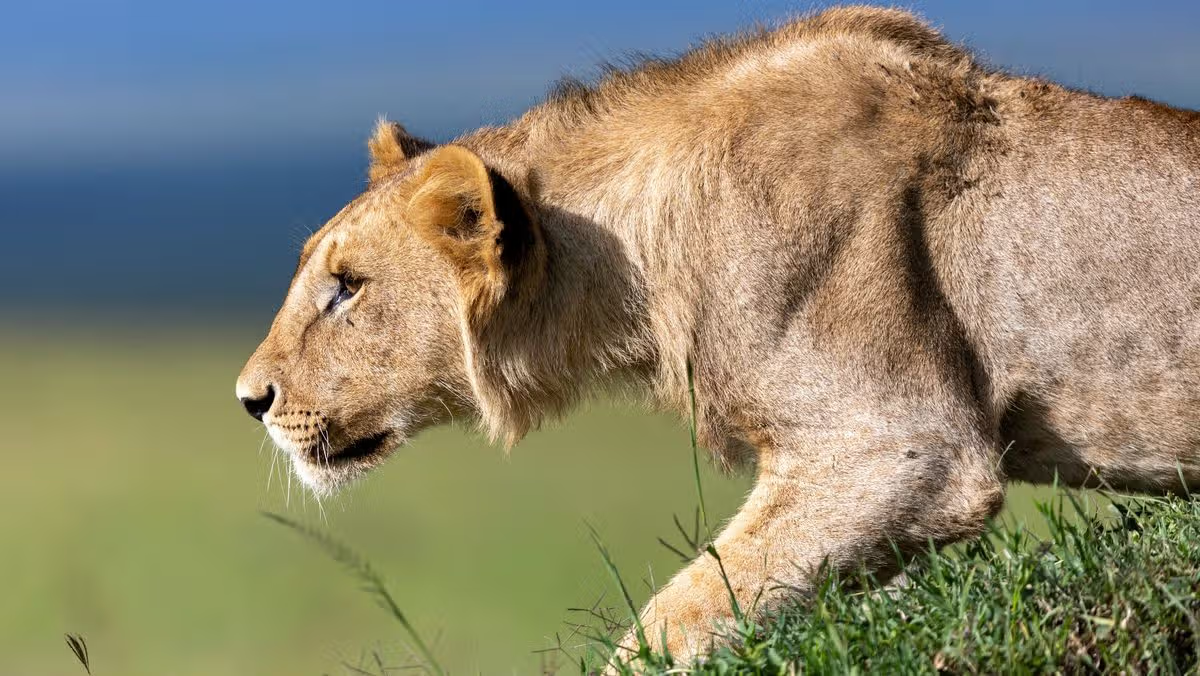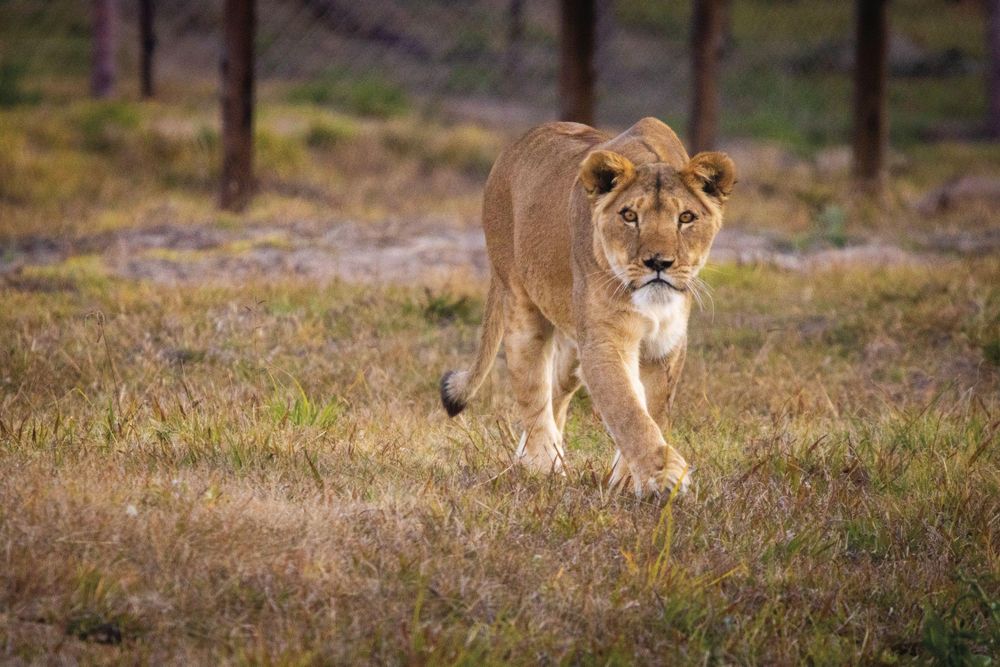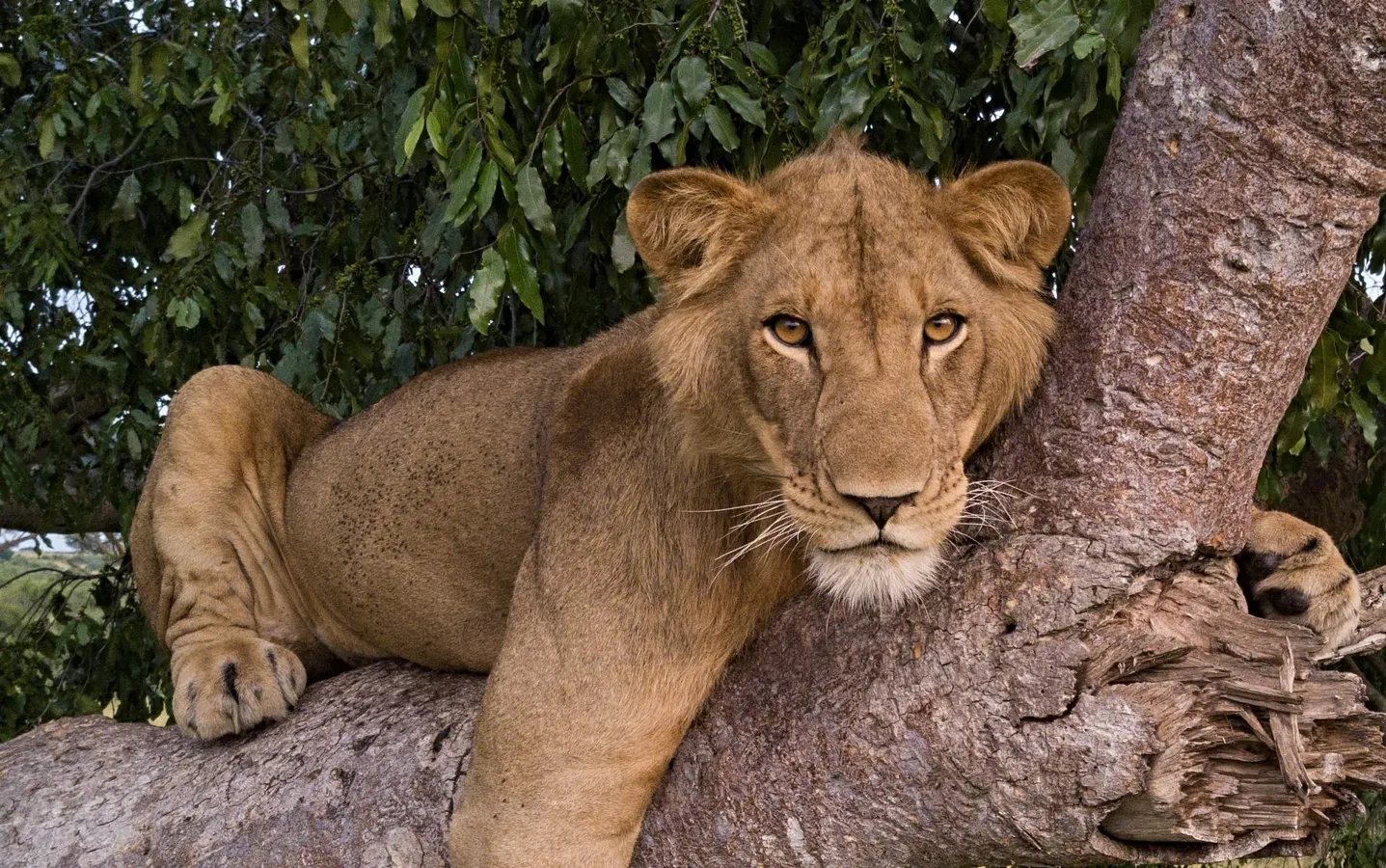
A YOUNG JACOB UP A TREE, WITH ALL HIS NINE LIVES STILL AHEAD OF HIMALEX BRACZKOWSKIOur boat drifted through the Kazinga Channel, the waterway linking Lake George and Lake Edward in Uganda's Queen Elizabeth National Park. Hippos surfaced around us, elephants sauntered along the water’s edge, and an African fish eagle called overhead. But it wasn't the animals I could see that occupied my mind; it was one particular lion I couldn't.HIPPO AND BABY ON LAND, KAZINGA CHANNEL, UGANDA(Photo by Wolfgang Kaehler/LightRocket via Getty Images)LightRocket via Getty ImagesELEPHANTS PLAY IN THE KAZINGA CHANNEL, UGANDAN RAYSomewhere in the park, beyond this particular stretch of channel, was a three-legged male lion named Jacob who’d done something almost unimaginable two years earlier. Under the cover of darkness, Jacob and his brother, Tibu, had slipped into the crocodile- and hippo-filled waters of the Kazinga Channel and swum more than a mile to the other side. The extraordinary crossing, captured on film by Luke Ochse and the Kyambura Lion Project, would later earn Jacob a place in the Guinness World Records. “We’d speculated for a long time that lions in Queen Elizabeth were swimming across the Kazinga, but no one had ever captured this behavior visually,” says Orin Cornille, a lion researcher from the Volcanoes Safaris Partnership Trust. What makes that achievement extraordinary is that Jacob made the crossing on three legs. What makes it unforgettable is everything that came before.Jacob The LionJACOB, AFTER LOSING HIS BACK LEFT FOOT IN A STEEL TRAP.ALEX BRACZKOWSKIRescued from a poacher's snare in 2019. Losing his back left leg in a steel trap during the COVID-19 pandemic. Surviving the poisoning of his family by poachers who were targeting lion body parts for the traditional medicine market. Gored in the chest by a buffalo. Withstanding territorial beatings from rival lions. Adapting to hunting on three legs. And finally, traversing almost 55 miles through the park, to Kazinga, where he would reunite with his brother. Most lions wouldn’t have survived even one of those events. Jacob’s survived them all. "He's the real-life Rocky Balboa of lions," says filmmaker Chadden Hunter, and that’s a comparison that is difficult to argue with. JACOB, WITH HIS BACK FOOT MISSINGALEX BRACZKOWSKIHunter continues, “When I first met Alex [Braczkowski], and he rattled through the trials and tribulations Jacob had suffered and survived, I went from being enthralled to drop-jawed. This one lion’s life was a Shakespearean tragedy wrapped up in a Lord of the Rings adventure.” Braczkowski, who has studied Jacob for years, adds, “Every chapter of his life presents something we didn't think possible. That's what defines him. An animal who keeps finding ways to survive against impossible odds… Jacob has had the most incredible journey and really is a cat with nine lives," JACOB IN THE FOREGROUNDALEX BRACZKOWSKIIn a world often dominated by statistics and population trends, Jacob provides something rare: a living individual whose story helps people connect emotionally with broader conservation and environmental challenges. That connection is powerful. People may not remember facts, figures, flow charts, population estimates and other data, but they do remember Jacob. He’s become one of the most incredible symbols of wildlife resilience anywhere in Africa, and as such, he’s just about to step into the spotlight and star in a new wildlife documentary, “Nine Lives”. With a Kickstarter page for those wishing to support the project.Queen Elizabeth National ParkLocated in western Uganda, between Lake George and Lake Edward, Queen Elizabeth National Park is one of Uganda’s most biologically diverse protected landscapes. The park is famous for its tree-climbing lions, enormous hippo populations, chimpanzee tracking, volcanic crater lakes, wetlands and savannah ecosystems. A YOUTHFUL JACOB WITH ALL HIS NINE LIVES STILL AHEAD OF HIMALEX BRACZKOWSKIBut beneath this picture postcard imagery lies a more complicated reality. The park's wildlife exists within a human-dominated landscape where growing populations, poaching pressures and habitat challenges create constant conservation pressures, particularly for the lions. “Over sixty thousand people live within Queen Elizabeth's boundaries… That's the real conservation challenge we need to solve,” Braczkowski tells me. He adds, “When we conducted our first survey in 2018, we documented 72 lions in Queen Elizabeth. Our census with the Ugandan government in 2022 revealed numbers had collapsed to 39.” JACOB AND HIS BROTHER, TIBU, PREPARE FOR TO HUNTALEX BRACZKOWSKIJACOB SUCCESSFULLY MATINGALEX BRACZKOWSKIAgainst that backdrop, Jacob's swimming feats across the Kazinga Channel takes on an even greater significance. "Jacob and his brother were searching for the last breeding females in the park,” Braczkowski says. “His fight for fatherhood is also a fight for the future of lions in Uganda." JACOB, THE LION WITH NINE LIVESALEX BRACZKOWSKIThe Science Behind The StoryThe man most closely associated with documenting Jacob's life is Dr. Alexander Braczkowski. He’s been following Jacob for 10 years now. As conservation biologist, National Geographic Explorer, and researcher affiliated with Griffith University, Braczkowski has spent years studying lions and predator ecology in Uganda. His research has revealed important insights into how lions are adapting to increasing environmental pressures, including in Queen Elizabeth National Park, where lions are often forced to travel longer and longer distances, navigate fragmented landscapes and compete intensely for territory and mates. The Kyambura Lion Monitoring ProjectBehind many of these insights and discoveries is the Kyambura Lion Monitoring Project, of which Braczkowski is the scientific director. The project has become one of Uganda's most important lion research initiatives, focusing on long-term monitoring, population assessment, conservation interventions and public education. Working alongside the Uganda Wildlife Authority and conservation partners, researchers from the Kyambura Lion Monitoring Project track lion movements, investigate mortality events and collect critical data that informs management decisions. DRONES ARE INVALUABLE TRACKING AND RECORDING EQUIPMENT WHEN IT COMES TO LIONSALEX BRACZKOWSKIThe project also plays a critical role in responding to wildlife emergencies. When the poacher's trip had badly injured Jacob during the pandemic, wildlife veterinarians, conservation groups and park authorities worked together to save his life. Without that rapid response, and years of dedicated monitoring, Jacob's extraordinary story might never have been documented. More importantly, the valuable conservation lessons his life continues to offer would have been lost.PREPARING A REMOTE MOTORIZED CAMERA BUGGY FOR USE IN THE FIELDALEX BRACZKOWSKIBosco Atukwatse, a project field coordinator with Kyambura Lion Monitoring Project says, “I have worked with lions for more than 5 years, and I’ve never seen one like Jacob. His remarkable resilience and adaptability are a testament to the importance of conservation efforts in our park. Being part of the incredible team monitoring and documenting his whereabouts is a dream come true for me,” he adds, “I’m excited to see the film about his story, and believe it will inspire people worldwide to appreciate the beauty of wildlife conservation.”The Team Behind “Nine Lives”THERE'S A DEDICATED TEAM BEHIND THE FILMALEX BRACZKOWSKITRACKING LIONS IS NOT ALWAYS SMOOTH SAILINGALEX BRACZKOWSKIWhile Jacob may be the star of “Nine Lives”, the film represents years of work by researchers, trackers, conservationists, photographers and filmmakers. The core team includes Luke Osche, Orin Cornille, Bosco Atukwatse, Winfred Nsabimana, Johnson Muhereza, Yahaya Ssemakula, Daniel Snyders and Alex Braczkowski; with Braczkowski and Chadden Hunter co-directing the project.Winfred Nsabimana describes the work that goes on behind the scenes when it comes to monitoring lions like Jacob; “Working with lions often means spending long hours behind the scenes, tracking movements, identifying individuals, documenting behavior and collecting the data that informs conservation.” SOMETIMES A DRONE IS THE ONLY WAY TO TRACK LIONS IN THE THICKETSALEX BRACZKOWSKIAND SOMETIMES NO DRONE IS NECESSARY AT ALLALEX BRACZKOWSKIFor more than a decade, the team has tracked the lions of Queen Elizabeth National Park, often working in terrain so dense that traditional filming became impossible. "Much of where Jacob has lived for the last four years is characterized by impenetrable sickle bush thickets," says Braczkowski. "For over a year we tried to capture him hunting from our Land Cruisers, but eventually had to turn to aerial thermal photography and videography." Nsabimana adds, “There were days when I lost hope of seeing Jacob again, and every successful search for him filled me with wonder at how much stronger he grew day by day… His journey reflects the challenges, resilience and realities that wildlife face, and I’m super excited to see his story shared, to inspire and ensure the struggles of these incredible animals are not forgotten.”JACOBALEX BRACZKOWSKIWhy Jacob's Story MattersThe best wildlife films do more than capture extraordinary animal behavior, they inspire people to care. Scientific research advances conservation, but storytelling has the power to reach millions. When audiences form an emotional connection with a single animal, they often begin to care about the landscapes, species and people connected to that story. That’s why documenting Jacob's life matters. As lion populations across Africa continue to face growing pressures, his story preserves more than the life of one extraordinary animal. It captures a unique moment in the history of Queen Elizabeth National Park and highlights the challenges and successes of conserving one of Africa's most iconic predators.Over the past decade, DrAlexander Braczkowski and his team have filmed almost every chapter of Jacob's remarkable life.ALEX BRACZKOWSKIOver the past decade, Alexander Braczkowski and his dedicated team have filmed almost every chapter of Jacob's remarkable life. Now, the challenge is transforming these thousands of hours of footage into “Nine Lives”, a documentary that will connect audiences with both an unforgettable lion and the conservation efforts behind his survival.For veteran wildlife filmmaker Chadden Hunter, compelling storytelling is what turns awareness into action. "Viewers love a good story. They love having a hero to root for, an individual facing adversity, experiencing a transformation and coming out on top," he says. “But the real prize is being able to introduce viewers to the ongoing plight of African wildlife, the realities of human-wildlife conflict and the resilience not just of Jacob but of the people trying to protect our planet's last wild places."A YOUNG JACOB, ALMOST A DECADE AGO, BEFORE HE'D FACED ALL THE DRAMAS TO COMEALEX BRACZKOWSKIThe temptation is to see “Nine Lives” as a story about one remarkable animal. In reality, it’s about so much more. It’s about poaching, it’s about habitat pressure, it’s about coexistence between people and wildlife, it’s about the importance of science, research and long-term conservation investment. And above all it’s about hope. In a world saturated with bad news, Jacob represents a different kind of narrative. He is evidence that intervention works, that conservation partnerships matter, that wildlife can recover when given a chance. Standing on the top deck of the boat as its putters its way down the Kazinga Channel, I understand why Jacob's story resonates so deeply with me. This is not simply the story of a lion. It is the story of survival against impossible odds. And in an era when conservation desperately needs stories that inspire action, “Nine Lives” may well become one of the most important wildlife films of its generation.Visit the Kickstarter page to support the project.
The Lion With Nine Lives: Jacob’s Story And The Making Of A Wildlife Documentary.
IN UGANDA'S QUEEN ELIZABETH NATIONAL PARK A REMARKABLE LION HAS DEFIED THE ODDS AND PROVED THAT CATS DEFINITELY HAVE NINE LIVES
1,818 words~8 min read