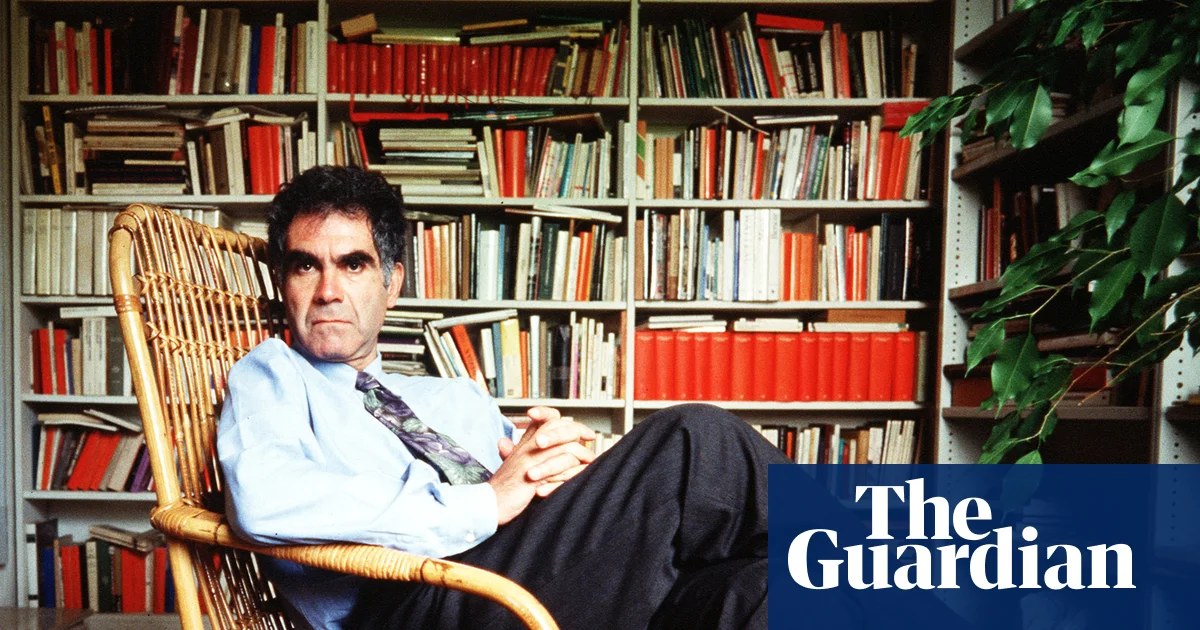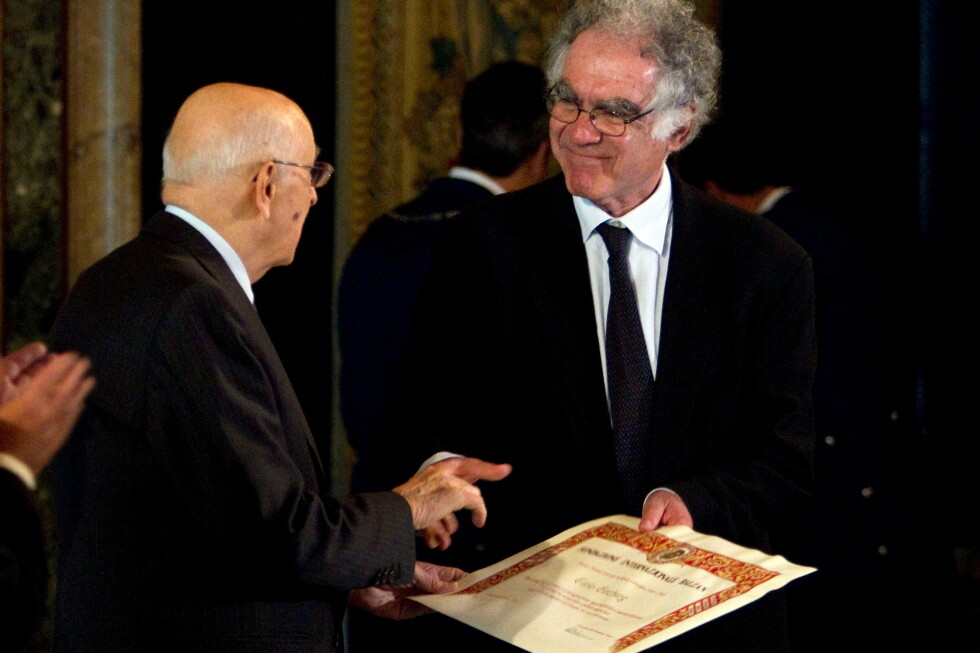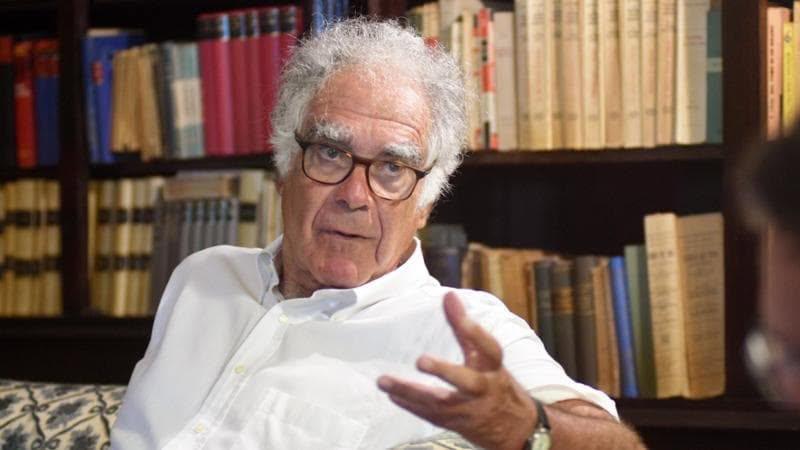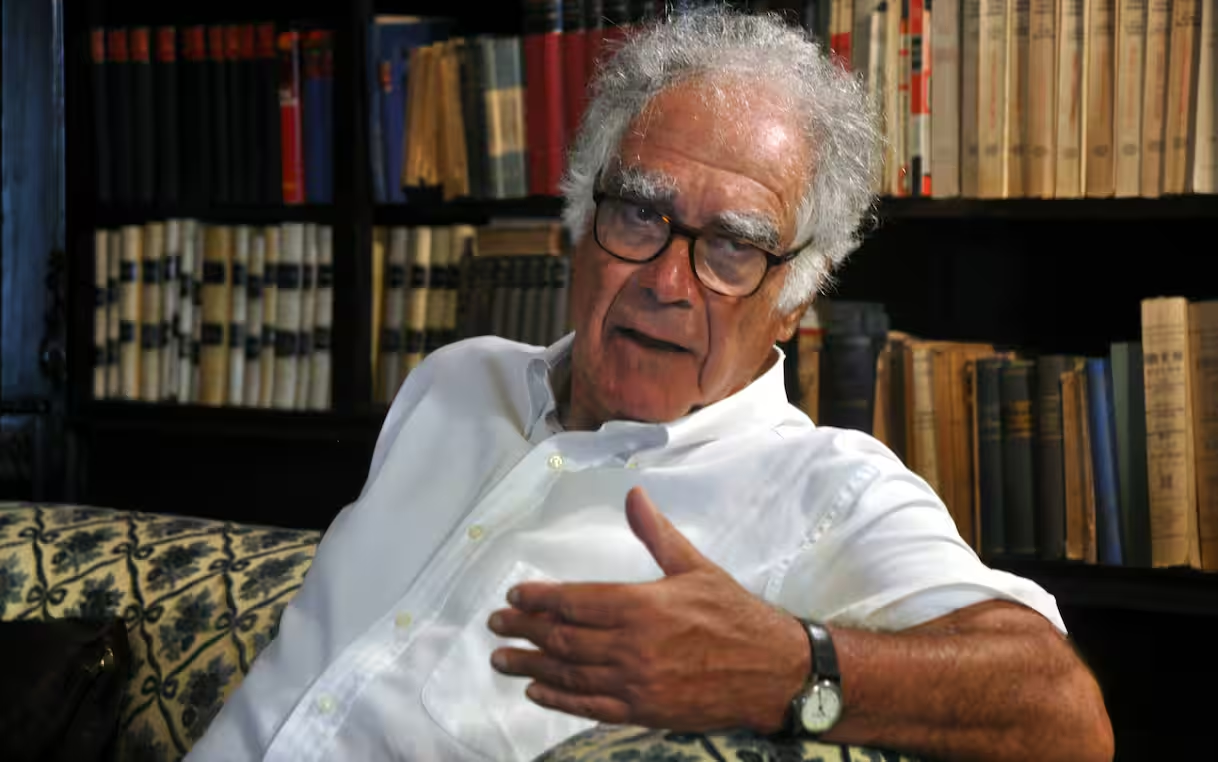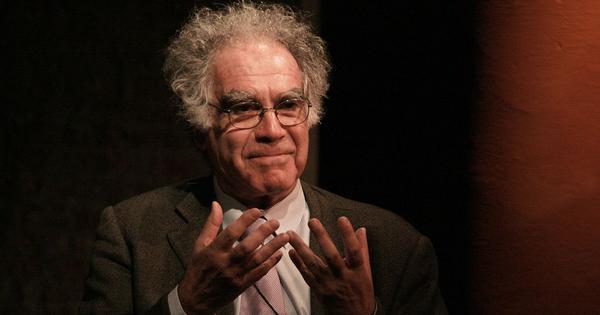
Carlo Ginzburg was an Italian historian and one of the founders of the field of microhistory. His interest ranged from the Italian Renaissance to early modern European history, with contributions to art history, literary studies, and the theory of historiography.A few of his best known works are The Cheese and the Worms: The Cosmos of a Sixteenth Century Miller, The Night Battles, and Ecstasies: Deciphering the Witches’ Sabbath.He was awarded the 2010 Balzan Prize and was elected an International Member of the American Philosophical Society in 2013. Ginzburg died on June 17. He was 87. In a conversation with his Indian publisher, Naveen Kishore in Kolkata, 2019, Ginzburg spoke about his career, “becoming” a Jew, his obsession with punctuation, and the deep influence of fiction on his work. Excerpts from the conversation:The thing about conversations of this nature is that they tend to begin midstream. There is a sense that you have been talking before and that you will continue to talk after. So I shall plunge into my homework.The lure of walking into a living landscape of possibility, especially if no one else has trampled that way before, is exhilarating: discovering first your roots, and then the initial glimmer of clues to the possibility of a life of history; becoming the historian; and yes, the question of identity. Your phrase: “becoming Jewish”. A Jewish father imprisoned and tortured by the fascists; your mother, an established Italian writer of fiction, antifascist, and of the Communist Party of Italy. Your home must have been a beehive of cultural and political activity. You must have been influenced by the left-wing politics of your parents.This leads to a question we in India are beginning to grapple with, to come to terms with each waking moment of our daily lives: our secularism is ripped into shreds as we don the garb of our various personal identities aggressively. So I’m very interested in what you think the word “identity” embodies.It is a very challenging question. You say first “identity” and then “identities”, and I think this goes to the heart of the issue. Why? Well, I think we should always make a distinction between the observer’s categories and the actor’s categories. Here I’m reworking a distinction that was put forward by the American linguist, anthropologist, and Protestant missionary Kenneth Pike. He talked about the etic level, from phonetics, and the emic level, from phonemics.So I would say certainly the word “identity” is part of the actor’s language, or languages. But as an analytic category, it doesn’t work, in my view. Why? Because it is, first of all, a political weapon, and I should look at it from a distance, using a different kind of analytic category.What is puzzling for me, and even troubling, about the word “identity”, first of all, is its etymology: from the Latin idem, “the same”. So the changing nature of a person is not there. But there is something even more troubling. When somebody is talking about the Italian identity, the European identity, the Jewish identity, I think this is part of the actor’s language. But it is not part of my own language, because I would not accept this idea of something fixed, something rooted in a distant past and still here with us. No.So I said to myself while listening to you: Okay, I certainly became aware, slowly, that my commitment to history was related to a distant past, and that distant past had been affected by my father’s life and death, my mother’s life, and also my childhood experiences. But all this was part of a complicated landscape, a language I was sharing with other people who were not actually part of my family.I came to a different notion of identity, meaning the place of convergence of different sets, in the mathematical sense. I would say about myself: I am part of an animal species, the Homo sapiens sapiens species. I am part of the masculine moiety of it. I am an Italian citizen. I share this membership with many other Italian citizens. I am also a member of a more restricted set involving, let’s say, Italian retired professors from a Jewish background, and so on and so forth. And then there is a set in which there is only one member: my fingerprints.My fingerprints could be relevant, even crucial, in order to identify myself from a legal point of view, or from the point of view of a policeman, in certain circumstances. But actually, when I’m thinking about myself, I have to understand that what is specific, less specific, and generic are always interacting in my own behaviour. And I think this is true about everybody. So this is a sort of answer to your challenge. I don’t know whether you would accept this or whether you would suggest a different notion of identity.No, I’m actually very taken by the notion of all these multiple identities within the self, which is what is coming across to me. And I find that, as a man of theatre, this is particularly exciting. We will come back to this, because I have a question for you a little later, precisely about the self as archive. Hold on to that thought.If you allow me the analogy of a theatrical performance and writing a book on a historical subject, the experience of sensing other lives, both lived and imagined, and the elsewhere that inhabits the silences between the spoken word and the hearing one. An audience, of course, hears and listens and follows a sequence of unfolding suspense. But it also senses a parallel, often contrary text, a story that remains unspoken: the subtext, which we talk about a lot in theatre, that is simultaneously linked to the playwright-historian’s intent.So, like history as narrative, recital, or even a performance from the past, the present often plays the role of a palpable subconscious presence in every study of the past. After all, the study is inevitably made from the perspective of the present, looking at the past. So maybe explore this to start with: What, in your opinion, is the meaning of theatre? And what is the meaning of history?Again, this is really challenging. I love that. I would say the idea that there is a dialogic dimension, which is obvious in theatre, is not so obvious for historians. Here, I’m deeply influenced by the imposing work of a great Russian critic, Mikhail Bakhtin. I remember that I read his book on Dostoevsky a long time ago, and I’m fascinated by this idea of a dialogic dimension, in which dialogue does not necessarily mean a peaceful dialogue, but also a clash of worldviews.I have been confronted for many years with a kind of literally dialogic evidence, meaning Inquisition trials. What is striking in those trials is, of course, the asymmetrical relationship recorded by them. On the one hand, you have judges, friars, having power: power to produce the evidence, power to ask questions with a strong subtext, imposing their own worldview, using symbolic power and physical power – torture. So the relationship is deeply asymmetrical.But it is also possible, as I discovered, to read the evidence in those trials against the grain. Here I am referring to a famous sentence by Walter Benjamin, “reading history against the grain”, something which I would interpret – and I don’t know whether Walter Benjamin would ever have agreed – as: We can read historical evidence against the intentions of those who produced it. So there is a technique that implies the possibility of reading between the lines.However, I was lucky enough to discover by chance – by chance; maybe we are going to talk about chance later on…We are going to talk a lot about chance.I discovered it by chance, but it was a kind of planned chance: to discover in the archive a trial in which there was a deep gap between the Inquisition’s assumptions and the defendant’s answers.I discovered this in the State Archive of Venice. It was in 1963, I think, and I came across a four-page document in which an inquisitor asked questions of a young peasant from a little town in Friuli, on the eastern border of Italy, in 1593, I think. The inquisitor said, “Are you a benandante?” I had never heard this word before, and I assume that even the inquisitor had never heard this word before. The literal meaning of the word was clear in Italian: somebody who goes for the good. But the answer was completely unexpected.After some attempt to evade the question, the young man said, “Yes, I am a benandante. Since I was born with a caul, meaning wrapped in the amniotic sac, my spirit leaves my body four times a year, and we, the benandanti, fight in spirit against the witches for the fertility of the crops. We, the benandanti, use as weapons fennel branches. The witches use sorghum sticks.”I read this, and I was so overwhelmed by what I read that I left the archive and started to walk. I was in Venice. The archive is one of the most wonderful places in the world, close to the church of Santa Maria Gloriosa dei Frari, where you have a wonderful painting by Titian and a wonderful painting by Giovanni Bellini. I was walking back and forth, smoking cigarettes, something I stopped later on. But this detail gives me the distance. It was I, but also a different kind of being, who had been affected by that discovery, which luckily enough, after a while, led me to Udine. And I discovered 50 trials against benandanti, men and women, some of them very long, full of details. This was the topic of my first book, The Night Battles.In that case, the dialogic dimension was evident, not only at the literal level, meaning questions and answers, but also in the gap between the inquisitor and the benandanti, and then in the clash between the two worldviews, their respective worldviews.Just one thought, because you mentioned witchcraft, before we start digging into the archive. What stayed with me was that you do not believe in magic, but you are excited by those who do believe in magic. Could you speak a little about this?I decided to become a historian in Pisa. I was there as a teacher, as a professor, some years ago, before my retirement, but I was there a long time ago as a student. I was in the library, and I suddenly made a triple decision: trying to become a historian, deciding to work on witchcraft trials, and trying to rescue the voices and attitudes of men and women accused of being witches.Actually, the third decision implied a lot of problems, of which I was completely unaware at that moment, because it meant working on the archives of repression in order to rescue the voices of the persecuted. So I think that my interest in historical methodology was, in some way, elicited by that kind of paradoxical use of the evidence: against the intentions of those who produced it. Although possibly, my interest in methodology would have emerged anyway.In any case, as you recall, I don’t believe in the power of magic, but retrospectively, I realised that three books pushed me to choose that topic as a topic of research. Books, yes – texts, let’s say.One of them was Carlo Levi’s Christ Stopped at Eboli. In a way, I think that Carlo Levi’s experience in a small village of southern Italy – he was sent to internal exile by the fascist regime in the 1930s – was important for me. Carlo Levi and my father had been friends. They were both involved in the same underground antifascist movement. I have recollections of Carlo Levi from my childhood. Then I met him again.I was really struck by his book because he was looking at the attitudes, the culture, of those southern Italian peasants from a distance. He was a man of the Enlightenment, in a sense, but also with deep interest and emotional participation. That kind of split – distance and the attempt at closeness – is something that struck me deeply, and I think is still affecting my work as a historian.Then there was a work by an Italian anthropologist, the most important Italian anthropologist so far, Ernesto de Martino: Il mondo magico, The World of Magic. I realised much later that there is a dreadful English translation of this book, with passages that have been suppressed, other passages that have been added – really dreadful. Maybe there is a better translation. I didn’t check. But I read this book in Italian, of course. And when I came across that document about the benandante, I suddenly thought about Siberian shamans. But I did not realise why. I became aware of the connection, of what pushed me toward that flash of mind, much later, because I realised that de Martino started his work with a two-page-long quotation from a book by Sergei Shirokogoroff, a Russian ethnographer who wrote a classic book on shamanism, The Psychomental Complex of the Tungus, published in English – his wife was English – in 1935.But here I must add something, which looks like a digression, an anecdote, related to my maternal grandfather. His name was Giuseppe Levi. He was a biologist, and he taught biology in many Italian universities until 1938, when, being Jewish, he was ejected from Italian universities. He taught for a few years in Liège. He was a powerful figure. Three of his pupils got a Nobel Prize, something really unusual.I was deeply influenced in my childhood by his relationship to science. The first, and I must say the only, time I looked at a microscope was in his laboratory, in the place where he was doing research. He asked me to have a look at it. Actually, I saw something yellow. I was deeply disappointed, but I didn’t dare to say that I was so disappointed. But the microscope became, much later, a metaphor for microhistory. This had, for me, a deep resonance.But what about the anecdote? My grandfather, Giuseppe Levi, was a great mountain climber. In his youth, he came to India, went to the Himalaya, and then he went to the Caucasus. So I heard those stories. And when I was an adolescent, he told me something that left me wordless. He told me that in India – I don’t know where – he saw a fakir, and the fakir made a tree come out from the ground.I was speechless, because I was unable to believe this. But I was speechless also, and maybe above all, because my grandfather, a real positivist, was telling me this. I said, “But how is this possible?” And he said – and I realised later that this was real positivism – because he saw this. It was a question, but he had no answer. So this was real science: he had no answer.I am still with this kind of split. There are questions, real questions, but sometimes we have no answer. I don’t know whether I answered your question.Absolutely. Totally. Thank you – and well beyond.There is something else I wanted to talk to you about, which again has to do with archives. But you have to be patient about this, because I have a little text.Probe. Memory that one digs around in, carefully isolating the fact from its shadow. Fiction? Or is it the other way around? Often the impressions that flit at rapid, miss-and-blink speed during the process of digging result in a memory that is intuitive and necessary. All of this could take a lifetime of deduction.The apparent dailiness of facts, as they reveal themselves, may appear to be ordinary. But the ordinary adds up, and often results in an exemplary gathering of multiple layers of fact. Or a fictionalised fact disguised as someone else’s truth.Over very long time spans, and under so many different skies, spread over centuries – and yet some things don’t appear to change. Almost remain unpolished, in a state best described as raw. Like feelings that appear of lesser consequence, and yet seem to occupy our interest beyond the emotions they inspire. What is often restored by way of thought becomes visibly stronger than all that is lost, forgotten, unremembered – as in deliberately erased from memory.It’s a race: the writing of what I need to say before it erases itself from my mind, accelerating the forgetting even as I write. There is a no-man’s-land between remembrance and its opposite: forgetting.I urge you to talk to us about the historian as a living archive. The complexity of personal ethics while sifting through evidence without falling prey to bias or prejudice, or the injustice of the times we live in.You are provoking me on different grounds: history and fiction, the historian as a living archive. I would like to give you a kind of torturous answer, starting from the archive at a literal level, not as a metaphor.In my previous answer, I said I was pushed by three authors. I mentioned Carlo Levi and Ernesto de Martino, but I haven’t yet mentioned the third author: Antonio Gramsci. I was affected, like a lot of people in my generation and later, by Gramsci’s writings, meaning, first of all, his Prison Notebooks. Actually, I started to work on witchcraft from what retrospectively seemed to me a naive hypothesis: witchcraft as a crude form of class struggle. This was in 1959. It makes sense retrospectively.In any case, I was working on inquisitorial records with this hypothesis in my mind, and I came across a trial that became the topic of my first published essay: a witchcraft trial that took place in Modena, in northern Italy, in 1519, against a peasant woman, Chiara Signorini. She was accused of having put a charm on a landlady who had ejected her from the land.So, in a sense, I was confronted with a document that supported my hypothesis. I was deeply disappointed. I thought that the hypothesis was not so interesting if it was possible to find such easy support for it.Actually, at the end of my essay, which had a different title, “Witchcraft and Popular Piety” – why? Because that peasant woman, Chiara Signorini, when the inquisitor asked her, “Did you put a charm on your landlady?” said, “Yes. The Virgin. The Virgin Mary told me to.” And then she started to describe the Virgin Mary, who appeared to her: a young, robust lady.And the inquisitor began to say, “But was she a woman? Was she black?” And then, after a series of imposing questions – later there was also torture – Chiara Signorini confessed that she had met the devil, and the devil asked her to put a charm on her landlady.I was impressed by the clash between the two worldviews, by the inquisitor’s worldview, and also by the fact that the peasant resisted on one point. Notwithstanding the inquisitor’s insistence, she said, “No, I never attended the witches’ sabbath.”But in any case, I started my research again with the feeling that my initial hypothesis did not work. So I had no hypothesis, in a sense. And I decided to begin a sort of archival tour of Italy, looking for inquisitorial trials.The first destination was Venice, because in the State Archive of Venice, there is a huge amount of inquisitorial trials. Since I had no clues, I started looking at a late-19th-century inventory, in which every trial had a kind of one-line résumé: magic, heresy, but very, very laconic. And then the date, the name of the defendant.Every scholar was allowed to ask for, I think, three or four volumes each day. So I was in Venice, and in the morning I went to the archive and started to play something that I retrospectively called Venetian roulette. I entered the archive and said, “4, 34, 45, 67”. And then I started looking. In this way, I came across Menocchio’s trial. So it was a chance, but a planned chance to a certain extent.I have been playing this game with different kinds of evidence – for instance, with electronic catalogues: asking a word and then looking at the results, and then walking in the dark. So it is a combination of chance and prejudice, I would say, and bias. I think this is something at the very core of the game. We have biases. We start from biases. We start from questions that are inevitably anachronistic, rooted in the present. But then it is possible to learn something from the actors’ voices, from the evidence, and so to correct our initial biases, and then establish a dialogue that is potentially endless.Now, history and fiction. Certainly, our questions – my questions – were affected by fiction. I have been an avid reader of novels. Probably the novel that most deeply affected me was Tolstoy’s War and Peace. I read War and Peace in a translation that had been revised by my father when he was in internal exile. My father died when I was probably ten, a child. I read War and Peace for the first time and understood very little of it. But then I read it again and again over the years.I think that even that book on Menocchio was affected by my reading of War and Peace, insofar as Tolstoy said – and this is at the very core of his novel – that in order to have an appropriate account of a battle, we should reconstruct the lives of all the people involved in it. Not only, let’s say, generals, but also the humblest soldiers.So I think there was, in my attitude in reading those inquisitorial trials, fiction as well. And I think that my earliest books, The Night Battles and The Cheese and the Worms, had a narrative dimension that could be taken as close to fiction. But.Now, the “but” became crucial – not only for me. I was deeply aware that I was dealing with evidence. But that “but” became crucial later, when, in the late 1970s and early 80s, I was confronted with a completely different intellectual atmosphere, in which there were scholars and writers arguing that there was no clear-cut distinction between fictional narratives and historical narratives. Everything was fiction. Everything was rhetoric.I strongly reacted against this for decades. First of all, I started from the hypothesis that, over centuries and millennia, fiction – different kinds of fiction – and history – different kinds of history – were involved in a competition, and in a contentious dialogue, sometimes, in order to represent reality. And I would say reality without quotation marks. So there has been this back and forth of devices, for instance. I have been exploring some of them.And then there was a kind of bifurcation concerning the strategy to be used in order to fight against this neo-sceptical attitude, which I thought had dangerous moral, political, and cognitive implications. This was a long time before the spread of fake news. But today I would argue that the success, the impact, of fake news was also prepared by this poisonous intellectual atmosphere, against which I have been fighting for decades. I realised this when I started to teach at UCLA, and saw that the most brilliant students were fascinated by this neo-sceptical attitude.So there was a potential bifurcation. And here, again, I would like to quote Gramsci, because it came to my mind. He was talking about something completely different, not fictional and historical narratives. He was talking about the future of revolution in the West, in Western Europe. He said there are two possible strategies: guerra di posizione, guerra di movimento. War of position, or a war based on an aggressive strategy.Digging trenches. What did it mean, in my metaphorical perspective, to say to the neo-sceptics, “Fictional narratives are fictional narratives. Historical narratives are historical narratives. Fiction is fiction, truth is truth?” So this was like digging a trench and staying there. This was not effective. I thought this was the wrong strategy.A different strategy had been used, and should have been used: an aggressive strategy. And I realised the potential of this aggressive strategy when I was invited to give a series of lectures in Jerusalem in the early nineties. I gave the title of my lectures, which later became the title of a book, History, Rhetoric, and Proof. Now, the crucial word in this title – there was a provocation in the idea of proof, because this sounded like a sort of homage to positivism. But then there was rhetoric.When I was preparing those lectures, I realised that actually there are two traditions of rhetoric in the Western tradition. One goes back to Aristotle, then is reworked by Quintilian, then reworked by Lorenzo Valla, for instance. In that tradition, proofs are crucial. Aristotle, in his Rhetoric, has a detailed description and analysis of different kinds of proof.The other tradition, starting from Nietzsche and Nietzsche’s followers, is completely different. In fact, the opposite. In that tradition, rhetoric is opposed to proof. Now, what I argued for in my lectures was that we historians have to rely upon the Aristotelian, Quintilian, Vallian tradition, which implies the possibility of arguing and demonstrating that the so-called Donation of Constantine – in which, according to tradition, a document says that Constantine, the Roman emperor, before dying, gave part of the empire to the Christian Church – was a forgery.Now, Valla, in the 15th century, demonstrated that this document was a forgery. If we are unable to demonstrate that the pseudo-diaries of Hitler are a forgery, if we are unable to demonstrate that fake news is fake news, we are lost. We are lost not only as historians, but as citizens and as human beings.So: archive.Carlo Ginzburg in Kolkata. Photo by Naveen Kishore.It’s interesting, because I was going to lead into something that you actually led me to, which is anger and rage. How does the historian train, discipline, control rage and anger in these very dark times? Not only with the injustice of the times, but from within the academy, where prejudice and bias must be coming into play. Anger, therefore, at one-sided scholarship, or what we often label as distortion, versus the objective, insofar as one can be, when faced with the starkness of histories of extreme atrocities, for example.Also, the notion of what I see as the distortion of the archive, versus the idea of detection: Sherlock Holmes. As in, when you talk about your Jewish identity being largely the result of persecution, how then do you work your way, as a detective-historian, through the distortion by the perpetrators, who were also meticulous chroniclers of their own versions of the persecution?No, I see the implications of what you say, and this is very important. I think that anger certainly can inspire our questions. In the demonstration, anger must be controlled, because otherwise our target could react by saying, “But you are too emotional”, and so on. So I think there are ways of controlling, and this is part of writing. We haven’t spoken about writing so far, but I think that writing can imply a kind of controlled anger, which would be very effective if based on an effective demonstration.Here I am, in a way, referring to Karl Popper’s argument. I think the aim of our demonstration, which is potentially refutable – potentially refutable, because otherwise, as Popper argued, it would not be related to a scientific perspective – is to transfer the burden of proof onto our opponents. This is the aim, and this is potentially possible, or reachable, through an effective use of the evidence: constructing an argument that would be convincing enough, but potentially refutable.And what may we learn from what I’d like to call unreliable archives: documents that are simply, even cleverly, revealed to hide the truth, and are therefore largely untrue? After all, one needs to dig between the lines to reveal attitudes and circumstances of what we may label the victim’s truth. How does one do this? As you yourself have often said and talked about, the ambivalence of identity, the dilemma of being both on the side of the victim at the level of emotion.Actually, I realised this ambivalence quite late in my research. Because, first of all, there was this commitment to an attempt to rescue the voices and attitudes of the victims. As I realised after many, many years, after having published even The Cheese and the Worms, my recollections of childhood were involved.I was close to the very centre of the German retreat. There were Germans. We were surrounded by Germans. I was with my mother and my maternal grandmother, and my maternal grandmother was the only non-Jewish member of my family. She said to me, “If they ask you, ‘What’s your name?’” – I was five – “you should say, ‘‘My name is Carlo Tanzi.’” Actually, Tanzi was not a Jewish name. It was the name of her father.Later on, I realised that at that moment, I became Jewish. At that moment. Because I was aware. This remained in my mind as a kind of double identity. So there was another identity. And actually, my grandmother wrote my first name, Carlo Tanzi, on the front page of the book that was being read to me at the moment. Actually, I was also reading, because I had learned to read. So, at that moment, I became Jewish.A friend of mine, Paul Holdengräber, who was responsible for the cultural program at the New York Public Library, asked me to contribute to a program on Jewishness. I sent the title for our interview: “Being Jewish, Becoming Jewish”. I became Jewish at that moment. In that sense, my awareness was the result of persecution.So your question is, what can we do with pieces of evidence that are basically untrue? I was asked a few months ago – I was in Latin America, and I had been invited to participate in a conference whose title included several words, one of them “false truth”. So I decided to speak about fake news, of course. But I started by saying that two of the most powerful books of history published in the 20th century were, in fact, about what we could call fake news, in a sense.They were both published in the same city, Strasbourg, by two French historians. One of them was Marc Bloch, and he published a splendid book, which actually convinced me that I wanted to become a historian: Les Rois thaumaturges, The Royal Touch, which is about a tradition according to which French and English kings were able to heal people suffering from scrofula, an infection of the neck glands. So people travelled long distances in order to be healed by the kings.Bloch, in that great book, unveiled the lie, the plot, we could say, according to which those kings presented themselves as a kind of magicians. Actually, the motto placed by Bloch on the front page of his book was, “Ce roi est un grand magicien”. “This king is a great magician.” A line from Montesquieu’s Persian Letters.The other book is by Georges Lefebvre, also published in Strasbourg. Both Bloch and Lefebvre were teaching in Strasbourg at that moment. Lefebvre wrote a book about La Grande Peur de 1789, the Great Fear of 1789, a rumour – fake news, we could say – which spread in the French countryside immediately after the fall of the Bastille, according to which the aristocrats had paid bandits to kill peasants as revenge for the Bastille.Both Bloch and Lefebvre were able to work on that fake news, we could say, in order to show, in the case of Bloch, the deep roots of monarchical power. Across a long span of time, the last French king who healed people suffering from scrofula was Charles X, in 1825, just before the July Revolution. In the case of Lefebvre, it was to capture the political atmosphere in the French countryside, and the peasants’ fear of the aristocrats’ revenge at that turning point in French, European, we could say, world history.So documents about a legend, about a lie, about fake news, can be used in order to unveil, to capture something very deep. The problem is how to read those documents, and I think there is no blueprint. In other words, we have to teach that technique through examples, and so we are back to cases, case studies. We could look at those great books as case studies. But is it possible to provide a general description of a technique? No, I don’t think so.I want to shift this a little to your books, specifically. Before we get into that, I had a slightly lighter question, which is your obsession – the delightful, wonderful obsession – with titles. I mean, a book about Machiavelli called Nevertheless?Well, I provided a translation, but this was a word that, as I discovered, is absolutely crucial for Machiavelli. In the central chapter of The Prince – a book that has been read, commented upon, attacked for centuries – as far as I know, nobody realised that the central chapter begins with a general sentence, like “The prince must be truthful”, nondimanco, “nevertheless”, and then the most provocative arguments are provided. So there is a tension between the norm and the exception. The norm and the exception.So I put as a title Nevertheless: Machiavelli, Pascal. And I started my introduction from the comma. I’m obsessed with punctuation, not only with titles, but with punctuation as well. I think the ambiguity of commas is fascinating. So I started from that.And then, The Cheese and the Worms: I love the title. I remember that Fernand Braudel sent a letter – not to me, but to my publisher, Giulio Einaudi, who was also a close friend of my father. My father cofounded the Einaudi publishing house in the 30s. Braudel sent a letter saying, “I read this book, Il formaggio e i vermi. The book is very good and I would like to publish it in my series” – which he did – “but the title is impossible”.I read this and I thought, well, you think about French cheeses. In France, a cheese with worms would be impossible. Not in Italy, not in Sardinia, not in the Abruzzi, in any case. So for Menocchio, this was a metaphor. But he was looking at real cheese, rotten cheese, as a metaphor for the emergence of life from the world. Like in a rotten cheese, worms emerge. They were the angels. So I had to choose this as a title.So, yes, I have a passion for titles. Actually, if I start a conversation with young, and even less young, scholars about their own research, their ongoing research, I always have a sort of impulse. I start to suggest titles for their research. I don’t know anything, but I start to think about titles.Microscope. Can I bring you back to the microscope? Your work reflects the sensitivity of microhistory: the attention to smaller details, akin to viewing through a microscope. The Cheese and the Worms: The Cosmos of a Sixteenth-Century Miller is read widely, especially in India. Tell us about the writing of this book. What were the basic questions you were posing? What sources were you consulting? How did this study help you arrive at the idea of microhistory, for which you became famous? And what is microhistory?Well, first of all, I must say that microhistory emerged from a debate within a group of Italian historians. I should mention Edoardo Grendi, Giovanni Levi, and Carlo Poni. My book was published before the emergence of that debate. I never used the word “microhistory” in that book. So it can be called, retrospectively – it can be regarded as – an example of microhistory, and I would not object. But the real debate about microhistory, using that word, or “microanalysis”, as Grendi did, started some years later, and possibly also as a polemical reflection on my own book, The Cheese and the Worms.I can say how the book emerged. I had come across that document concerning a benandante. The next destination of my archival journey was Udine, because I knew that there were inquisitorial trials in the ecclesiastical archive of Udine, which is not far from Venice. So I took a train and went there. I tried to enter the archive. Impossible. The archive was not available to scholars.So I was in Udine, a lovely city, and I started to work in the town library, the Biblioteca Comunale. By chance, a really lucky chance, I found a handwritten document that had been stolen from the ecclesiastical archive and then bought back by the town library. It was a list of the first thousand inquisitorial trials performed in Friuli, and luckily, the descriptions of those trials were longer than in Venice.So I started reading them. It was like reading the menu of an available and unavailable banquet, because the archive was closed. I was reading the résumés of those trials. There were a lot of trials against benandanti. I was taking notes. Ultimately, I was able to enter the archive, but before that, I was taking notes, and I came across a trial against a peasant who believed that the world had emerged from rotten matter. I was struck by the strangeness of this description. Impressed by the anomaly.I must confess, I have always been fascinated by anomalies. Later on, I tried to argue on a general level that anomalies are more instructive, from a cognitive point of view, than norms, because norms cannot include all the possible violations of the norm. But anomalies necessarily must refer to the norm.I argued about this, probably wrote something about this. But then a Brazilian historian, who is also a friend, wrote a very detailed book, a long book on Italian microhistory, and sent me a message saying, “But are you aware that your argument has been anticipated by Carl Schmitt, the author of Political Theology?” A very influential jurist, philosopher of law, extreme Catholic, then committed Nazi.I was surprised, because when I put forward that argument about norms and their exceptions, I had not yet read Schmitt’s Political Theology. I read it again. Actually, this is not his argument. He referred to his argument and said in a footnote, “This has been put forward by a Protestant theologian”. He didn’t name him: Kierkegaard.In any case, in some way, his argument came to me, and I put forward this tension between norms and exceptions, which actually inspired my latest book, Nevertheless. I started my introduction by identifying the crucial source of Carl Schmitt’s alleged original argument about norms and exceptions. Schmitt did not quote his source, but could have referred to a Catholic scientist and philosopher and theologian: Pascal.But in any case, I’m not going to anticipate my argument. This would be too long a digression.I have three more questions. One is to do with another title, The Enigma of Piero. What was the enigma? Why did you choose to study Piero? To link mathematics with a painting? Do you want to talk about this?Unfortunately, the title of the English translation is not mine. I didn’t like it. It is too self-evident. But in any case, I was extremely happy about the publication of the book by Verso. My title in Italian was Indagini su Piero. Indagini meaning “inquiries”, but I think the detective-like element is probably even stronger in Italian. It is a bit more unusual to say indagini in a scholarly context.In any case, Indagini su Piero. And then there is a subtitle, which was kept in the English translation. I worked on Piero’s Baptism, a marvellous painting at the National Gallery in London; then his frescoes in Arezzo; and then the Flagellation, a marvellous painting as big as this, in Urbino.I had a very selective approach to Piero’s paintings. I focused only on patrons and iconography. I didn’t say a word about style, as I emphasised in my introduction, which is absurd in a sense, because I have been fascinated by Piero’s works, as everybody looking at his works is, by his powerful style. But, as in a scientific experiment, I made a selection. This is not a one-to-one relationship to reality, in this case, Piero’s works. I made a selection.But there was a sort of friction, an interface, we could say today, between my own approach and an art-historical approach focusing also, maybe primarily, on Piero’s style. And this was chronology. The chronology of Piero’s works is very debated, because we have some evidence, but little evidence, about the dates of his works. So I suggested a different chronology—for instance, of the Flagellation, which had been regarded as an early work by Piero by possibly the greatest art historian of the twentieth century, Roberto Longhi. I argued that, actually, this was not an early work by Piero, but was related to his stay in Rome in 1458–59.The reactions of many art historians to my work were highly critical. I was very happy about that. Because, you know, if everybody had accepted my argument, probably my argument would have been innocuous and uninteresting. I am interested in debates. I like debates, even if we had a conversation, not a debate. But with interesting divergences.So this was the topic of my book on Piero. Why did I write it? It emerged in a strange context: visiting Syracuse, in Sicily, visiting the museum there, with a lot of works from antiquity, including a huge Greek vase. I was circling the vase. It was a battle against the Amazons. And there is a soldier with a knife in his hand, doing this. I looked at it and immediately thought about a detail in Piero’s frescoes in Arezzo. I thought, well, maybe I should work on Piero. I was working on a completely different topic: The Witches’ Sabbath.Only much later, after having spent some years working on Piero della Francesca, actually writing a book on Piero, did I realise that there was a deep, profound connection between my project on The Witches’ Sabbath and Piero della Francesca. My approach to Piero: the relationship between morphology and history. Morphology meaning a completely ahistorical approach, in which time and space are put in parentheses.I’m fascinated by connoisseurship. By the way, I’m not a connoisseur at all. I’m not an art historian. But the way in which an art historian comes across a painting and says, “This is by”, or, “This was made in Cremona in 1550”. On which basis? On a stylistic basis, without knowing anything about external evidence. This is morphology - a word that goes back to Goethe’s work on plants, on animals, on animal bones.So, morphology and history. History was represented in the 16th and 17th centuries as a goddess with two eyes: chronology and geography. In the case of morphology, you have neither chronology nor geography, very often. So you work on forms. In my work on The Witches’ Sabbath, I tried to use morphology in order to rescue lost historical connections. So the final chapter is entitled “Eurasian Conjectures”, trying to turn what had been collected on a morphological basis into a historical argument.This brings me to my second-to-last question. It connects, in a different sort of way, with history and mythology. You have mentioned that the method of the detective is more pertinent to historical research. This is certainly necessary in ferreting out the evidence. Would you agree that the reading of the evidence in history is more than just putting together the clues? The reading has to explain something of the past.How does a historian find explanations? Can the explanations draw on an imagined past? Or do they have to be based on logical, rational connections? This is a matter that is being fiercely discussed in India these days, in relation to whether mythology can be taken as history, because the popular history being propagated is more make-believe than history itself. And what you quoted was very wonderful: they write it, and then they start to believe in it.I wouldn’t say either logical or rational. Because the method I tried to describe – I was not inventing the method; I was trying to describe a method that has been used in different contexts, starting from Neolithic hunters. This was my argument. The idea of seeing a footprint and making a guess about an animal that went there is not something logical, I would say. It is a kind of inference based on morphology, based on past experience. So it is not logical.Is it rational? But not in the sense of a mathematical demonstration. It is a demonstration of a kind, I would say. This is something, I argue, that has been shared by – and then I have to mention the three characters I put at the beginning of my essay on clues.Giovanni Morelli, the Italian connoisseur, who in the late 19th century argued that it is possible to identify original paintings from copies, paintings by Renaissance masters and so on, on the basis not of blatant details, but of marginal details, like earlobes or nails. He included in his essays a table with Botticelli nails, Botticini nails, and Cosimo Tura’s earlobes.Now, here we come to the second character in my essay: Sigmund Freud. Freud was fascinated by Morelli’s research and books. Actually, Morelli trained in Germany. He was from Italy. He wrote in German, using a pseudo-Russian pseudonym, Ivan Lermolieff. Freud came across Morelli’s books. A copy of his most important book is in Freud’s library in London, where he had to leave Vienna after the Anschluss.So: Morelli, Freud, and then Sherlock Holmes, a fictional character. We have history and fiction in order to reconstruct this very long trajectory, in which we have Neolithic hunters, Babylonian diviners, Italian connoisseurs, psychoanalysts, and so on and so forth.Last one. This has to do with conspiracy. The Jews and the Muslims in Europe, from the fourteenth century onward, have been written about as conspirators against European culture. The accusation was made and acted upon, among others, by the Catholic Church, in some cases. Governments, we know that. And others spread through rumours.The notion of a conspiracy by certain groups to undermine society is still prevalent in many societies, sometimes to their considerable detriment. Historians have tried to expose conspiracy by asking: who conspires, against whom, why? But what if the historian himself or herself is either unaware of the conspiracy or contributes to keeping it alive? Who exposes the historian?You know, in a way, my question about conspiracies was also related to contemporary Italian history. In the early ‘70s, a bomb was put in Milan and many people were murdered. Immediately, the guilty man was identified: an anarchist. He was not guilty. But having experienced this event, the identification of the responsible person, then the long debate about this, I realised that when a conspiracy is set up, a false conspiracy always conceals a real conspiracy, which usually comes from the top, from above.So there is this double level, which was clear enough in 1321 France, when a conspiracy against Christian society was discovered, identifying the responsible first in lepers, then lepers inspired by Jews, then lepers inspired by Jews inspired by Muslims in Granada. I was able to argue that when we look at the chronology, at the geography, and at the content of the convictions of people regarded as responsible – usually after torture, they confess their guilt – it is possible to argue that in fact the secular power launched this fake news. So we have to read between the lines once again.And when we are confronted with conspiracies – well, as I say in the introduction to my book, actually, there are real conspiracies. After all, in a different context, I said: when we look at the president of the United States, at that moment George Bush Senior, and then we look at the protégé of Andropov, Gorbachev, we can see that secret services, which exist, play a big role in contemporary politics. So we may say that conspiracies are a kind of caricature of political action.How effective is a conspiracy? There was a conspiracy that led, in Italy, to the murder of Aldo Moro, the president at that time of the Christian Democracy party. The Red Brigades. Were the Red Brigades puppets, as I believe? There were maybe secret services, as a plural, involved, and so on and so forth. So this is still a kind of unsolved mystery, but I think we are confronted with a conspiracy.What was the impact of that conspiracy? What was the impact of that murder? It is a question for historians, I would say. It is not self-evident. I would also say that unintended consequences are not the exception, but the rule. Because reality is too complicated to be mastered, even by a service or a government.
‘My questions were affected by fiction’: Carlo Ginzburg (1939-2026), pioneer in microhistory
Ginzburg’s work helped define microhistory and influential approaches to evidence, interpretation, and cultural history. He died on June 17.
8,184 words~37 min read