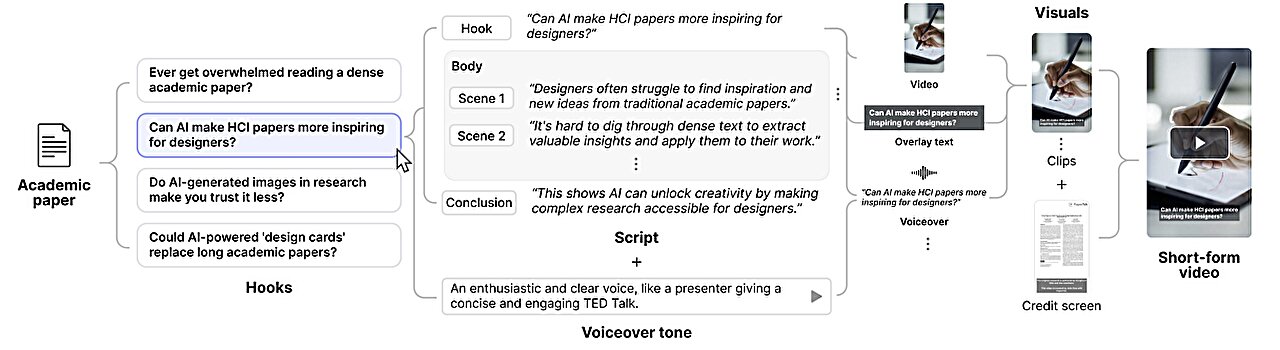
Overview of the PaperTok system, designed to help users transform academic papers into short-form videos through an iterative workflow. Credit: Proceedings of the 2026 CHI Conference on Human Factors in Computing Systems (2026). DOI: 10.1145/3772318.3790553
Students in the University of Washington's Prosocial Computing Group noticed a trend on social media: People were using generative artificial intelligence to make short science videos. The trouble was that these people weren't scientists, which, given AI's proclivity to be convincingly wrong, could accelerate the spread of misinformation. So the lab wondered how to enable scientists and other researchers to better adapt to platforms like TikTok.
"The alternative is that science is being talked about without scientists," said co-lead author Meziah Ruby Cristobal, a UW doctoral student in human centered design and engineering.
Turning papers into short videos
Those discussions led the team to build PaperTok, an AI tool that helps users turn research papers into 45-second videos. A researcher uploads a paper to the tool, which uses Google Gemini to write a short script explaining the paper. The researcher can then iteratively edit the transcript and resulting video clip.