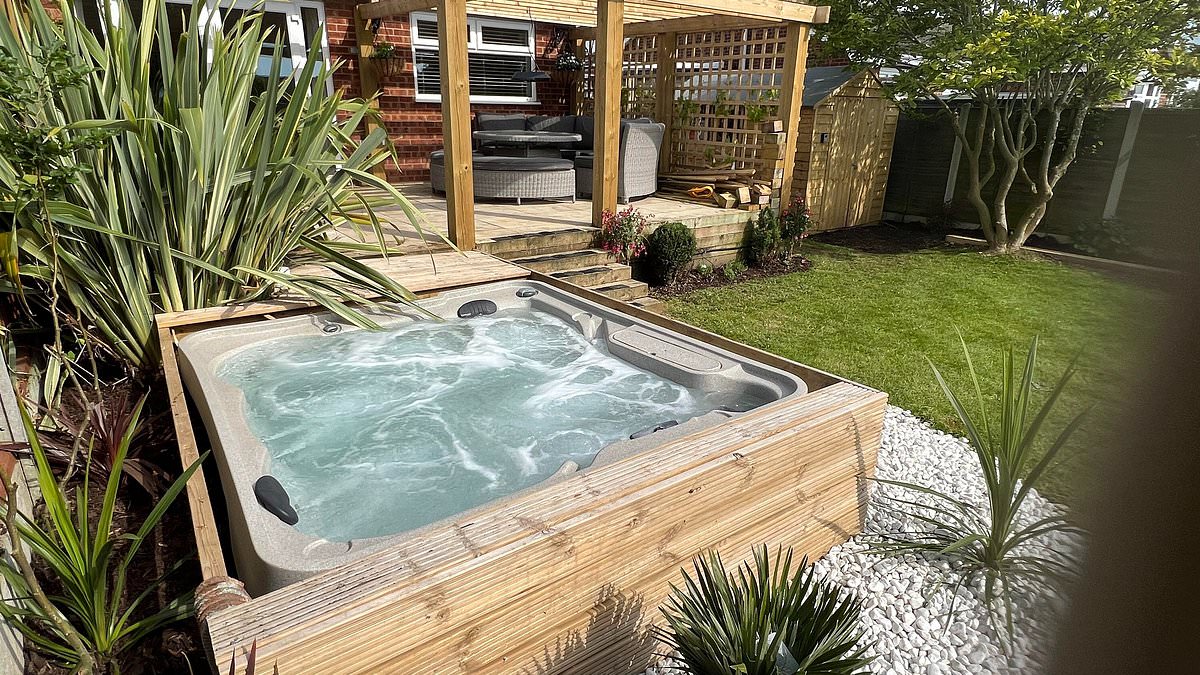
My neighbour's house was bought by a couple who are now renting it out as an Airbnb. It is causing major disruption in our small cul-de-sac. It is a big house which can accommodate large groups such as family gatherings and hen parties. The guests bring lots of cars, arriving at all hours of day and night, and park across the pavement. The property also has a large garden, with a hot tub which is used into the early hours. In the summer the noise is so bad that some nights, my family cannot sleep until whenever the neighbours decide to go to bed. I live in a seaside town but we are not near the beach and live in a fully residential area. The town next to ours has shut down similar accommodation stating the owners needed planning permission. But my council says planning permission is not required. Our neighbours have been given an antisocial behaviour warning, but the council is not taking any further action. What can I do? Too noisy: A This is Money reader's neighbour runs a noisy Airbnb with an outdoor hot tubJane Denton, of This is Money, replies: You can report problems with a local Airbnb via the firm's online Neighbourhood Support scheme. This allows concerned neighbours to request a call back from the firm, or fill in an online form to tell it about nuisance Airbnb sites and noise. However, with Airbnb unlikely to pop round in the middle of the night and tell your neighbour's guests to keep the noise down, I'm not sure how much help this would be.It is significant that the council has already issued the owner of the property with an antisocial behaviour warning.You must keep a careful record of the problems you are facing. The council's environmental health department could classify the disruption and noise as a statutory nuisance, which would allow them to issue an abatement notice.To be a statutory nuisance the noise must unreasonably and substantially interfere with the use or enjoyment of a home or other premises, or injure health or be likely to injure health. The abatement notice requires whoever is responsible to stop or restrict the noise. The notice will usually be served on the person responsible but can also be served on the owner of a property responsible for a noise issue, even if they don't live there. You could also push the council for an antisocial behaviour case review. This has specific requirements which you can read about on the Gov.uk website.On the planning issue, there is no single rule confirming whether planning permission is necessary to run an Airbnb, or a holiday home of any kind. Unhelpfully, different councils have different rules. Parking on the pavement is not illegal outside of London and Scotland, though councils in England can introduce restrictions for specific streets.It would be worth trying to engage directly with the owner of the Airbnb property again. Write a letter explaining the persistent problems you and others in the cul-de-sac face, and detail the impact it has on you. Encourage the owner to implement more stringent house rules at the Airbnb. I also asked two lawyers for their take on your dilemma. James Naylor, a partner at Naylor Solicitors LLP, says: There's no single fix, but a few practical and legal steps may help.Keep a proper log of every incident — the date, time, how long it went on, and exactly what happened, along with how it affected you and where in the house you were at the time. Photos, audio or video can also help, provided they are captured lawfully. James Naylor is a partner at Naylor Solicitors LLPA council warning does not mean the matter is closed, so keep reporting each new incident. Report the late-night noise, including music, shouting and hot tub use, to Environmental Health, who can investigate whether it amounts to a statutory nuisance and, if so, may serve an abatement notice. The disruptive guest behaviour itself should be reported to the council's anti-social behaviour team, making clear each time that the problems have continued despite the warning being given.If you feel nothing is really changing, you can ask for an antisocial behaviour case review. Most councils will consider one once you have made three qualifying complaints within six months, although some also require each complaint to have been reported within a month of the incident. It is worth checking your council's criteria and making sure you report each incident promptly so it counts.On the planning side, rather than accepting an informal verbal view that permission is not needed, ask the planning department to put its decision and reasoning in writing. Do you have a property question? Email: jane.denton@dailymail.co.uk A written assessment gives you a clear record of the council's position and is much easier to challenge or refer back to later if the situation escalates. While you're at it, ask whether your council operates any registration or licensing scheme for short-term lets, and whether this property should be included.On parking, outside London there's no blanket ban on pavement parking yet, though new legislation passed in April 2026 will let councils introduce local bans — it's just rolling out slowly. If things do not improve, it is worth speaking to a solicitor about a private nuisance claim. Where a neighbour's use of their property causes substantial and unreasonable interference with your enjoyment of your home, the courts can, in appropriate cases, grant an injunction or award damages.Finally, report the listing to Airbnb itself. It is worth letting it see how the reality compares to the listing description. Adam Boyd, a property litigation partner at Freeths, says: Initially, you should write directly to the owners and give them an opportunity to address the issues. In some cases, that can be the point where hosts decide to tighten house rules, rethink how the property is being managed, or introduce stricter controls on guests in an attempt to stop further complaints.If that still does not resolve matters, the next step is to involve the council. Adam Boyd is a property litigation partner at FreethsContact your council’s environmental health or noise nuisance team whenever there is a significant disturbance. Where noise is severe and persistent, it can amount to a statutory nuisance, meaning it unreasonably and substantially interferes with your enjoyment of your home. In those circumstances, the council has powers to investigate and, where appropriate, take formal action, including serving notices on the owners requiring the activity to be reduced or stopped altogether.It is significant that the owners have already received an antisocial behaviour warning, as this shows the council has at least recognised there is an issue. If problems continue, it is important to keep reporting each incident and ask whether the threshold has been met for a Community Trigger review. This brings together the council, police and other agencies to reassess the case where complaints have not been resolved satisfactorily.For the parking issues, the first question is whether the road or pavement forms part of the adopted public highway. If it does, pavement obstruction or parking breaches are usually matters for the council’s civil enforcement team, or the police in more serious cases. If the land is private, enforcement options are likely to be more limited.However, planning permission is less straightforward unfortunately. Although a Short-Term Let Accommodation Bill is currently in the pipeline which will aim to clarify the position on planning, there is not yet a uniform approach to regulating these properties. Whether permission is needed will depend on the property’s actual use and the council’s local policy. For example, in Greater London, a property can generally be let for up to 90 nights in a calendar year without planning permission. If this property is effectively operating as a commercial holiday let in a quiet residential cul-de-sac year-round, you should certainly ask the council’s planning enforcement team to investigate and confirm its position in writing. Best mortgage rates and how to find them Mortgage rates have shot up again due to inflation triggered by the conflict with Iran reversing hopes that the Bank of England would cut rates. This means those remortgaging or buying a home face higher costs.That makes it even more important to search out the best possible rate for you and get good mortgage advice, whether you are a first-time buyer, home owner or buy-to-let landlord.This is Money's partner L&C can help you with its fee-free mortgage service.> Compare mortgage rates> Find the right mortgage for you To help our readers find the best mortgage, This is Money has partnered with the UK's leading fee-free broker L&C.This is Money and L&C's mortgage calculator can let you compare deals to see which ones suit your home's value and level of deposit.You can compare fixed rate lengths, from two-year fixes, to five-year fixes and ten-year fixes.If you’re ready to find your next mortgage, why not use This is Money and L&C’s online Mortgage Finder. It will search 1,000’s of deals from more than 90 different lenders to discover the best deal for you.> Find your best mortgage deal with This is Money and L&C Mortgage service provided by London & Country Mortgages (L&C), which is authorised and regulated by the Financial Conduct Authority (registered number: 143002). The FCA does not regulate most Buy to Let mortgages. Your home or property may be repossessed if you do not keep up repayments on your mortgage.
What can I do about my nightmare Airbnb neighbour with a hot tub?
Our neighbours have been given an antisocial behaviour warning, but the council is not taking any further action. What can I do?
1,572 words~7 min read