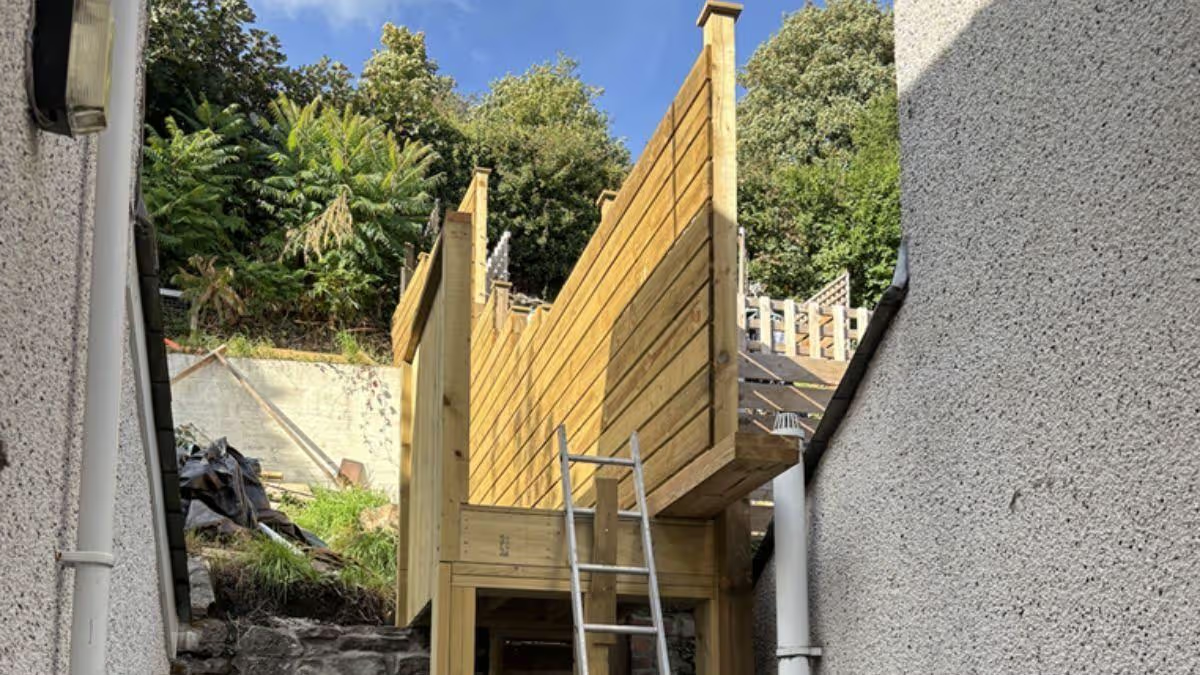
My family and I are greatly troubled. The landlord of the house next to us built a toilet extension on to the side of our house, without planning permission, or our permission, as a lean-to without a separate supporting cavity wall.Our back boiler burst during the building process. We have been without heating for many years now and our beautiful home has been destroyed with damp. Of course, it would be hard to prove that the two are related, but is it a coincidence? The drainpipe on the side of our house was cut, over the extension, meaning the rain has a long way to travel down our wall, destroying the house, before it hits the flashings of the extension.The toilet was built on to my brother’s bedroom and the noise of it and the tenants using it at all hours have caused him chronic sleep deprivation. The lack of heating has, I suspect, resulted in my disabled brother suffering from hypothermia and recently he was hospitalised with pneumonia.The local council accepted information in support of the planning retention application that was at variance with the facts – wrong addresses on drawings, etc – but ignored our many pleas that the application be declared invalid.I lodged an appeal with An Coimisiún Pleanala, but they returned it to me saying a vital document was missing which meant my appeal was deemed to be invalid.We have tried going for legal aid, but they cannot find a surveyor to examine the house.I am very sorry to hear of all the distress that you have been through on this matter.Firstly, you will need to establish whether the side wall to your property is in fact a side wall or a party wall. A side wall is an enclosing wall to a property (one of four, including the front, the back and two sides), which exclusively serves that property, and it is fully owned by the property owner. A party wall is a shared wall between two properties, and each property owner has rights in relation to the wall. If the wall is a side wall of your house, then your neighbour should not have built their extension in the manner that you have described. However, if the wall is a party wall, then they were entitled to build up tight against the wall. This fact could be easily determined by a chartered building surveyor on a visual inspection of the property, together with a review of the title documentation.If it is a side wall and the neighbours have not built an independent wall for themselves, then they have been very short-sighted, and this will be potentially devaluing for them and could hinder or prevent a future sale of their property going through.I note that you say that the neighbour cut your rainwater pipe and has left this exposed at a higher level than the extension. The fact that your rainwater pipe is in this location suggests to me that the wall is a side wall as opposed to a party wall; however, this could be determined only by an inspection. [ Existing tenants won’t allow us access to view the home we hope to buy. What can we do?Opens in new window ]It was totally inappropriate for the neighbour to cut the rainwater downpipe and to leave it in the way that you have described. As a minimum, the neighbour should have rerouted the pipe in such a way that the rainwater is adequately discharged to the underground drainage network and the neighbour is fully responsible for this. If this matter is not attended to, it can give rise to more significant problems in time. If they don’t address this, they are leaving themselves exposed to a potential claim not just for the cost of the making good the works, but the costs of any potential damage caused. I also note that you had an issue with your back boiler leaking and that this happened during the building process. While the possibility that the building work caused the issue cannot be ruled out, I suspect that that is unlikely and that it is just a coincidence. Issues of this nature would normally be covered by a standard household insurance policy, and this is a matter that could have been pursued and the cost recovered through an insurance claim on the household policy.The noise nuisance issue is a complex one but one the neighbour could well have some responsibility for.If the wall is a party wall or is being treated as such by your neighbours, such walls are intended to provide minimum sound and fire-resisting standards between two properties. While this puts an obligation on the neighbour, the downside here is that the sound insulation standard required for party walls is relatively low (as anyone who lives in either a semidetached or a mid-terraced house can attest to).[ I found blocked-up air vents in my home when decorating. Should I leave them covered?Opens in new window ]Establishing the sound-resisting standard of the wall will involve specialist tests carried out with sound recording equipment, all of which will prove relatively expensive.If the tests prove that the wall meets the minimum standards, then you will have no hope of recovery of any cost or being able to get the neighbour to do anything about this. However, if on the other hand you can prove that the sound insulation standard falls below that required by building regulations for a party wall, then you would be in a strong position to pursue the neighbour for not only the cost of the tests but to also compel them to upgrade the wall to meet the sound-resisting standard and possibly even for compensation for health issues stemming from same, subject to being able to prove a direct link between the noise and the illness.Of course, the key question here is how did your neighbour get to build the extension in the first place, given all of your issues appear to stem from this?First of all, an extension to the side of a house requires planning permission. Did your neighbour proceed without it deliberately or was it due to a lack of knowledge as to what constitutes exempted development?I would suggest that it is rare for a person to build on to someone else’s property without the owner of the structure’s express permission and, if spotted in time, that person could find themselves in a difficult situation.[ My neighbour has been cultivating land they don’t own. What can be done?Opens in new window ]However, as this situation unfolded, your position was jeopardised by your neighbour’s actions as you were denied the opportunity to consider their proposals before it was built to see if this would have an impact on your property. However, when the retention application was made, you did at that time have the opportunity to make observations on the planning and I can only surmise that these were lodged by you. I note that you then subsequently appealed to An Coimisiún Pleanála, which could have been done only in the context of having previously submitted observations. You say that while you were initially advised that the documents submitted were adequate, you were subsequently told that a significant document was missing. You do not state what document was missing.It is clearly disappointing that this was not drawn to your attention when you lodged the information, but the process is very precise, and the onus is on the applicant to ensure that all appropriate documentation is included. If all the pertinent facts were made available and known to the local authority, such as the incorrect property address and more importantly the fact that there was no side wall to the neighbour’s extension, then I suspect that the planning permission would not have been granted by way of retention or at the very least, various conditions would have been factored in.If you wish to pursue any of the issues discussed above it may be worthwhile to engage the services of a chartered building surveyor to carry out a high-level review and to see if there is merit in pursuing the case further.Val O’Brien is a chartered building surveyor and member of the Society of Chartered Surveyors IrelandDo you have a query? Email propertyquestions@irishtimes.comThis column is a readers’ service. The content of the Property Clinic is provided for general information only. It is not intended as advice on which readers should rely. Professional or specialist advice should be obtained before persons take or refrain from any action on the basis of the content. The Irish Times and its contributors will not be liable for any loss or damage arising from reliance on any content
Next door’s landlord built a toilet attached to the side of our house. What can we do?
An appeal to An Coimisiún Pleanala was returned as a document was missing
1,450 words~7 min read