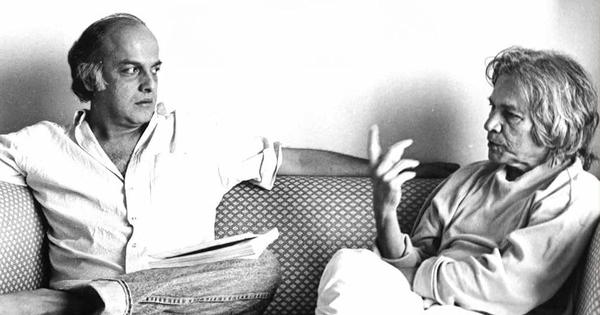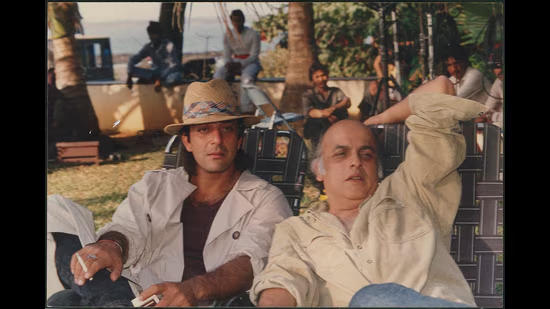
“I came asking for light. /I was given fire. / And in the fire, I disappeared. / What remains is not me. / What remains is the smoke of a self, undone, curling through the empty chambers of the heart,” reads the Epilogue titled The Last Scripture in filmmaker Mahesh Bhatt’s The Ashes Are Warm: Memories of a Lifetime Spent with UG Krishnamurti. In the book, Bhatt looks back on a life in cinema and in the public eye, with its accoutrements of success and love, and adjuncts of scandal, grief and notoriety.Actor Sanjay Dutt and Director Mahesh Bhatt on the sets of Saatwan Aasman (1992) (HT Photo)In reliving the moments and milestones of his life, Bhatt sounds like a man sitting amid the remains of his own certainties and ruins, touching each burnt object once to acknowledge that it existed, and not necessarily to restore it. The volume draws on Bhatt’s private jottings: diary-like entries written in hotel rooms, on film sets, and during moments of rage, tenderness, doubt and despair.Readers who pick up the book in search of a spiritual biography will be disappointed, perhaps usefully so, for, in this story of “two vagabonds with no destination.” UG is not presented as a guru, redeemer, philosopher or saint. In fact, the book’s deepest respect for him lies in its refusal to sanctify him. He is “the raging sage” in Bhatt’s life, the man who offered no balm, doctrine or Pethidine for the soul. The filmmaker says he went to UG scorched by life and did not receive consolation; instead, the anti-guru “rubbed salt” into his wounds. It is a brutal image, but also an honest one. UG, in a way, saved Bhatt not by comforting him, but by making comfort impossible.That is why the book begins, correctly, at the end: Vallecrosia, Italy, March 2007. UG is dying on a white sofa, stubbornly refusing hospitals, machines, prayers, dependence, and ritual. It is a death scene emptied of everything we usually bring to death in order to make it bearable. UG had made a pact with Bhatt that he would not leave the planet without meeting him, and he kept that promise. Bhatt stayed with him through those final days, watching a man who had refused every spiritual costume, raging against the theatre of dying.The Ashes Are Warm is affecting in parts because Bhatt does not pretend to have mastered the fire he writes about. It rejects the usual template of celebrity memoirs, most of which are invariably predictable: this happened, therefore I learned that; I fell, therefore I rose; I broke, therefore I became whole. “This is not a memoir of achievement,” the flap says; “it is the chronicle of an undoing.” True to the avowed dictum, Bhatt returns, again and again, to the collapse of the self-image as husband, lover, filmmaker, seeker, and storyteller.The book’s emotional centre, however, is not only UG. It is also, you’ve guessed it right, Parveen Babi. The pages on her are among the most devastating and unforgettable in the volume because Bhatt recounts events with rare candour and without the protective varnish of nostalgia. He remembers standing outside the morgue in January 2005, after her body had been found three days too late, and deciding that if no one claimed her, he would: “She’ll get a grave. Not a headline.” Parveen, who had once appeared on the cover of Time, had become, in death, what fame fears most: unclaimed, unattended, and exposed to the biological indifference of the body.Fame is hungry when a person is alive and vulgar when they are dead. Knowing this very well, Bhatt switched off his phone because he did not want to become a sound bite in the death of the woman he once loved. He also knows something more painful: his life and career were inseparable from her suffering; he recollects as the survivor who knows survival has its own guilt: “She cracked. I rose. / She drowned. I floated. / I owe her everything.” The honesty of that admission is startling. While it does not redeem him, it also does not ask the reader to absolve him, and merely names the terrible imbalance by which art is often made. The loss of the woman he loved left Bhatt with material for a film. Arth came from this world, but the book is honest enough to understand that art uses pain, transforms it, sometimes profits from it, and is then haunted by it.Ashes Are Warm is also moving because it understands grief as education without romanticising it. In Tutored by Grief, Bhatt writes that he did not grow up through success or self-discovery; he grew up being instructed by loss. His violation of his own idea of marriage, Parveen’s mental illness, the death of UG’s son Vasant from sarcoma, the failures of love, the commercial rejection of difficult films, all become part of a brutal apprenticeship. UG’s sentence, “Life is pain. Don’t ask me why it is so. It is so,” becomes central to the book. It does not console, but denies the human demand that life explain itself.This is where the book becomes a meditation on storytelling itself. Bhatt calls UG the “Story Buster,” a man who saw stories as the anaesthesia human beings need because life can be unbearable for some. For a filmmaker, this is not merely a clever line, it sounds like an existential accusation. Bhatt built his life on stories. UG tore down the storyteller. The result is a fascinating tension that runs through the book: Bhatt knows stories are false, but he cannot stop telling them; he knows cinema is the ultimate make-believe, but he also knows it is sometimes the only way a wound can speak.The reflections on Kaash, Saaransh, Arth, Janam and Zakhm are therefore among the book’s richest passages. Bhatt sees his early cinema as born from grief: Saaransh comes from death without consolation; Arth from the limits of love; Janam from the need to stop hiding shame; Kaash from the unbearable knowledge that a father may fail precisely where love matters most. In Kaash, a dying child’s third wish — “I want to live” — cannot be fulfilled. No miracle descends. The film was admired by critics and rejected by audiences. UG’s explanation was harsh but he seemed to have a point: people cannot deal with that kind of realism; if one wants to make a living, one must entertain them with what entertains them.Bhatt does not pretend otherwise. He admits that many of the films he later made were choices made to earn a living; some succeeded, some comforted, many were mediocre, some bad. He recognises the split between the inner life and professional output, truth and commerce, and between what scars and what sells. His return to truth, he suggests, came most powerfully in Zakhm, born of his mixed heritage and the plural India he had grown up believing in, in the shadow of the Babri Masjid demolition, the Mumbai riots and the bomb blasts that showed how Partition’s fault lines had never really healed. The book understands Zakhm as a wounded argument for the right to live by one’s own creed.That thread gives the book its political undertow. India appears here as a civilisational argument that once allowed doubt to exist side by side with devotion. Sunita Pant Bansal’s Afterword is especially sharp on this point. She sees in Bhatt’s scribblings, besides personal unease, the fear of what happens when conversation is replaced by certainty. This is a crucial reading of Bhatt’s life with UG. The man who refused doctrine becomes, in a strange way, a defence against all forms of authoritarian certainty: spiritual, political, cinematic, and personal. UG’s negation is not nihilism, but a refusal to let any system, however seductive, become a cage.Having published 10 books on UG Krishnamurti and having known both UG’s circle and Bhatt over decades, Sunita brings a rare combination of intimacy and restraint. She says her task was to “hold the arc without taming the intensity,” and that is exactly what the book needs. Too much shaping would have killed its fever; too little would have left it scattered. The result is not smooth, and it should not be. A book about undoing should not read like a traditional biography.Bhatt has never been a minimalist of emotion and the book, too, does not offer peace. The lines at the beginning of this review may be the finest summary of the Bhatt-UG relationship. Light helps us see. Fire destroys what we think we are. Bhatt did not find a teacher who gave him a path. He found a blaze that made paths irrelevant.Nawaid Anjum is an independent journalist, translator and poet. He lives in New Delhi.
Review: The Ashes Are Warm by Mahesh Bhatt
The filmmaker’s scorching memoir of his life with the anti-guru UG Krishnamurti as told to Sunita Pant Bansal also touches on his successes and failures, both romantic and professional
1,458 words~7 min read