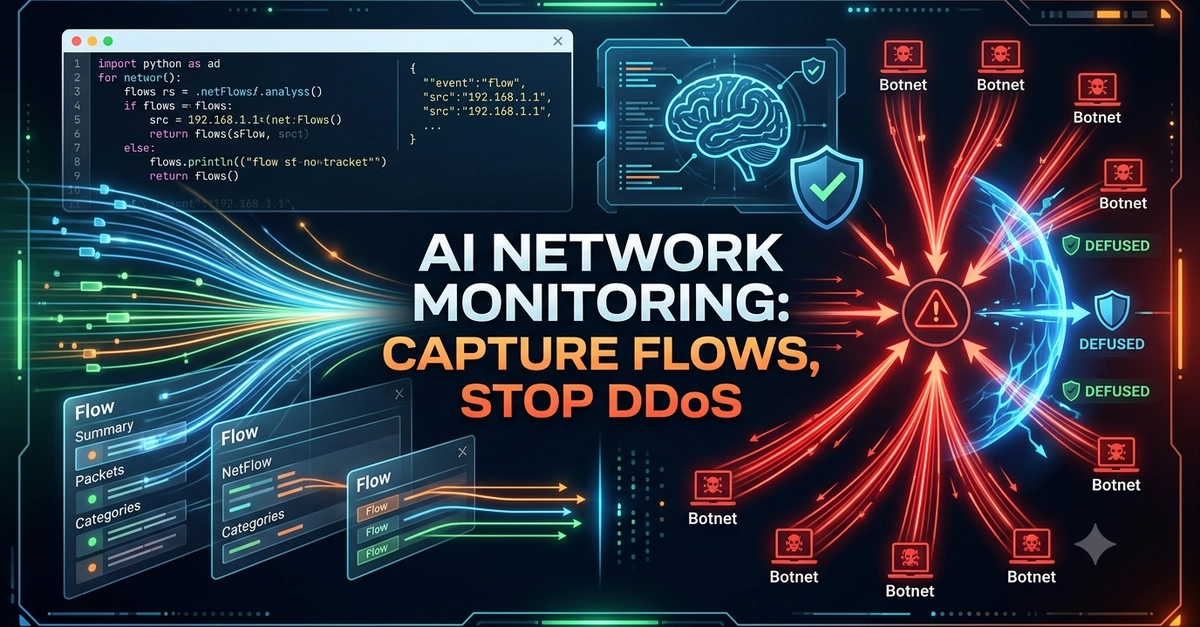
As AI architectures transition from static data processing to real-time agentic monitoring, the data engineering pipelines feeding them must adapt. If you are building an AI-driven anomaly detection model, a security agent, or an automated network observability tool, you can't rely on historical batch logs. You need live, structural telemetry straight from the network edge.
When monitoring network traffic at scale, two industry standards dominate: NetFlow (stateful conversation aggregation) and sFlow (stateless packet-level sampling).
In this post, we will build a production-grade, asynchronous network ingestion engine using Python and Scapy that captures live wireless traffic, extracts 5-tuple flow metrics, and streams structured JSON events ready to be swallowed by a message broker (like Kafka) or an AI vector database.
The Architectural Challenge: Avoid the Bottleneck
The biggest pitfall when writing a packet sniffer in Python is blocking the execution loop. If your script captures a packet, processes it, formats a JSON string, and logs it sequentially, your script will choke and drop thousands of packets during a sudden burst of network traffic.