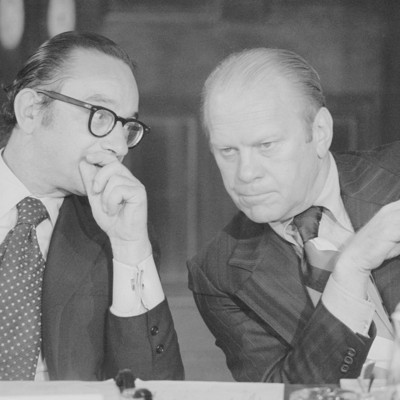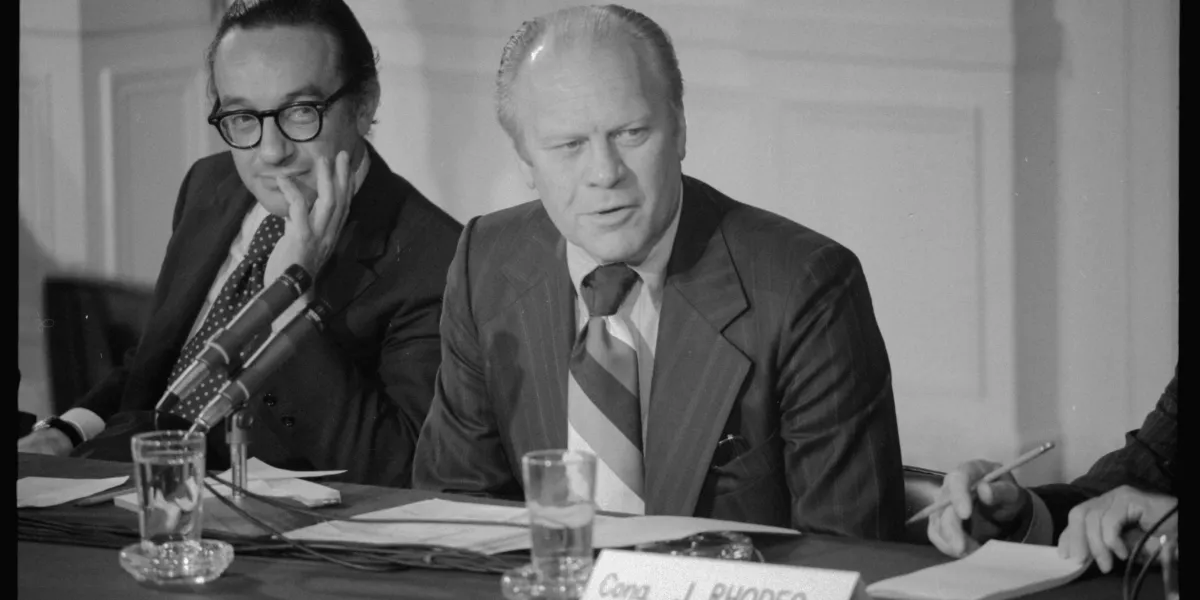
The younger Greenspan cut a different figure.He studied clarinet at the Juilliard School and worked as a professional musician while attending New York University in the late 1940s. He was briefly married to Joan Mitchell, an art historian who introduced him to the libertarian writer Ayn Rand.Through the 1950s Greenspan was part of Rand’s inner circle – which emphasized radical individualism, self-interest and laissez-faire capitalism – while he developed the building blocks for an economics career.Greenspan later came under criticism for his early association with Rand. But we believe that his approach to economics was essentially practical and fact-based, not ideological.“You begin with a conceptual framework of cause and effect,” is how he put it in the book interview. “And then you observe reality, and try to anticipate what is going to happen in the future, even though you can never see beyond a certain horizon.“Data are a measure of what is going on in reality,” he continued. “If you want to endeavor to try to lower the probabilities of forecasting mistakes in the future, the more information you have about the structure of the system, the better off you will be.”After completing his undergraduate degree at NYU, Greenspan moved on to graduate study at Columbia University, one of the preeminent economics departments in the country at the time. But he left academia in 1954 to join a consulting firm while still managing to publish academic work in economics.One example was a piece that foretold economist James Tobin’s “Q theory of investment,” a tool to estimate whether a business or market is overvalued or undervalued. That insight was prominently noted in Tobin’s Nobel Prize 1981 citation.Meanwhile, as he built his consulting firm, Greenspan took great pride in its data-based work.“My reputation was as an economic forecaster of the United States,” he recounted in the book interview. “Through my company, I became an expert in about 15 different industries. I brought to the table types of analysis which no one else had.”From left, President Gerald R. Ford, Alan Greenspan’s mother, Rose Goldsmith, Alan Greenspan, writer Ayn Rand and Rand’s husband, Charles Francis ‘Frank’ O’Connor, after Greenspan’s swearing in as CEA chairman. David Hume Kennerly/The Gerald R. Ford Library/Getty Images
Alan Greenspan said 3 years with Gerald Ford beat 18 at the Fed. His death at 100 raises the question: was he right? | Fortune
The former Fed chair told NYU economists that his time as Gerald Ford's top economic adviser was "more interesting" than running the central bank.
1,084 words~5 min read