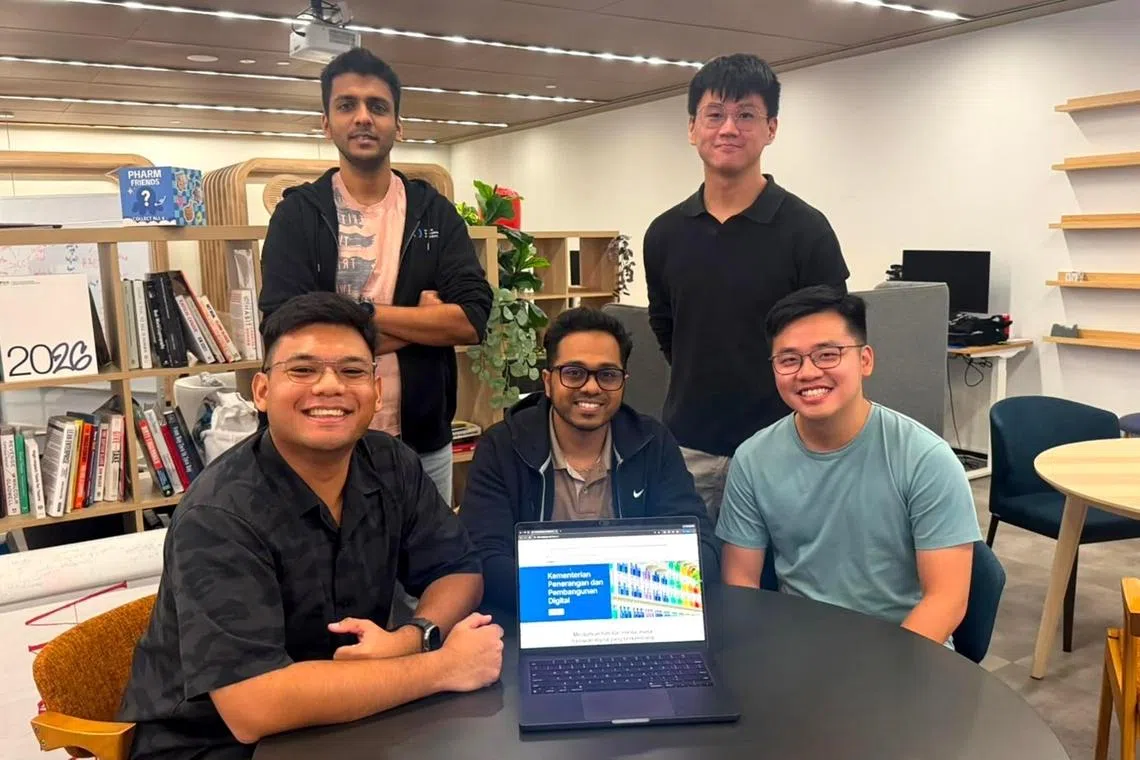
SINGAPORE – Artificial intelligence-powered translations of online government resources went live on June 26 as part of a pilot project aimed at making information accessible to a wider pool of Singaporeans.Polyglot, a widget available on the Ministry of Digital Development and Information’s (MDDI) website, allows users to view information in any of Singapore’s four official languages – English, Chinese, Malay and Tamil. It is developed by a five-member team from Open Government Products (OGP), a division of the Government Technology Agency (GovTech).The pilot trial also serves as a stepping stone towards the eventual goal of having translations available on all government websites and digital services in future. No specific timeline has been set yet for this.Polyglot is built on a translation engine jointly developed by MDDI and GovTech.Unlike older systems, which often translated terms word by word without accounting for Singapore’s local nuances, it uses large language models to deliver greater accuracy by analysing entire sentences and passages in context, said team member Harish Venkatesan.“We also pair this with the Government Terms Translated database, so that outputs reflect how terms are actually used here rather than defaulting to generic translations,” said Harish, an engineering manager at OGP.For instance, terms such as “Chinatown” and “Government” may not be translated accurately for the Singapore context by commonly used translation tools, said another team member, Muhammad Shazli Shahril Shintaro.“Outside of Singapore, Chinatown is often translated as 唐人街 (tang ren jie). But in Singapore, we refer to the area as 牛车水 (niu che shui)” said Shazli, a senior product operations specialist.“I always thought that 牛车水 was a direct translation of Chinatown, and realised only after working on this project that it is a uniquely Singaporean term that refers to bullock carts that were historically used in Kreta Ayer.”The carts were used to transport fresh water drawn from wells before piped water became widely available.A typical translation tool would also translate the term “government” as “kerajaan”, the common Malay term used in countries such as Malaysia, a constitutional monarchy where monarchs serve alongside elected parliamentarians.“Singapore is a republic, so a much more context-appropriate term would be ‘pemerintah’,” Shazli added.The pilot will run until October, during which a notification banner on MDDI’s website will direct visitors to a beta version of the site, where the translation tool is accessible via a drop-down menu in the top-right corner of each page.The pilot will run till October, during which a notification banner on MDDI's website will direct visitors to a beta version of the site. PHOTO: OPEN GOVERNMENT PRODUCTSTo ensure the highest accuracy possible, the Polyglot team is seeking help from the public to report errors and provide feedback on how translated words, phrases and sentences can be improved.Officers from MDDI will also be able to edit the translations manually, an intentional feature designed to keep humans involved in the process. Shazli said this is necessary when dealing with AI tools.He added: “There will also be a banner on every page that has been translated, which tells users that AI was used in the translation, so as to set expectations that it might not be fully accurate.”The team, which also includes three OGP engineers, began working on a prototype of Polyglot during Hack for Public Good 2026. The annual hackathon, held in January, sees about 200 OGP officers develop solutions to public-interest problems.The long-term vision is for accurate translations to become a standard feature across all government websites, said Shazli.However, he added that such a scale of deployment will have to be earned, and the development of Polyglot will depend on what is learnt from the pilot and public feedback.There have been several instances of translation errors in government materials in the past. In July 2017, the Chinese character for “disrespect” or “contempt” was used in place of a character for “read” on a rostrum sign at a Speak Mandarin Campaign event.During the National Day Parade show in 2020, one line of Tamil song lyrics meant to read “My Singapore” had misplaced strokes and letters that made the words unintelligible. The Tamil words for “friends” and “siblings” were also misspelt.“In future, I hope that translations can be a given, as there’s no scarcity in providing such a service, unlike now, when it is provided on demand,” said Shazli.“This would help to reinforce Singapore as a multiracial and multilingual society that is inclusive of all, especially the older generation that might be more comfortable with vernacular languages.”
New pilot trials AI translations of online govt resources
Singapore pilots AI-powered translations for government resources in Chinese, Malay, and Tamil, aiming for broader accessibility. Read more at straitstimes.com. Read more at straitstimes.com.
738 words~3 min read