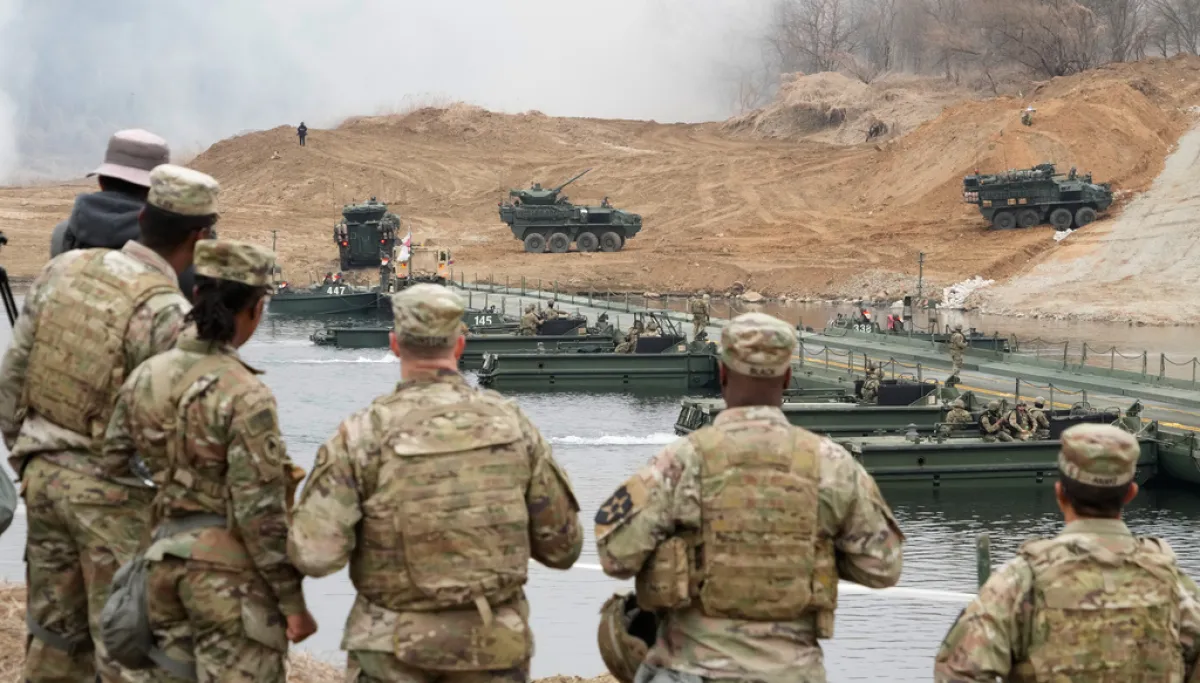
In Focus delivers deeper coverage of the political, cultural, and ideological issues shaping America. Published daily by senior writers and experts, these in-depth pieces go beyond the headlines to give readers the full picture. You can find our full list of In Focus pieces here.Congressional Republicans are understandably leery of passing a third reconciliation bill so close to an election, especially one that spends $350 billion to fulfill President Donald Trump’s supplementary defense request. They should do so despite their misgivings because House Democrats will likely starve defense if they win control.No one who has studied the matter doubts that the United States needs to increase its defense spending significantly. China is arming at a rapid clip and already has more navy ships than America. It’s crucial to our security that we start to increase the size of our fleet simply to keep up.
Many American weapons systems are also nearing the end of their useful life. Our strategic nuclear force needs replacing, for example. Many of the Navy’s aircraft carriers and submarines are aging out of service, and the Air Force’s fighters, bombers, and support aircraft are also increasingly decades old. The new equipment will surely be more capable than what it replaces, but that won’t supply the needed increase in the military’s size.The rapid development of drone warfare is another important factor. The U.S. needs its own drone capability, and fast. It needs to create and deploy newer, cheaper anti-drone defense systems to counteract what enemies like Iran have already shown they can do. When Iran can force America to use an expensive Patriot missile to take down one cheap drone, Iran’s asymmetric warfare allows the poorer and weaker power to win the economic war of attrition against us.Then there’s Trump’s desire to build a “Golden Dome” anti-missile defense system. The success of Israel’s “Iron Dome” shows that a successful defense against ballistic missiles and other aerial threats is possible. Building and deploying that won’t be cheap, but it will be worth every penny we spend.Taken together, one can easily see why Trump proposed spending a record high $1.5 trillion on defense this year.Political realities also show why he chose to split it into two parts: a $1.15 trillion baseline budget and the $350 trillion supplemental request he wants funded through reconciliation. The baseline budget has to go through the regular appropriations process. That means Senate Democrats can filibuster it unless they get something they value. That surely means additional domestic spending, or the rescission of any proposed program cuts that Republicans can agree upon.Democrats have traditionally pushed for so-called “parity”: every dollar of increased defense spending needs to be met by a dollar in increased spending on domestic programs. Trump’s $1.15 trillion on-budget request is already a 28%, or $242 billion, hike from last year. The parity principle for that increase alone would shock Republican consciences. Adding $350 billion more would be impossible to advance through Congress.That entire amount, however, is what it will take to fund what America needs. Many of the administration’s biggest plans, such as additional F-35 fighters and ramping up production of critical munitions, are to be financed through this proposal. Rejecting it essentially says America is not prepared to meet the many and growing needs that changes in warfare and China’s rise pose.Funding these programs through reconciliation also gives the administration flexibility in how to spend the money. That fund is intended to be disbursed over many years rather than all at once. As with the funds for the border wall and border enforcement included in the first two reconciliation packages, the programs a third bill would pay for would come online over the next few years. They are thus more like capital investments than ongoing operational spending.U.S. Army’s armored vehicles move during a joint river-crossing exercise between South Korea and the United States as a part of the Freedom Shield military exercise in Yeoncheon, South Korea, Saturday, March 14, 2026. (Ahn Young-joon/AP Photo)