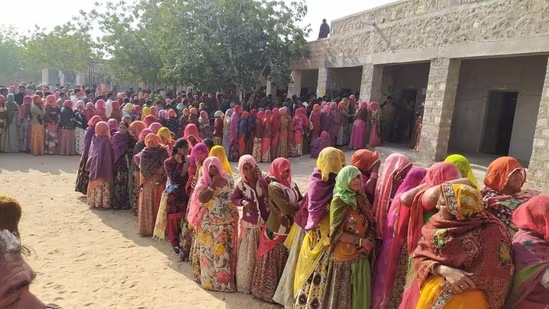
In the Unnao district of Uttar Pradesh, Seema runs a reverse osmosis water plant supplying safe drinking water to her community. With dependable, round the clock electricity enabled through the Government of India’s Decentralised Energy for Women’s Economic Empowerment (DEWEE) initiative, her enterprise is able to operate consistently, grow its customer base and increase income. Reliable power has not just improved business performance; it has expanded choice, confidence and economic independence.Growth of India (Representative Image)Hundreds of miles away in Sawarda village, Rajasthan, young Ritvik is adjusting to evenings that no longer end at sunset. With lights staying on into the night, study time stretches longer and family routines change. These moments may seem small, but together they illustrate something fundamental: When energy works, it enables learning, productivity and ambition. Energy is not an end in itself. It is a driver of income, resilience and opportunity.India’s progress on energy access over the past two decades has been extraordinary. Through sustained policy leadership and investment, the government has connected more than 800 million people to electricity, laying the foundation for one of the most ambitious development and energy transitions in the world. This achievement reflects not only the scale of infrastructure delivered but a national commitment to inclusive growth, productivity and economic opportunity.India’s energy transition is often discussed through metrics such as capacity additions or emissions avoided. These measures matter and reflect important national ambitions. But for citizens and businesses, the true value of energy lies in what it makes possible. Reliable electricity allows enterprises to extend working hours, farmers to add value to their produce, health centres to deliver consistent care and households to invest more confidently in education and livelihoods. Energy drives income, and income drives development.While access has expanded rapidly, the next phase of India’s journey is about maximising the economic value of that access. This depends on continuing to strengthen the systems that already underpin India’s power sector: efficient transmission and distribution, financially stable utilities and strong coordination between national policy and local delivery. These are areas of active progress and reform under government leadership, reflecting an understanding that energy must support growth, competitiveness and national resilience.Delivering consistent and productive energy at scale is not only a technical challenge but a systemic one. It requires alignment across ministries, regulators, utilities, financiers and entrepreneurs, all working towards shared national priorities. When these systems are aligned, energy becomes a platform for economic growth rather than a constraint on it.A wide range of actors have a role to play in supporting India’s vision for a prosperous, energy-secure future. Philanthropic organisations, development partners and impact investors can contribute most effectively when they work in service of government priorities helping strengthen institutions, reduce early stage risks and support solutions that are already aligned with national objectives.In practice, this support is focused on enabling outcomes rather than directing strategy. It includes building strong implementation ecosystems that bring together policymakers, utilities, entrepreneurs and financiers around practical challenges such as improving distribution efficiency or enabling productive uses of electricity. It involves helping move beyond pilots by developing pipelines of commercially viable, investment ready enterprises, so that capital can follow proven models at scale. And it requires ensuring that system improvements respond directly to how people and businesses actually use energy to earn, produce and grow, including women-led enterprises and small manufacturers that form the backbone of local economies.India’s clean energy transition is, therefore, about more than sustainability. It is about economic strength and energy independence. A resilient and flexible power system supports domestic enterprise, reduces exposure to external shocks and underpins long-term growth. As India advances towards Viksit Bharat, the government’s vision for the nation by 2047, energy will remain central to that ambition.Ultimately, the success of India’s energy transition will be judged not only by capacity installed but by the opportunities unlocked: Higher incomes, stronger businesses, better services and greater economic participation. By keeping people, productivity and income at the centre of the energy conversation and by continuing to support government-led efforts to strengthen the systems that make this possible, India’s energy transition can deliver on its full promise.(The views expressed are personal)This article is authored by Jonathan Berman, chief executive officer, Shell Foundation and Woochong Um, chief executive officer, Global Energy Alliance for People and Planet.
Why energy drives opportunity
Authored by - Jonathan Berman, chief executive officer, Shell Foundation and Woochong Um, chief executive officer, Global Energy Alliance for People and Planet.
712 words~3 min read