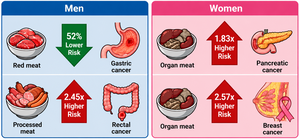
Professor Park Min-seon (left) of Seoul National University Hospital and Professor Ryou In-Sun of Ewha Womans University Seoul Hospital (SNUH) Red meat has long been regarded as a potential cancer risk, with the World Health Organization classifying it as “probably carcinogenic to humans.”But a new Korean study suggests the association might differ depending on population, sex and type of meat consumed.Seoul National University Hospital said Thursday that higher red meat consumption was linked to lower gastric cancer mortality among Korean men in a large cohort study.Men in the highest quartile of red meat consumption had a 52 percent lower gastric cancer mortality rate than those in the lowest quartile, according to the hospital.The association was particularly pronounced among men with a body mass index below 25 and those with a history of smoking.The findings are part of a study examining the relationship between different types and amounts of meat consumption and cancer mortality while accounting for factors including sex and lifestyle habits.The study was led by Park Min-seon, a family medicine professor at Seoul National University Hospital, and Ryou In-sun, a professor of family medicine at Ewha Womans University Seoul Hospital.The researchers analyzed data from 53,847 men and 93,715 women ages 40 and older across Korea, making it the first large-scale cohort study to examine associations between meat consumption and cancer mortality in an Asian population, the hospital said.The team suggested that Korea’s distinctive dietary patterns could help explain why the findings differ from many previous studies conducted in Western countries, which have often served as the basis for dietary recommendations.According to the researchers, pork accounts for a much larger share of red meat consumption in Korea than in Western countries, where beef is more common.Koreans also tend to consume fewer cured and smoked meat products, resulting in a lower intake of salt and certain fats that have been linked to cancer risk.“Rather than directly applying the findings from Western populations to Asian populations, a sex-specific approach that takes dietary habits and living environments into account is needed,” Park said. Sex-stratified forest plots of hazard ratios for cancer mortality by meat type and consumption level (SNUH) Among women, however, the association between red meat consumption and gastric cancer mortality was less clear.Instead, the researchers found that a higher consumption of organ meats, including dishes such as gopchang and sundae made from beef or pork intestines, was associated with increased mortality from breast and pancreatic cancers.Women in the highest quartile of organ meat consumption had a 2.57-fold higher risk of breast cancer mortality and a 1.83-fold higher risk of pancreatic cancer mortality than those in the lowest quartile. The associations were stronger among women ages 60 and older, those with a BMI below 25 and nonsmokers.Ryou said organ meats may contain higher concentrations of heavy metals than muscle meat. These substances can accumulate in body fat and may be released into the bloodstream as body fat changes with weight loss or aging, potentially contributing to cancer mortality.Overall, the study found no significant association between total meat consumption and overall cancer mortality in either men or women. The researchers said the health effects of meat should be evaluated by meat type rather than total meat intake alone.They added that further research is needed to examine other potential influences, including socioeconomic status, cooking methods and long-term dietary patterns.The findings were published in the latest issue of the international journal Frontiers in Nutrition. (SNUH)
Red meat may not raise cancer risk for Koreans, study suggests
Red meat has long been regarded as a potential cancer risk, with the World Health Organization classifying it as “probably carcinogenic to humans.” But a new Ko
571 words~3 min read