38 MIN(s) ago
Tanvir Shahriar Rimon
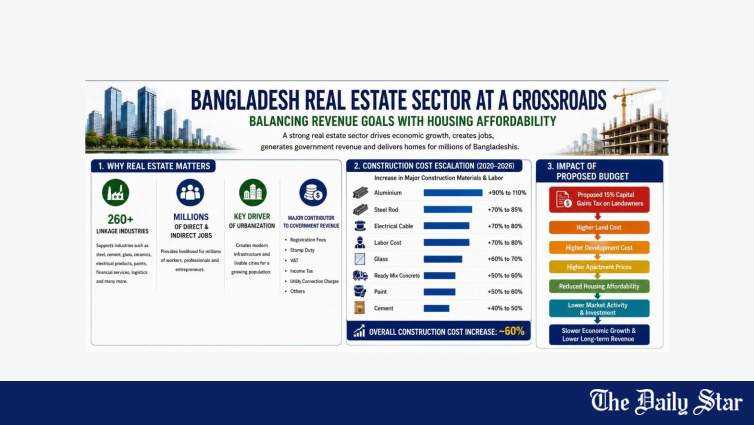
A few days ago, one of our landowners called me with a concern that has become increasingly common in recent weeks.His project is currently under development through a joint venture arrangement. Upon completion, he is expected to receive ten apartments as his share of the developed property. Having learned about the proposed 15 percent capital gains tax on landowners’ shares, he wanted to understand what it would mean for him.His voice reflected genuine anxiety.“Why should I have to pay another tax?” he asked. “I already paid taxes when I purchased and registered the land years ago. Isn’t this double taxation?”Whether one agrees with his interpretation or not, his concern highlights a larger issue that deserves careful consideration. Beyond the technicalities of taxation, it raises important questions about housing affordability, investment incentives, and the future of Bangladesh’s real estate sector.The government’s objective of expanding the tax base and increasing revenue collection is both understandable and necessary. A growing economy requires public investment, and public investment requires revenue. However, the challenge for policymakers lies in striking the right balance between revenue generation and economic activity.The real estate sector occupies a unique position in Bangladesh’s economy. It is not merely a business sector; it is an economic ecosystem that supports more than 260 backward and forward linkage industries.Yet the industry is currently navigating one of the most difficult operating environments in recent history.