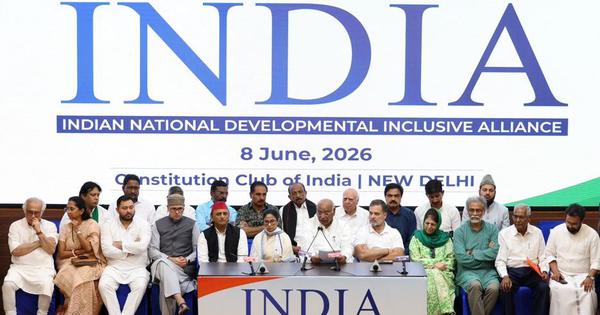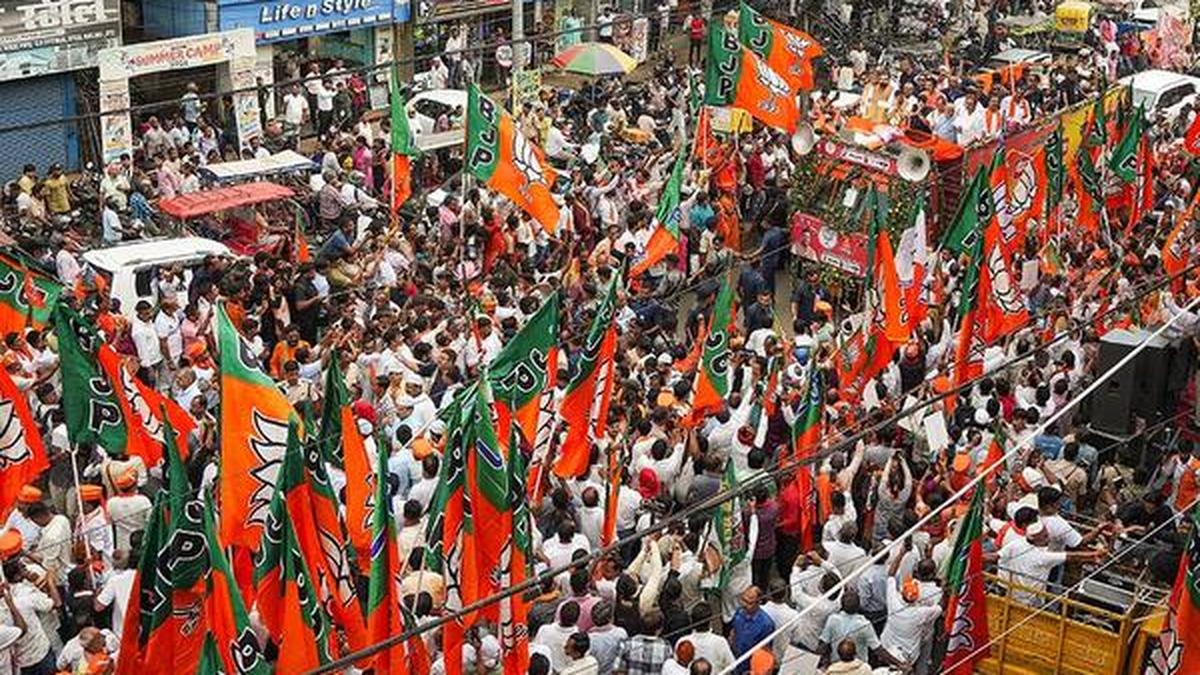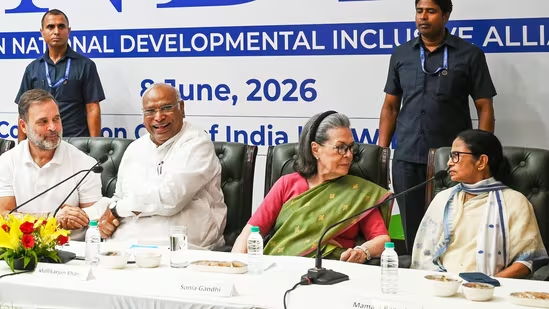
The rise of regional parties was more about democratising representation to account for caste-based realities than a strong ideological revolt against Congress. Naveen Patnaik, Jyoti Basu and Nitish Kumar are, in that order, the three longest-serving chief ministers of a major state in India. These leaders came neither from the Congress nor the BJP or its ideological predecessor. The roots of their political rise are found in the political churn in India of the 1960s and 70s when Congress’s hegemonic dominance in Indian politics started giving way, but a new national hegemon was nowhere in sight.Congress president and Rajya Sabha LoP Mallikarjun Kharge (2nd from left), Congress chairperson Sonia Gandhi, Lok Sabha LoP Rahul Gandhi, TMC chief Mamata Banerjee in New Delhi earlier this month. (HT Photo)Now that India has a new national political hegemon in the Bharatiya Janata Party (BJP), Indian politics seems to be going back in time. The BJP’s initial successes came against the Congress. Now it is subsuming regional parties which first grew against the Congress. Today, there is very little space for regional parties unwilling to do business with either the BJP or the Congress. The numbers, based on an analysis of databases curated by the second author of this story, are crystal clear: regional satraps are an endangered species in Indian politics. The trend is best read with a useful schematic on the chronology of Indian politics: the 1st, 2nd, 3rd and 4th “Party System” classification which represents absolute Congress dominance (1952-1967), Congress getting weakened in states (1967-1989), coalition politics (1989-2014), and BJP dominance (2014 onwards).Regional satraps have gone extinct in IndiaThere is only one non-Congress, non-BJP aligned government in a major state/UTThe Aam Aadmi Party (AAP) government in Punjab is the only one of its kind today, in power in one of the 22 major states or union territories (with at least four Lok Sabha seats) without an alliance (notwithstanding its numerical importance) with either the Congress or the BJP. There were two more such governments until the results of the latest state election cycle: Trinamool Congress in West Bengal and the CPI(M)-led government in Kerala. The AAP government in Delhi was another such until it lost in 2025. If one were to go back slightly further in time, until the state election cycle aligned with the 2024 Lok Sabha election, there were two more on the list: the BJD in Odisha and the YSRCP in Andhra Pradesh. Go back one more year and the TRS was in power in Telangana. At its peak, the number was 10.Even with alliances, the number of non-BJP, non-Congress chief ministers is close to an all-time low in five decades As of today, there are only five non-BJP non-Congress chief ministers in the 22 major states/UT in India. In terms of percentage share, the number comes to 23%, the lowest since 2005. At its peak, since the BJP’s formation in 1980, this number was 67% in 1997. This number was 11 until March 2023. Between 2023 and now, the BJP has wrested four of these states, but even the Congress has wrested two. Interestingly, two of the states where the BJP has put its own chief minister after replacing a regional party’s chief minister are states where it was in an alliance rather than an adversarial relationship with the incumbent CM’s party.The trend is similar when it comes to share of MPs/MLAs for non-BJP non-Congress parties Forget chief ministers, regional parties are now finding it more difficult to get even MPs and MLAs elected. The share of non-BJP non-Congress Lok Sabha MPs peaked in 2004 at 47.9%. It fell to just about one-third in the 2019 elections and made a marginal recovery in 2024, which could prove to be temporary given the Trinamool Congress’s ongoing implosion. The MLA share trend is broadly similar, with the non-BJP non-Congress MLA share showing temporary resilience to the BJP’s growing dominance post-2014 but beginning to succumb lately.Where will Indian politics go from here? This is the most important question. The rise of regional parties was more about democratizing representation to account for caste-based realities than a strong ideological revolt against Congress politics. The BJP made its fortunes by fusing Hindutva and later welfare without trying to turn the clock back on the more egalitarian representation among majority Hindus. This, in a way, rules out the social engineering route to challenge the BJP’s current dominance. The BJP’s recent victories against parties such as the TMC, which thought they had perfected the welfare game, also underline the limitations of palliative economic care. Roshan Kishore is the Data and Political Economy Editor at Hindustan Times. His weekly column for HT Premium Terms of Trade appears every Friday.Number TheoryUnlock a world of Benefits with HT! From insightful newsletters to real-time news alerts and a personalized news feed – it's all here, just a click away! -Login Now!See Less
Regional satraps have gone extinct in India | Number Theory
The rise of regional parties was more about democratising representation to account for caste-based realities than a strong ideological revolt against Congress.
813 words~4 min read