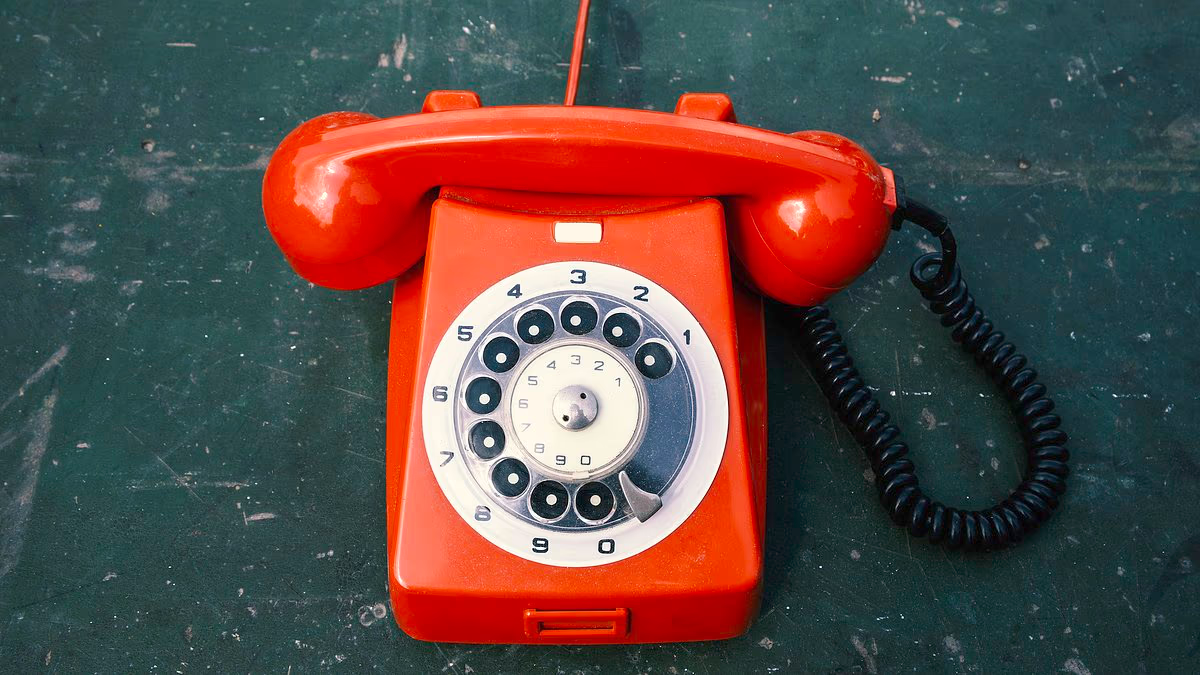
Tangled and grey at the back of a drawer, the weird, alien devices stared wanly up at me. As so often happens when you try to clear out your loft, I was forced to stop and think.A memory stirred, half exciting, half terrifying. These devices had once been my lifeline and hope.For many years in the newspaper trade I was haunted by the fear of discovering the greatest story of my life only to learn I could not find a telephone to send it to London. This was all too possible, especially in some of the places I rashly went to.A few of these relics, once the very height of the newest technology, looked as if they might be handy for rigging up a connection between a Soviet spacecraft and an American one. This wasn’t all that far from the truth.What I had found was a load of equipment that had once been the most advanced in the world. These curling wires with their odd slots and nodes had been crucially important. I had spent a small fortune on getting hold of them from obscure suppliers.Now they were ‘technojunk’, useful perhaps to Wallace & Gromit, or to a large bird building a nest, but not to me.Armed with them, I might in theory transmit my words from almost anywhere in the world. These were adaptors to allow me to plug my computer into the phone network, anywhere from Siberia to Caracas.For a few years of my life, mainly in the old Soviet Union, I was quite an accomplished telephone engineer (only two of those many fiddly wires actually mattered) and could merrily connect my lovely red British telephone to the decrepit, clunkily bugged Soviet telecom network, not to mention those once-thrilling devices, my fax and my answering machine. For a few years of my life, mainly in the old Soviet Union, I was quite an accomplished telephone engineer, Peter Hitchens recalls A few of these relics, once the very height of the newest technology, looked as if they might be handy for rigging up a connection between a Soviet spacecraft and an American one, writes Peter HitchensAnywhere in the Evil Empire, I was able, for a few kopecks (Soviet coins whose actual value was so small it could not even then be converted into Sterling), to listen to the messages left on my machine in Moscow, by pressing a special device against the mouthpiece and bleeping a unique signal.I was especially pleased when I once did this from the far reaches of Kazakhstan.How the KGB (always listening) must have envied my such advanced stuff.I was also able to do something called ‘Packet Switching’, by which a small laptop could connect me, via copper-wire phone lines dating from the days of Stalin, to the main computer of my then newspaper in London. I was sending text messages before they had been invented.Yet only a couple of years earlier, I had been hefting a far cruder device, known as a Tandy, around Eastern Europe, from revolution to revolution.This required no sockets, but would squirt strange hissing and scraping signals down the line to London, via rubber cups squeezed hard over the telephone receiver. A machine in London, as I recall, would hiss and scrape in reply.I seem to remember it did not always work. During Christmas 1989, I woke one morning unable to move or stand (I had to be loaded sideways into the tailgate of the family car and driven to a chiropractor to be untangled) thanks to the constant weight of the machine on my shoulder, over several weeks, which had trapped a crucial nerve.I was not sorry when the Tandy became obsolete – as it swiftly did.So how pleased I was, in the days when I travelled unceasingly to report from weird countries, to have the complete set of such plugs.Now they are junk. My own landline phone at home has packed up. The last hotel I stayed in had no phones (or sockets) in the rooms (a growing trend) and, when I couldn’t manage to turn the lights off (a common problem now), I had to contact reception via an app.And when I wanted to thank my bike shop for a complex repair, swiftly done, it wanted me to do so via a QR code. My subsequent attempts got me blocked by the internet police. I have no idea why. I hate apps.Yet I know that apps and QR codes, and WiFi too, I suspect, will be forgotten things of the past round about the time I finally get the hang of them. Whatever we master, it quickly becomes obsolete and flees away, unusable and forgotten.Once I knew how to make a call from a phone box whose dial was broken. I knew (though never did this) how to disable a phone so that my rivals could not use it.I knew how to reverse the charges in four languages. I knew the procedure for making a foreign call from a Paris cafe, the strange token that had to be bought, the cries of ‘ne quittez pas!’ the long wait, the appalling connection on a heavy black receiver that dated from the days of Marshal Petain.On good days I could trick a domestic Russian phone into putting me through to London via Helsinki, instead of facing the more usual three-hour wait to be connected by the operator.Probably I should have had a thing called a ‘booster’ that some Fleet Street offices possessed, to cope with the feeble volume of foreign phones. I wonder if it was related to the ‘mutter-box’ I once carted from Moscow to Riga for a BBC radio friend who had forgotten it. It was heavy and I was peeved when he said he didn’t really need it anyway. I never did discover what it did.I must be one of the last living people to have received or sent an actual telegram, from my neighbourhood Moscow post office to the Urals.Then there was the Telex, the creation of flimsy punched tapes, which had to be fed into that unforgiving machine. I tried hard to avoid it.Once in Tokyo, when the time zones were so different that it was impossible to contact anyone in London without staying up till four in the morning, I routed an entire long article through the Reuters news agency, using a secret five-letter code, which I still remember.Alongside the old cables lay the long-defunct short-wave radio on which I once listened to the BBC World Service in places where truth was in very short supply and the BBC still knew how to provide it.A fleeting memory came back of listening to it, turned very low, as I lay awake on a concrete floor in Mogadishu in December 1992, not wholly sure that I knew how to get home, or ever would.When the reassuring announcer said, as they still did, ‘This is London’, London had never felt further away.I don’t think I was ever really cut out for this foreign correspondent business.And now all that stuff will be going into the skip.
HITCHENS: The relics of my past which stirred so many vivid memories
Tangled and grey at the back of a drawer, the weird, alien devices stared wanly up at me. As so often happens when you try to clear out your loft, I was forced to stop and think.
1,179 words~5 min read