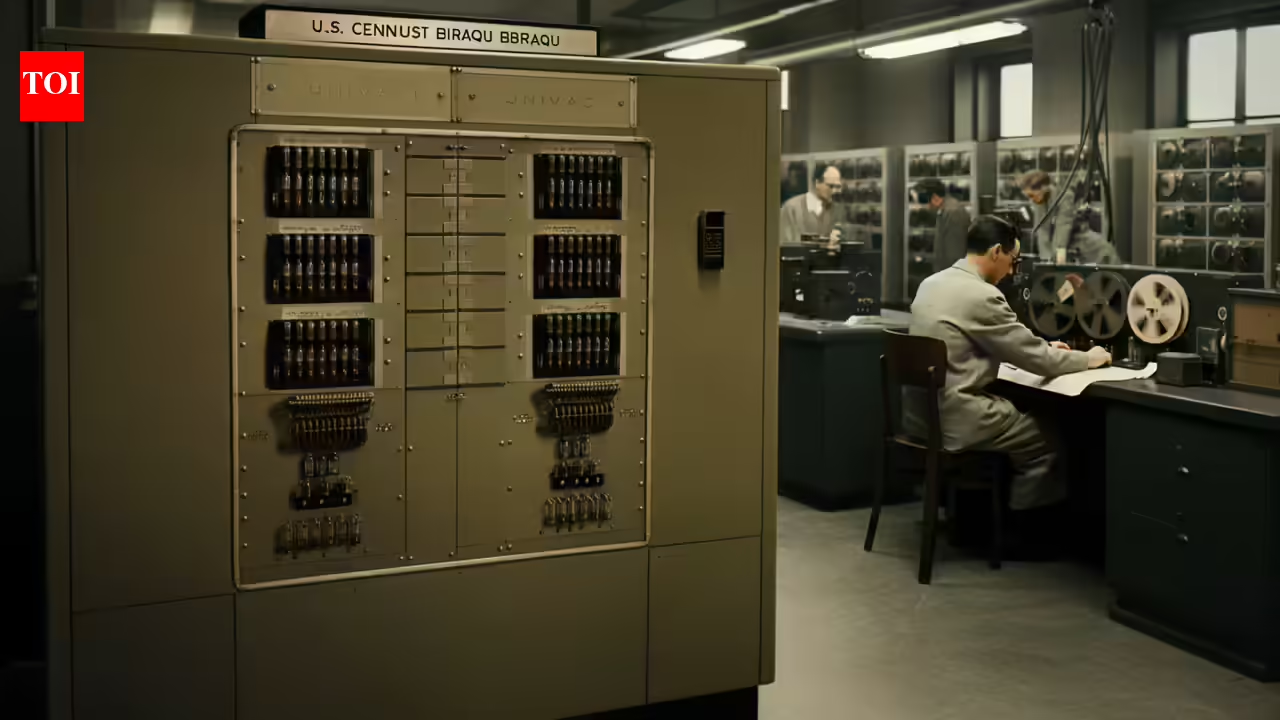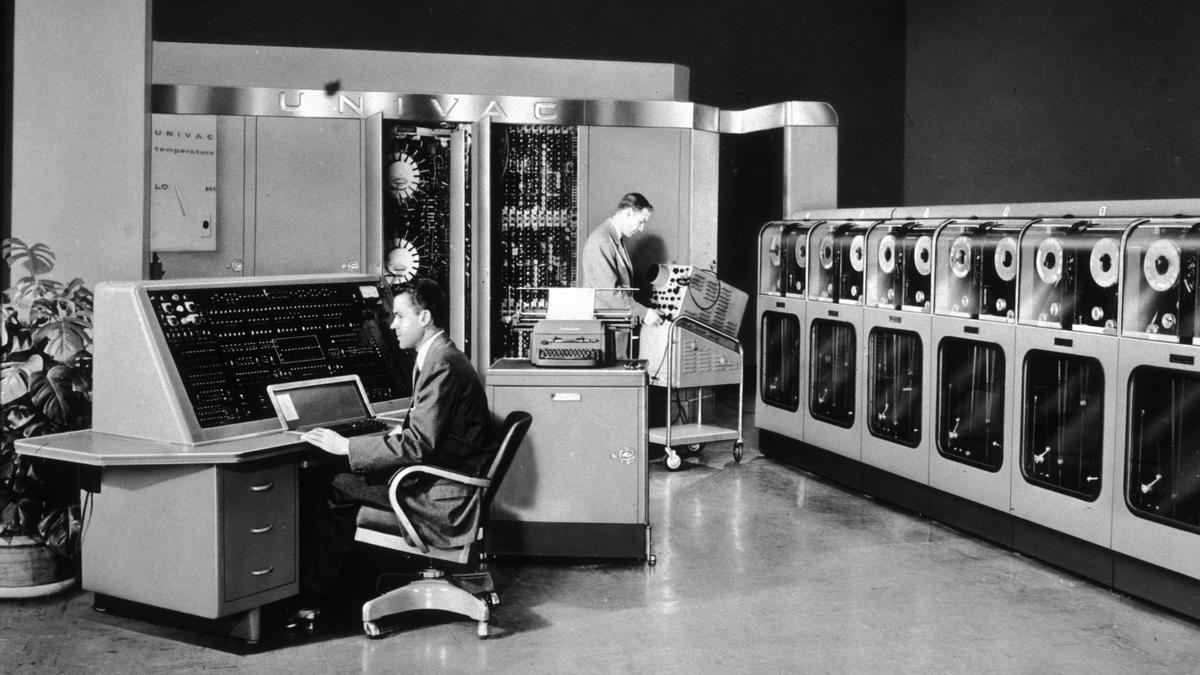
The personal computers of today are slick and savvy, performing countless operations seemingly at ease. Given the way in which technology has progressed, it seems unfathomable that early computers were giants, to say the least. To put it another way, the granddad of the computers that you and I use today came about during our grandparents time only. The scale and speed at which tech has improved has seen these room-sized devices shrink so small, all while becoming more efficient and capable of multitasking even better! One of the earliest successful commercial computers was the UNIVAC I, which was unveiled to the world in 1951. The men behind the machineThe need for computing is probably as old as counting and the search for mechanical devices that aided computation go back to ancient times. Fast forward to the age of computers, and it isn’t easy to answer the question “who invented the digital computer?” The UNIVAC, which stands for Universal Automatic Computer, certainly isn’t the answer, though it did play a pivotal role in taking computers from merely research and military purposes, to commercial, civilian applications.One of the answers for the question posed is American inventor John Vincent Atanasoff as he came up with the Atanasoff Berry Computer (ABC) along with his graduate student Clifford Edward Berry by 1941. Inspired and influenced by Atanasoff’s work, American electrical engineer J. Presper Eckert and American physicist John Mauchly got to work.Mauchly was vocal about electricity’s ability to calculate at high speeds. In one of his proposals to build a computer during the World War II, Mauchly conjectured that “A great gain in the speed of calculation can be obtained if the devices that are used employ electronic means... because the speed of such devices can be made very much higher than that of any mechanical devices.”Between 1943 and 1946, Eckert and Mauchly built the first large-scale, general-purpose electronic digital computer. This computer was called the Electronic Numerical Integrator and Computer, or ENIAC in short. Primarily funded by the U.S. Army Ordnance Department under the U.S. Army Department, the ENIAC was formally dedicated in February 1946. Built at a cost of nearly $500,000 (about $7 million today), the ENIAC was thus the result of military folks wanting a better way to calculate their artillery firing tables!Gains and lossesThe success of their ENIAC prompted Eckert and Mauchly to go into private business. They were soon about to find out that starting out on a venture wasn’t quite the same thing as putting together a computer. Through the Eckert-Mauchly Computer Corporation, the duo went on to realise that while they were able engineers, the same couldn’t be said about them as businessmen.While they had been working with the ENIAC project, Mauchly had met with several Census Bureau officials. During their discussions, Mauchly was able to stress upon the idea of non-military applications for electronic computing devices. With that groundwork done, the duo were able to obtain a study contract from the National Bureau of Standards in 1946 to start work on a computer that could be used by the Census Bureau. What started as a six month study ended up taking a year, and the results were the specifications of the UNIVAC.
75th anniversary of the UNIVAC I
Seventy five years ago – on June 14, 1951 – the UNIVAC I was officially put into service by the U.S. Census Bureau. The UNIVAC I, which the bureau calls the first successful civilian computer, heralded a new age in the tech industry by demonstrating the potential for computers in various applications. A.S.Ganesh takes you back to a time when these devices were far from being hand-held…
1,246 words~6 min read