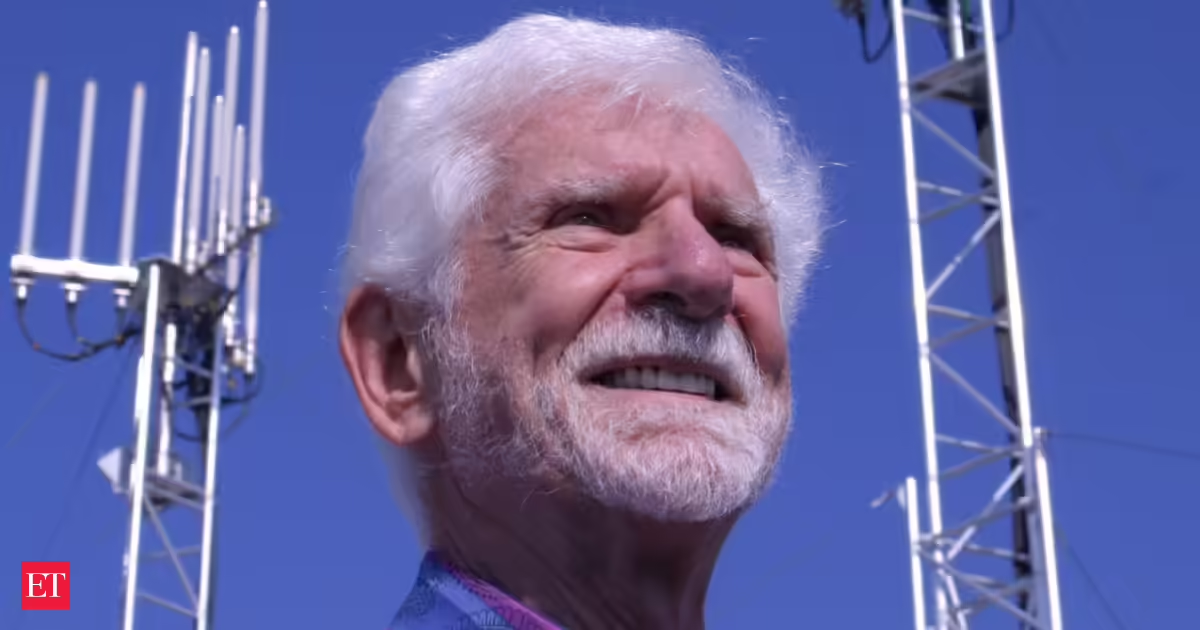
On April 3, 1973, Motorola engineer Martin Cooper walked onto a Manhattan sidewalk carrying a device that looked nothing like the smartphones people carry today. The phone was large, heavy, and limited by modern standards, yet the call he made that day became one of the most important moments in the history of communication.Historians of technology and peer-reviewed reviews published through PubMed Central consistently identify the event as the first handheld cellular phone call. What made the moment significant was not the hardware itself but the idea it demonstrated. For nearly a century, telephones had largely been tied to places such as homes, offices, and vehicles.Cooper’s public call suggested something different: communication could travel with the individual rather than remain attached to a location. That simple shift would eventually reshape how people worked, traveled, organized daily life, and stayed connected to one another.Martin Cooper | Wikipedia CommonsA phone call made in public carried a larger messageThe famous call is often remembered because it happened outside a laboratory. Rather than demonstrating the technology in a controlled testing environment, Cooper used the device on a public street where the concept could be understood immediately.A review published in PMC describes the 1973 call as the beginning of the era of handheld cellular phones. That distinction matters because the achievement was not simply technical. The sight of a person carrying a phone through a city made the future easier to imagine. People no longer had to think about communication as something connected to a wall, a desk, or a vehicle. Instead, the caller became the center of the system. The technology was still primitive, but the underlying concept was remarkably clear.Telephones had traditionally belonged to locationsFor most of the twentieth century, telephones were associated with places rather than individuals. If someone wanted to make contact, they generally needed to know where a person was likely to be. A phone number usually referred to a household, an office, or another fixed location.The 1973 demonstration challenged that assumption. Later reviews discussing the history of mobile devices note that handheld phones introduced a different model in which communication followed the user. This change may appear obvious today, but it represented a substantial departure from how people understood connectivity. The phone was no longer simply an object waiting in a particular room. It was becoming a personal tool designed to move through the world alongside its owner.The device mattered less than the ideaWhen modern audiences see photographs of early mobile phones, attention often focuses on their size and limitations. Compared with contemporary devices, they seem cumbersome and impractical.Yet historians repeatedly emphasize that the real importance of the first handheld call lies in the concept it proved. The phone itself would eventually be replaced by countless improved designs, but the principle remained intact. Researchers writing in PMC describe the 1973 demonstration as the start of a longer process through which mobile devices evolved into everyday tools. The original handset was only the first step, but it established a direction that would guide future development for decades.Mobility began changing expectationsOne of the most significant consequences of handheld communication was psychological rather than technical. Once people became accustomed to carrying phones, expectations about availability gradually changed.Communication no longer depended entirely on being at home or sitting behind a desk. Mobile technology introduced the possibility that individuals could remain reachable while traveling, working, or moving through public spaces. Scholars studying the history of telecommunications often point to this shift as one of the defining changes of the mobile era because it altered how people thought about presence, distance, and access. The device itself mattered, but the broader cultural change proved even more influential.A small demonstration launched a larger transformationPersonal Handy-phone System mobiles and modems, 1997–2003 | PexelsLooking back, the first handheld cellular call appears modest compared with later developments such as smartphones, mobile internet, and global wireless networks. Yet many technological revolutions begin with a simple proof of concept rather than a finished product.The 1973 call demonstrated that communication could be portable in a practical way. Once that idea became visible, researchers, engineers, and manufacturers had a clear direction for future innovation. The path from Cooper’s Manhattan sidewalk demonstration to modern mobile communication was long, but the essential premise remained unchanged. The person, rather than the place, became the focus of the system.The first handheld cellular phone call remains historically important because it represented a change in how communication was imagined. Martin Cooper’s demonstration did not immediately create the mobile world people know today, but it showed that such a world was possible. By proving that a phone could travel with its user rather than remain fixed to a location, the call helped redefine the relationship between people and technology. More than fifty years later, the devices have changed dramatically, yet the central idea introduced on that Manhattan sidewalk continues to shape everyday life around the world.
In 1973, Motorola's Martin Cooper called his AT&T rival from a Manhattan sidewalk on a 2.5-pound brick; 50 years later, that phone lives in 7 billion pockets
In 1973, the world witnessed a groundbreaking moment when Martin Cooper made the very first call on a handheld cellular phone. This pivotal event demonstrated that communication could break free from fixed locations, sparking a revolution in how humanity interacts. The hefty device was merely the beginning, paving the way for the sleek smartphones we rely on today.
815 words~4 min read