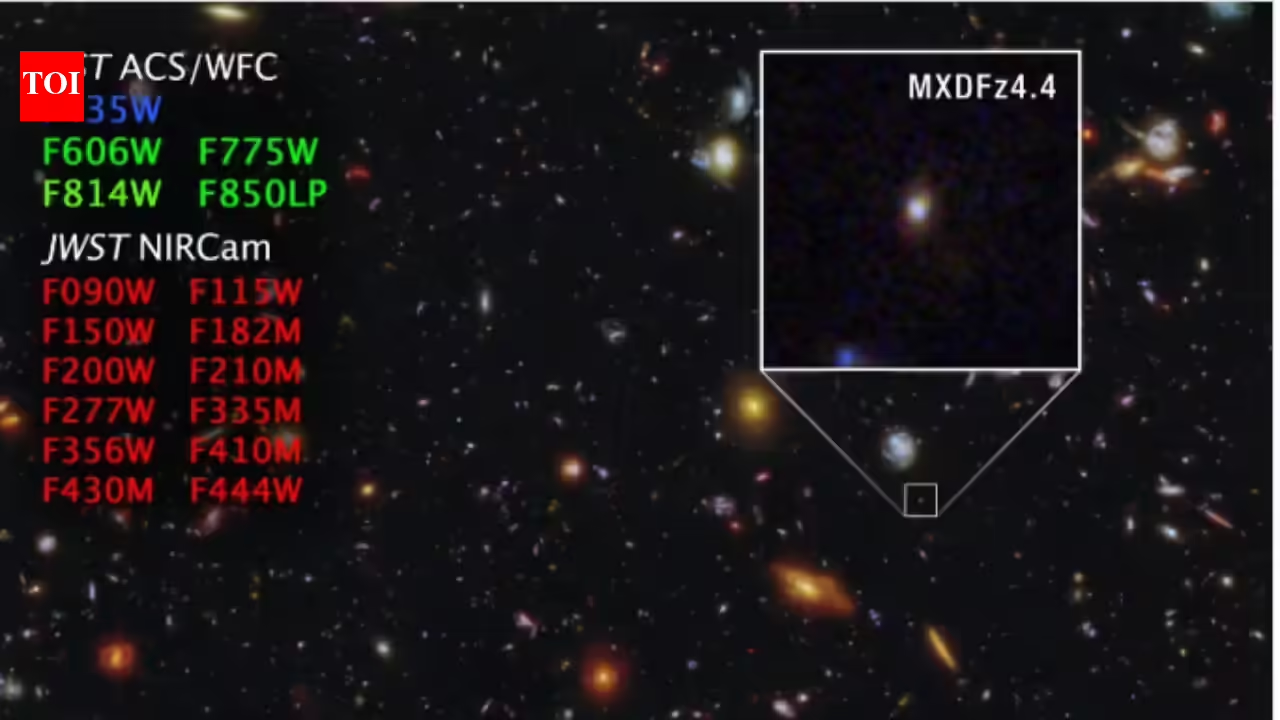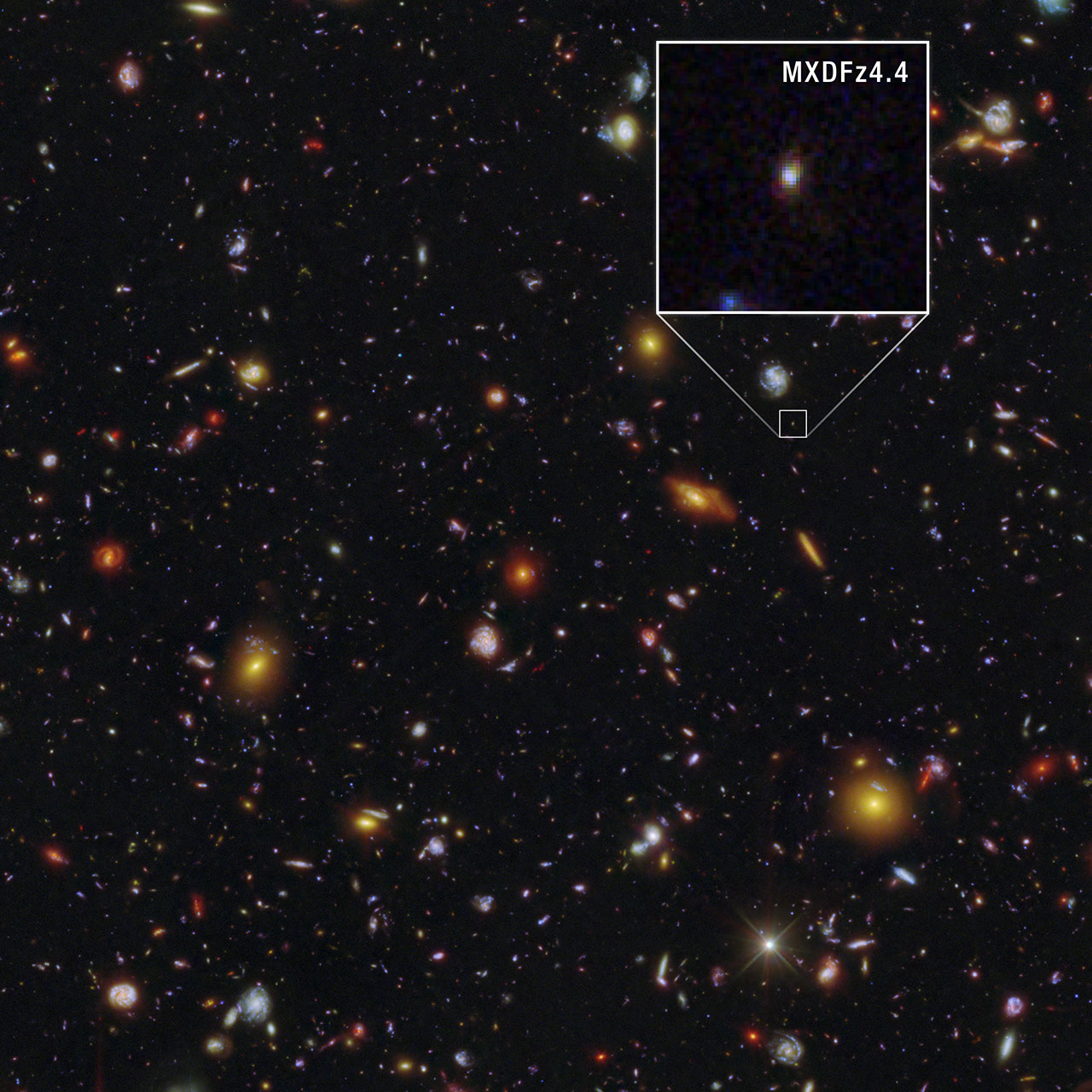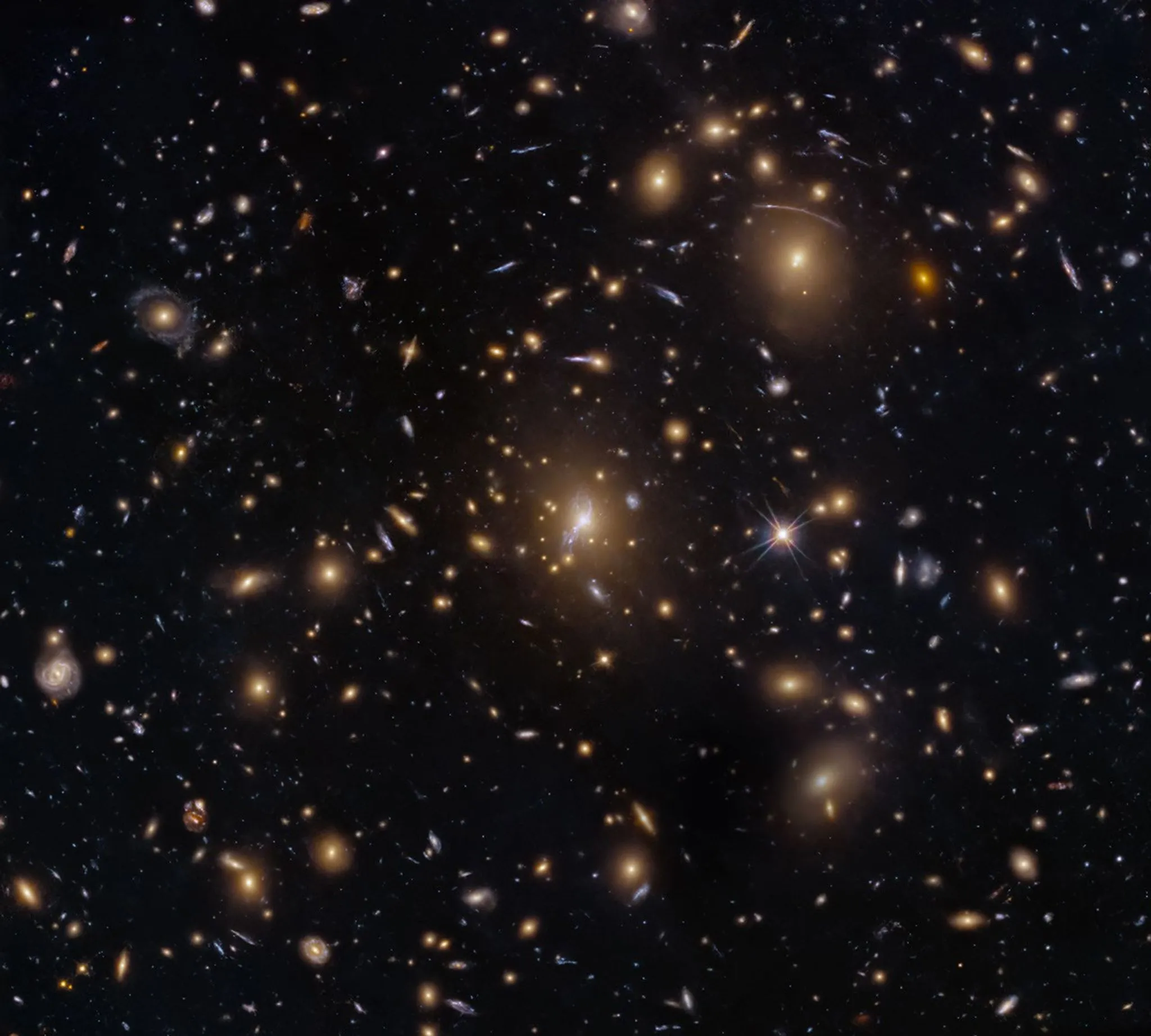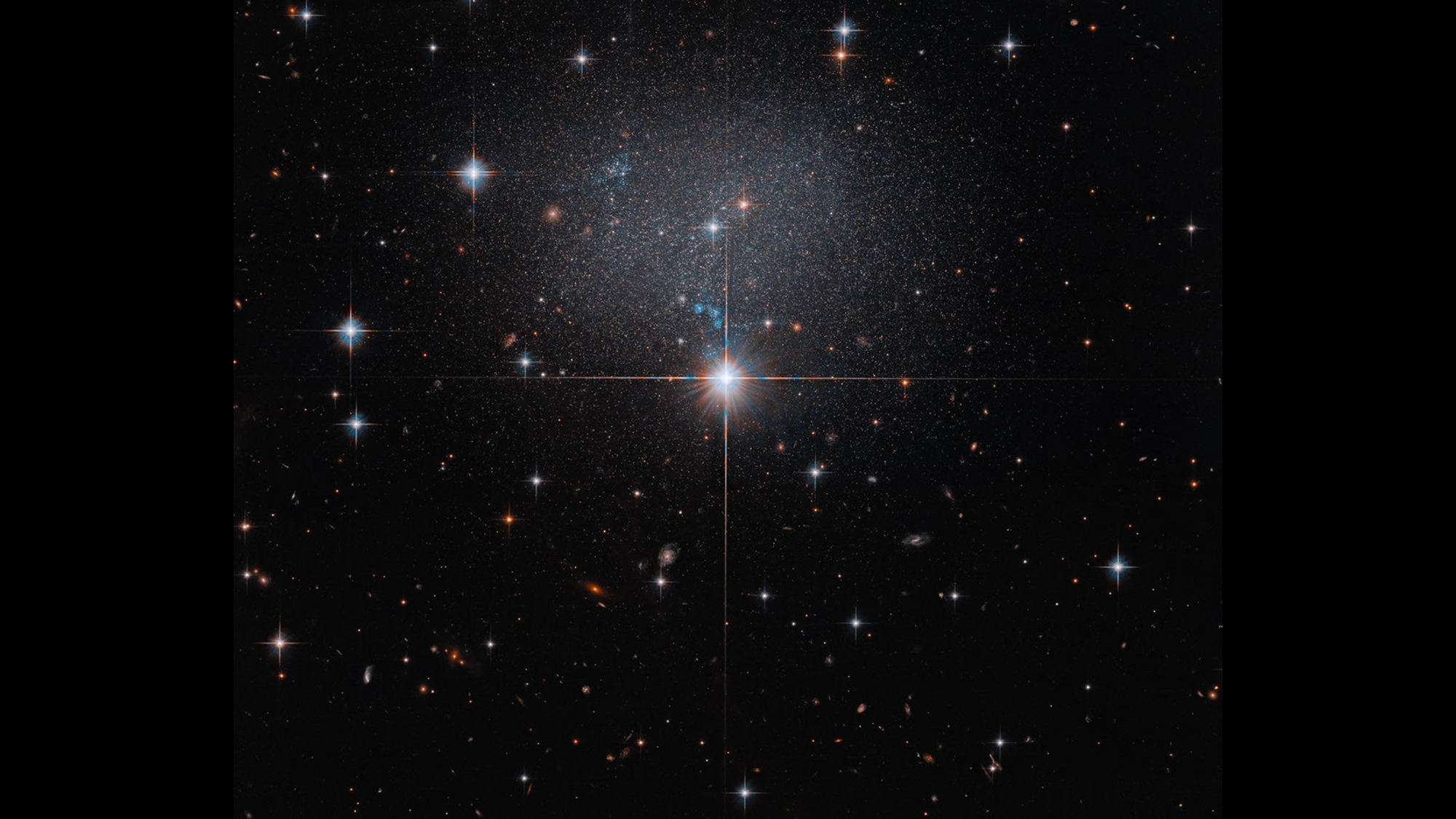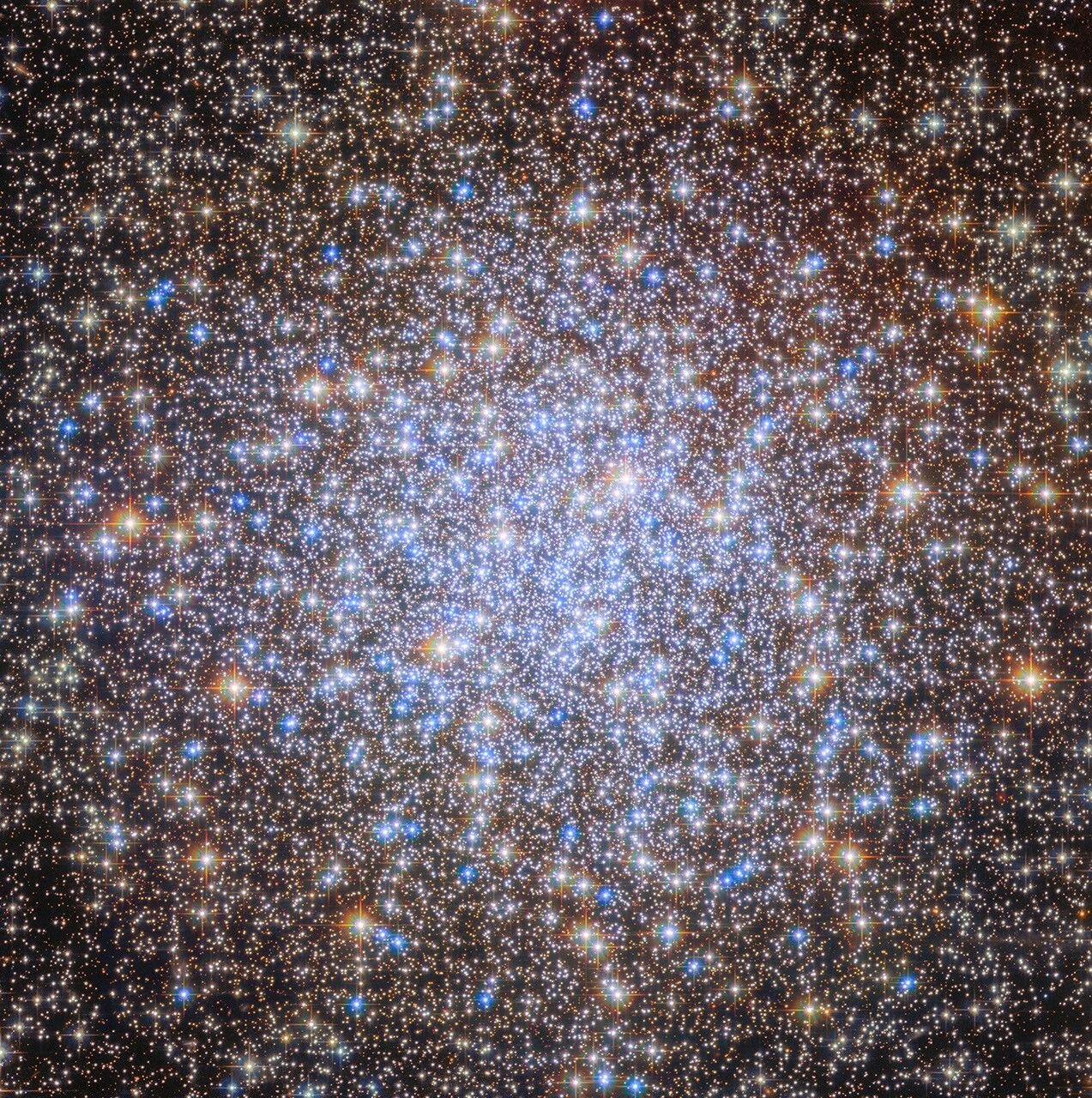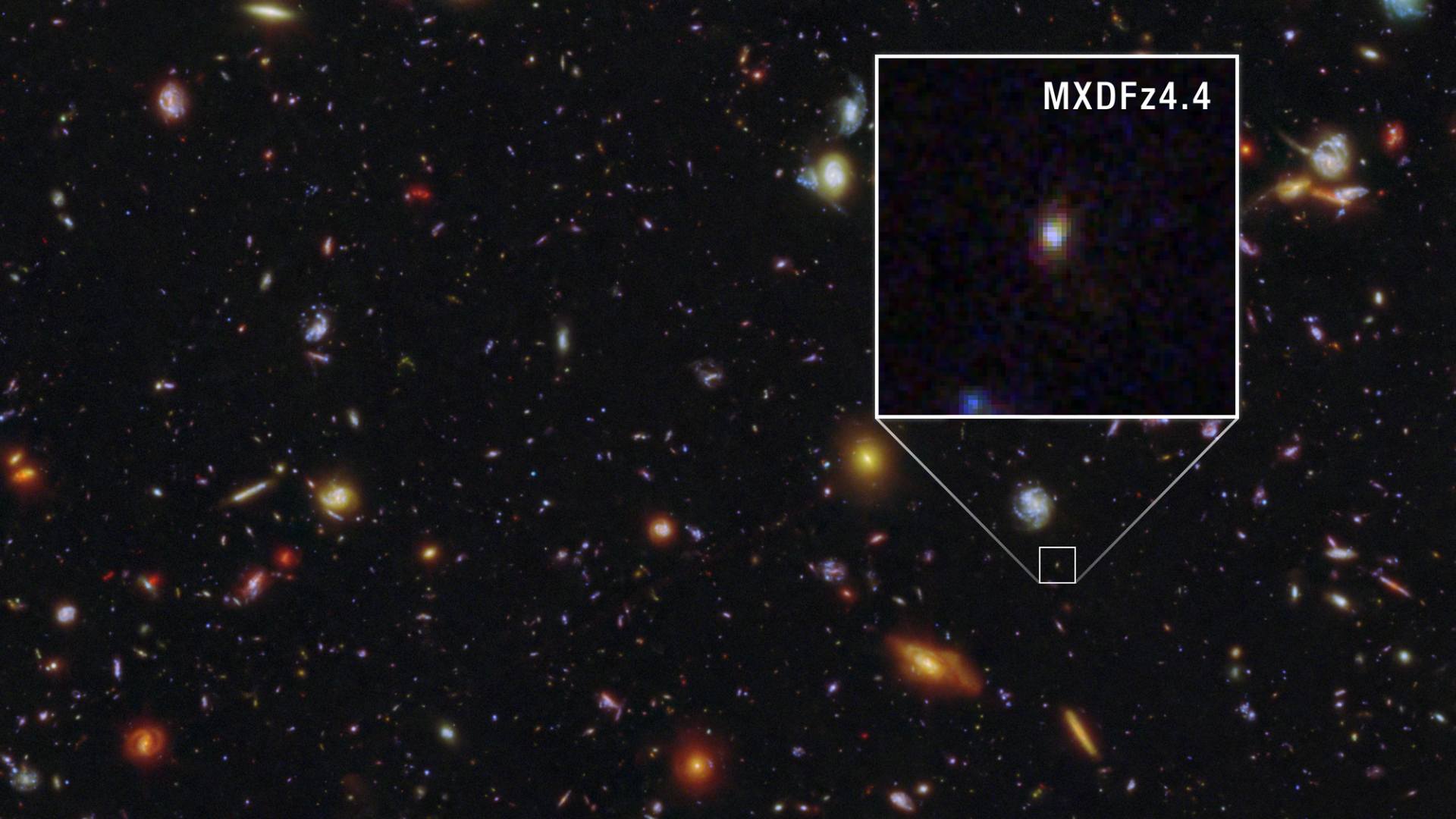
The Hubble Space Telescope's view of the distant galaxy MXDFz4.4 (inset).
(Image credit: NASA/ESA/CSA/STScI/Ilias Goovaerts and Anton Koekemoer (STScI)/Marc Rafelski (STScI, JHU)/ Image Processing: Alyssa Pagan (STScI))
A bright, dense cluster of hot, massive stars in a galaxy that existed 1.4 billion years after the big bang has been found helping to end the early universe's foggy days during which neutral hydrogen gas was draped across the cosmos, obscuring ultraviolet light from luminous objects.The cluster was found emitting ultraviolet light in a small but quickly growing galaxy by the Hubble Space Telescope. The presence of this ultraviolet light, and the star-forming history of the cluster producing it, suggests that bursts of star formation contributed to waves of ionizing radiation that gradually cleared out the opaque neutral hydrogen.In the aftermath of the big bang, the universe was filled with neutral hydrogen gas that is opaque at short wavelengths of light, such as ultraviolet. However, this ultraviolet light was the neutral hydrogen's worst enemy, gradually ionizing the gas across the universe. Once ionized, hydrogen gas cannot absorb ultraviolet light — and so, the cosmos became transparent at those wavelengths.Because of this, the first billion or so years are called the Epoch of Reionization. It is referred to as "reionization" rather than ionization because, technically, the gas had already been ionized once before during the first 379,000 years after the Big Bang.While investigating what brought about this epoch, astronomers had identified two chief suspects that could have produced sufficient amounts of ultraviolet light to ionize the neutral hydrogen. One is active supermassive black holes and the other is the first generations of hot, massive stars. The problem is, given that neutral hydrogen is adept at absorbing the ultraviolet light, astronomers have had difficulty tracing that ultraviolet back to its source and identifying which of the two suspects are the main culprit.In 2023 the James Webb Space Telescope (JWST) made a major breakthrough, finding a galaxy that existed just 900 million years after the Big Bang that was producing enough energy to ionize the neutral gas surrounding it.Now the Hubble Space Telescope has gone further, detecting ultraviolet light from a galaxy called MXDFz4.4. This ultraviolet light should only be visible if the surrounding gas had already been ionized."Observing a galaxy like this was thought to be impossible," said Ilias Goovaerts of the Space Telescope Science Institute (STScI) in Baltimore, who led the discovery, in a statement. "Researchers expected the 'fog' of neutral hydrogen that filled the early universe would be too thick and obscure our view of its ionizing light. Hubble not only spotted that light, but it also helped reveal incredible details about the galaxy's characteristics."