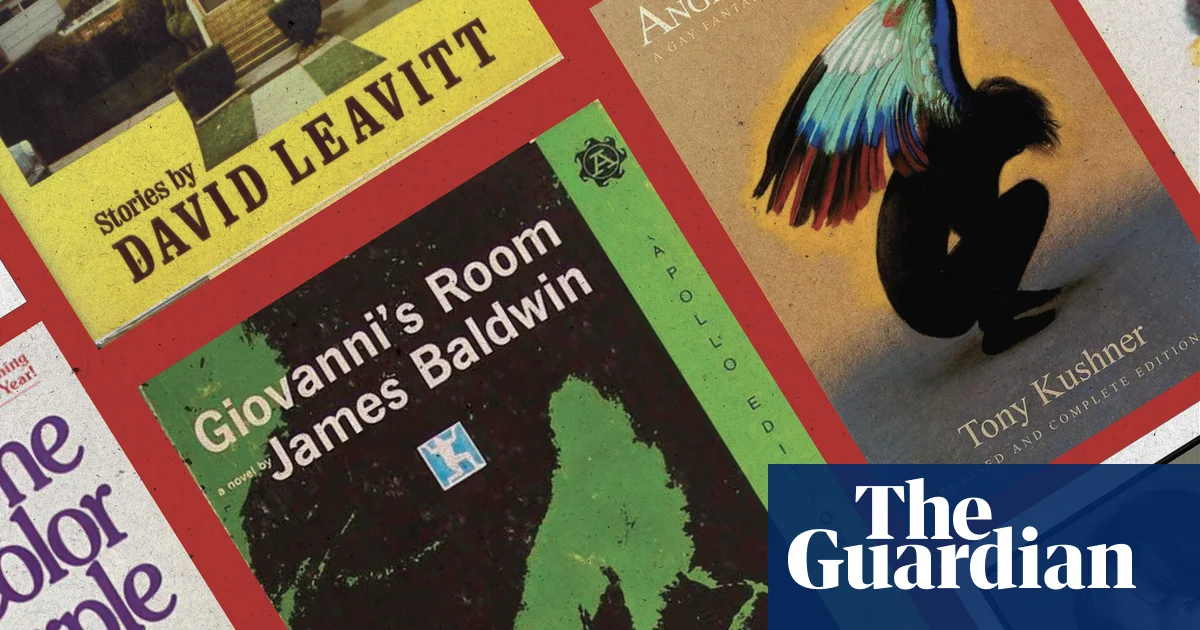
You could debate what the best American LGBTQ+ book is until the cows come home, but experts at least tend to agree on the first one: 1870’s catchily titled Joseph and His Friend: A Story of Pennsylvania by Bayard Taylor. Compared with the well-worn classics of the British LGBTQ+ literary canon – from Oscar Wilde to Jeanette Winterson and beyond – its US counterpart feels invitingly hazy: greener and ever-evolving to reflect the spectrum of queer American life.To celebrate pride month and the upcoming 250th anniversary of America, the Guardian asked nearly two dozen leading queer writers for their favorite LGBTQ+ book from the country they call home. Read on for their choices.Sarah Schulman selectsThe Heart Is a Lonely HunterCarson McCullersLula Carson Smith, born in segregated Georgia in 1917, changed her name to Carson, wore suits and wrote books with boyish protagonists named Mick and Frankie. As she transgressed gender, she also crossed the color bar, and her first novel, The Heart Is a Lonely Hunter, published at age 23 in 1940, featured queer and trans characters, but also scenes with only Black people in the room. She wrote about working people’s rights, and was driven by her and their own freedom vision. Before this publication, Carson won a scholarship to Juilliard to study piano, but ended up handing over all her money to a female sex worker and had to come home. There she married a fellow writer, Reeves McCullers, also on a gender tightrope, an alcoholic and depressed. The two loved and tormented each other through two marriages, while Carson went on to become a singular, organically talented literary marvel – writing novels, short stories, a memoir and plays. She died at age 50, and her death mirrors colleagues Tennessee Williams and Truman Capote, three queer geniuses who never got a grip on their addictions. I still read and re-read Carson with wonder and admiration.Michael Cunningham selectsThe Sun Also RisesErnest HemingwayThis is probably the least widely acknowledged queer novel in American literature. It’s the story of the doomed love between Jake Barnes, an American who’s had his balls shot off in the war, and an Englishwoman, Lady Brett Ashley – two expats living in Paris. Jake can’t have sex with anyone. Brett has sex with almost half the men she meets. She’s not coquettish, though. She wears men’s sweaters. Her hair is “brushed back like a boy’s”. She’s described as “damn good-looking”, never pretty or beautiful. She doesn’t need to be pretty. She’s a force. She’s fatale but not femme. I’d never underestimate the marginalization of LGBTQ+ writers, or our longstanding status as separate from “serious” writers, if we dare to write about the lives we know. By 2026, though, I’m ready for that distinction to retire. The love story between Brett and Jake is very much about the Q in LGBTQ+, with its insistence, a century ago, that “queer” applies to all sorts of writers and characters; that the particulars about who they have sex with are not necessarily among their most fundamental aspects. It’s an early call for the undermining of gender norms. From Ernest Hemingway, of all people.Robert Glück selectsThe New American PoetryEdited by Donald AllenIn the 60s, when homosexuality was considered a crime and a disease, I found The Satyricon in the Woodland Hills Branch library. It was my first encounter with normal homosexuality, but I was too late for life in ancient Rome. Later, I found Donald Allen’s The New American Poetry, the bible of poetry’s counterculture. I wonder if it’s understood what a queer bible it is? The Allen Anthology, as we called it, shaped postwar American poetry into schools: the Beats, the New York school, Black Mountain … There were lapses of course. The 44 poets were overwhelmingly male, but almost 30% queer! I discovered Philip Whalen, Robert Duncan, John Ashbery, Robin Blaser, Jack Spicer, Allen Ginsberg, James Schuyler, John Wieners and most importantly, Frank O’Hara. What a revelation for a generation of young queer poets! This was a world I could enter. I read that book till it fell apart – I have the pieces. Later, I became friends with some of these poets, and I learned that Don was gay. Later still, in a Proustian turn of events, he called me out of the blue and asked to publish a book on his Grey Fox imprint, and we became good friends.Bryan Washington selectsLight From Uncommon StarsRyka AokiRyka Aoki’s Light from Uncommon Stars nearly defies description: in the midst of a deal between the literal devil, a damned violinist and her potential protege – a teenage trans runaway – a queer love story unfolds alongside and within a family of interstellar refugees. The novel is a love letter to California, doughnuts, found families, infatuations and the costly choices – macro and micro – marginalized communities make in the US every day. But while the book’s premise is literally beyond, Aoki’s prose is astounding. Some of the most gorgeous writing in English that I’ve read. Aoki simply works in a different frequency. When I think of queer American literature, this novel reaches the limits of possibility and says, do more.Melissa Febos selectsChelsea GirlsEileen MylesWhen I was a young teenager, this book provided a portal into a possible future – a life of days filled with art and girls and sex and the kind of chaos I knew only from the inside at that age. I was living in a smallish town on the Massachusetts coast and didn’t know anyone gay under 35. I used to skip school and hitchhike to Provincetown just to look at gay people. I was in love with my best friend and had no idea that was a cliche. Myles’s New York read like a dream sequence: drinking and danger and the erotic and giddy fun all swept up into the same handful, every day. “With a woman I felt whole, not different,” they wrote, and I hung on to that, the proof that I was something so knowable a stranger could write it. That I could aspire to be an artist, a mess, a lover: the person I already was.Kaveh Akbar selectsFeeldJos CharlesAnne Carson said that Paul Celan “translated German using German”, and I think reading Jos Charles’s Feeld is the closest thing to that feeling I’ve ever come across in English verse. For Feeld, Charles – educated both as a musician and medievalist – strips English down to its studs, reconfiguring it into a new pidgin, one part pre-Chaucerian Anglo-Saxon and one part millennial text-speak. One of her poems ends: “i kno no new waye / 2 speech this / the power off lyons.” Another: “u who unforl me / how many / holes would blede / befor / u believ / imma grl”. Feeld is a painstaking, unprecedented work of an actual capital-G genius, a trans poet de- and re-constructing a language that never anticipated a life like hers. It’s a book that feels more miraculous every time I revisit it.Imogen Binnie selectsPeriodDennis CooperI moved to New York to figure out that I was trans, although I didn’t know it. That need was an internal, invisible Rube Goldberg machine of truths, fears and Do Not Enter signs, impenetrable and as ignored as possible. I worked at the notorious love-it-and-hate-it bookstore institution The Strand. Shelving fiction one evening, I found a novel whose cover image I’d previously seen as an implied author photo on the back of the classic transgender hoax novel, Sarah, by JT LeRoy. I didn’t know how to interpret the reuse of that photograph. Still don’t. But, appropriately, that confusion led me to sneak it into the employee bathroom and start reading.
The best American LGBTQ+ books, chosen by authors
From 20th-century classics to little-known treasures, Michael Cunningham, Hilton Als, Eileen Myles and others share their favorite books about LGBTQ+ life
4,816 words~22 min read