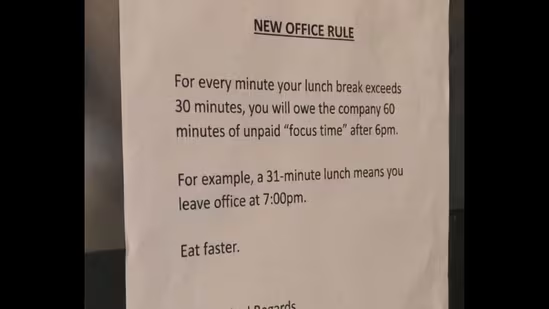
Ever feel like your reward for working fast is just more work? We’ve all been there—you crush your to-do list by noon, only to catch a frosty glare from a boss who assumes you're slacking off. It’s a frustrating corporate paradox: speed and efficiency are often met with micromanagement instead of applause, leaving high performers feeling trapped by the clock. Why does the modern workplace still confuse being busy with being productive? Along similar lines, career coach Simon Ingari recently shared a powerful workplace lesson on X that has resonated with thousands online.The tale of two employeesAs per the post, a stark contrast exists in how different company cultures treat efficiency, highlighted by the story of an employee who managed to finish an entire day's worth of work in just 4 hours. After completing his tasks, he simply closed his laptop and logged off. Crucially, his manager did not mind or even notice, because the only thing that truly mattered was the completed work. However, the write-up notes that such a balanced approach would have been entirely impossible at the employee's previous company.To illustrate this systemic issue, Simon Ingari asks readers to consider 2 remote employees, X and Y, who share the exact same role, workload, and responsibilities. While Employee X takes 9 hours to complete the tasks and remains online until 6 pm, Employee Y finishes the same amount of work in 4 hours and logs off at 1 pm.Stop punishing efficiencyUnfortunately, most traditional companies choose to punish Employee Y by piling on more tasks and demanding longer hours simply because they have time left on the clock. The post argues that this approach is entirely wrong. Employee Y is not a problem to be fixed; they are the company's greatest asset. Their speed is a reflection of superior skill and efficiency, not a lack of effort.The lesson concludes with a powerful ultimatum for leadership: if a company wants more output from efficient workers, it must pay them more. Otherwise, they should be allowed to log off. Punishing efficiency is ultimately the fastest way to drive top talent to mediocrity, which is why managers must learn to measure outcomes instead of hours.
‘Measure outcomes. Not hours’: Workplace lesson on why employees who finish tasks early can be a company’s biggest asset
A recent viral workplace lesson highlights a frustrating paradox: efficiency is often met with micromanagement, not recognition. Imagine two employees doing the same job; one finishes in 4 hours, the other in 9. Traditional companies often burden the efficient worker with more tasks. Experts argue this punishes top talent, urging leaders to reward outcomes over hours to retain valuable, speedy employees.
363 words~2 min read