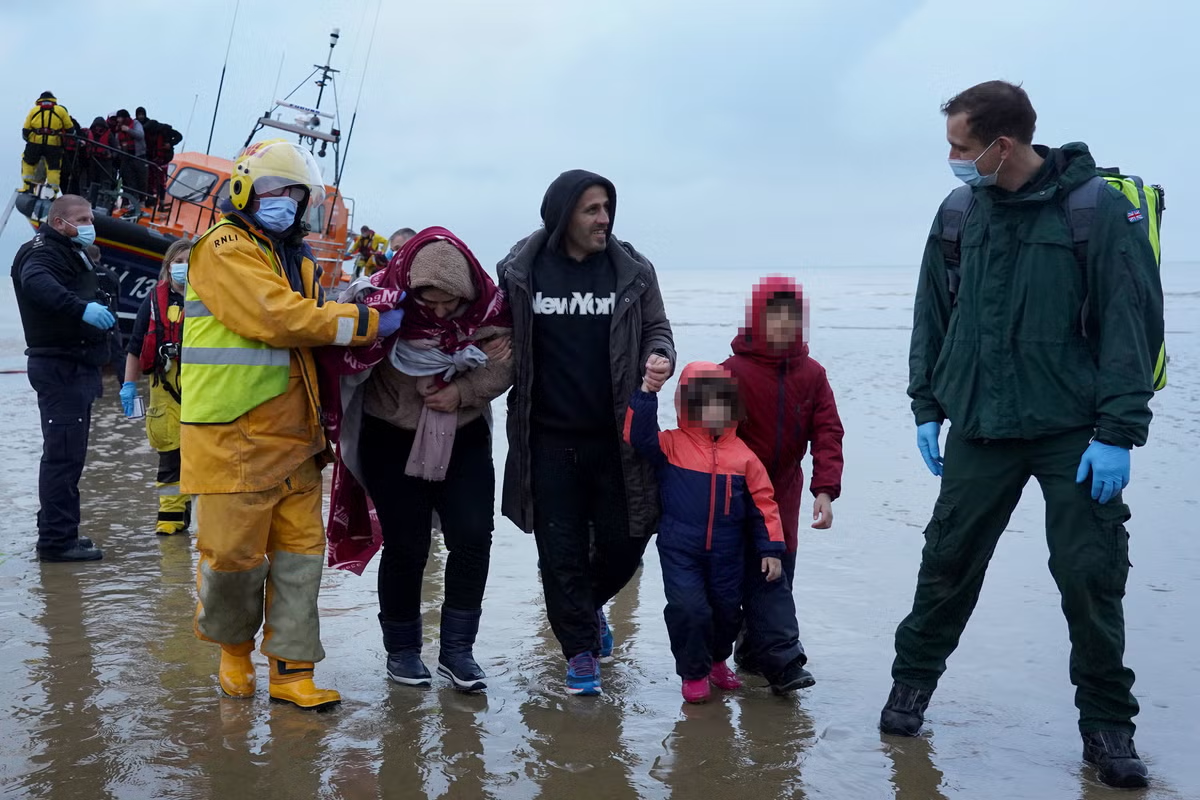
Unaccompanied young asylum seekers whose age is disputed may face medical examinations “as a last resort” and where other processes prove inconclusive, the Department of Justice has said.Such assessments, which have not been used in Ireland previously, are “unreliable, unnecessary, and possibly invasive”, the Children’s Rights Alliance (CRA) said on Tuesday.Determining the exact age of unaccompanied young people seeking asylum has become a significant issue in recent years for the department and Tusla, the child and family agency, as the numbers arriving have increased.Tusla – currently accommodating 625 unaccompanied minors, of whom 179 are Ukrainian – describes finding places for those whose ages are disputed as “challenging” as it cannot risk inadvertently placing an adult in accommodation with children.Last month it said that over the past four years, almost 300 asylum seekers who had claimed they were children were subsequently deemed to be adults.Earlier this month, Tusla withdrew a District Court application to have a young Somali it had accommodated with children declared an adult. The young person is charged with the murder of Vadym Davydenko (17) in an apartment in Donaghmede, Dublin, in October. The Somali turned 18, according to the dates he provided, on June 20th. Gardaí believe he was an adult at the time of Davydenko’s death.In a report to the Dáil Public Accounts Committee (PAC), the department said that since the inception of the EU Migration and Asylum Pact earlier this month, it would be the determining authority for age assessments.Since January, in preparation for this arrangement coming into force, department officials have been conducting assessments at the point at which a young person seeks asylum. The numbers being deemed children and referred to Tusla have fallen by 60 per cent.Where unaccompanied minors are clearly children, they will be referred immediately to Tusla without undergoing age assessment.[ Hiqa, PAC and legal professionals all voiced concerns around safety of child asylum seekers in Tusla’s careOpens in new window ]“The assessment will be multidisciplinary, carried out by trained staff of the department, supported by psychosocial professionals from a panel established for that purpose,” the report says.“In the event that the multidisciplinary assessment is inconclusive, the [legislation] provides that as a last resort, a medical examination may be carried out to determine age. Any medical examination must be performed with full respect for the applicant’s dignity and in the least invasive manner possible.“Before such an examination can be undertaken, the applicant must be informed in an age-appropriate manner and the applicant must consent to the examination.”Age assessment decisions can be appealed.In other EU jurisdictions, medical assessments typically entail bone and teeth examinations and possibly X-rays. They were described as “controversial” last year in a paper from the Irish Centre for Human Rights at the University of Galway. CRA chief executive Tanya Ward said the alliance “would be very concerned if this is the direction age assessments are going”. “From a children’s rights perspective this is an unnecessary interference in a child’s bodily integrity.”
Young asylum seekers may face medical tests to determine age ‘as a last resort’ in disputes
Move criticised as ‘unreliable, unnecessary, and possibly invasive’ by Children’s Rights Alliance
494 words~2 min read