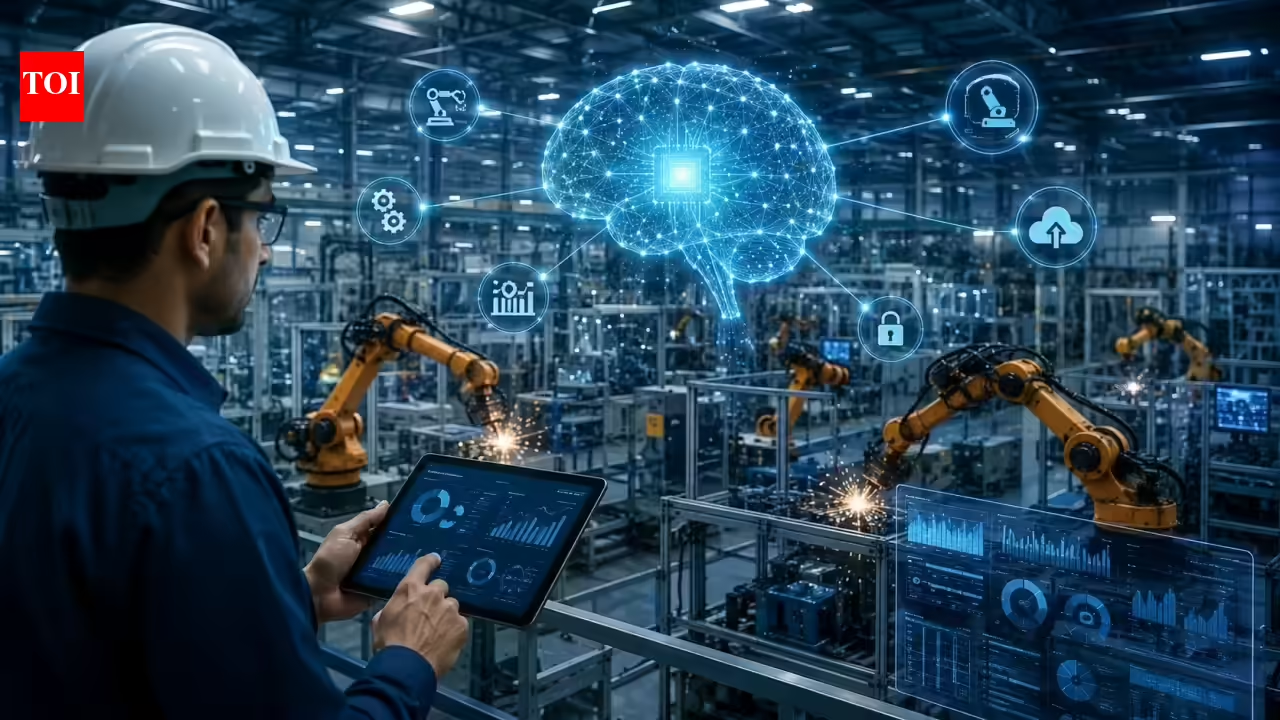
India has never lacked technological vision. Time and again, it has anticipated transformative technologies long before they became mainstream. It has built impressive scientific capabilities, developed indigenous innovations, and demonstrated remarkable ingenuity. Yet, in several critical sectors, it has struggled to convert early technological leadership into globally dominant industries.As India embarks on ambitious missions in semiconductors, artificial intelligence (AI), quantum computing and space technologies, it is worth reflecting on an important lesson from its past: invention alone is not enough. The true measure of technological success lies in scaling innovation into globally competitive enterprises.Ahead of its timeConsider semiconductors. India established the Semiconductor Complex Limited (SCL) in the 1970s — when semiconductors were still an emerging industry — recognising early that integrated circuits would become the foundation of the digital age. Yet, while Taiwan built TSMC and South Korea developed Samsung’s semiconductor empire, India failed to translate its early lead into a globally competitive manufacturing ecosystem. The problem was not vision or scientific capability, but limited capital, inadequate scale, inconsistent policy support and an inward-looking public sector approach.A similar story can be told about ECIL. Established in 1967, it developed indigenous computers, control systems and strategic electronics when India faced severe technology embargoes. ECIL played a vital role in building technological self-reliance. However, its focus remained on strategic requirements rather than globally competitive commercial products. As a result, scientific excellence stayed within institutions instead of creating large industrial ecosystems. The Simputer followed a similar trajectory. Conceived in 1998 by Indian technologists, it anticipated many features that would later define smartphones and tablets. Yet, despite its innovation, the supporting ecosystem was absent. Venture capital, software platforms, component supply chains and consumer markets were not mature enough to help it achieve global scale. A few years later, Apple transformed personal computing through the iPhone and built one of the world’s most valuable technology ecosystems. The lesson is clear: being first matters little if you cannot scale.India has seen similar patterns elsewhere. It developed early expertise in computing, telecommunications and electronics. Yet, many pioneering initiatives remained prototypes, pilots or public-sector achievements rather than globally dominant businesses.Models of successFortunately, history also offers examples of success. India’s pharmaceutical industry evolved into a globally competitive manufacturing powerhouse, making the country the pharmacy of the world and a leading vaccine producer. India also developed indigenous supercomputing capabilities through the PARAM programme. More recently, Aadhaar and UPI have shown how technology platforms designed for scale can transform a nation. Scale creates ecosystems, ecosystems create industries, and industries create global leadership.Today, India stands at another technological inflection point. AI, quantum computing and space technologies are likely to shape the next half-century, just as semiconductors and software shaped the last. India already possesses significant strengths in software engineering and digital infrastructure. The challenge now is to build globally scalable AI products and platforms. The emergence of DeepSeek showed that technological leadership is not only about building the largest models. It is also about making intelligence cheaper and more accessible. The AI race may ultimately be won by those who make intelligence affordable, ubiquitous and widely available.India is uniquely positioned to lead this movement. Just as UPI democratised financial inclusion, India should aspire to democratise intelligence through low-cost, energy-efficient AI models that can serve billions of people.Quantum computing presents another opportunity. Rather than merely replicating existing approaches, India should focus on reducing the cost of quantum infrastructure and developing practical applications in health care, materials science, climate modelling and drug discovery.The same should extend to space. The successes of Chandrayaan and Mangalyaan proved that frugal innovation can coexist with world-class ambition. As computing demands escalate globally, concepts such as space-based data centres powered by continuous solar energy are attracting serious attention. India should not merely participate in these conversations; it should lead them. We should ask bold questions about orbital computing infrastructure, space-based AI platforms or even data centres and quantum communication networks.These ideas may seem futuristic today. But so did semiconductors, smartphones and AI when they first emerged.Stopping too soonThe deeper lesson from SCL, ECIL and Simputer is not that India failed, but that it often stopped too soon. We celebrated technological capability before building the ecosystems needed for global scale. The next phase of India’s technological journey must combine self-reliance with global ambition. The challenge is no longer merely to invent; it is to build, scale, commercialise and create enterprises that can compete globally.India has already demonstrated world-class scientific and engineering capabilities. The opportunity now is to translate that ingenuity into globally competitive industries that shape the technologies of the future.The countries that lead tomorrow may not be those that invent first, but those that scale best. This time, India must do both.Kiran Mazumdar-Shaw is Executive Chairperson, Biocon Limited
India’s next challenge — from invention to global scale
In several key sectors, India has failed to convert early technological advantages into globally competitive industries, a gap it must now bridge
789 words~4 min read