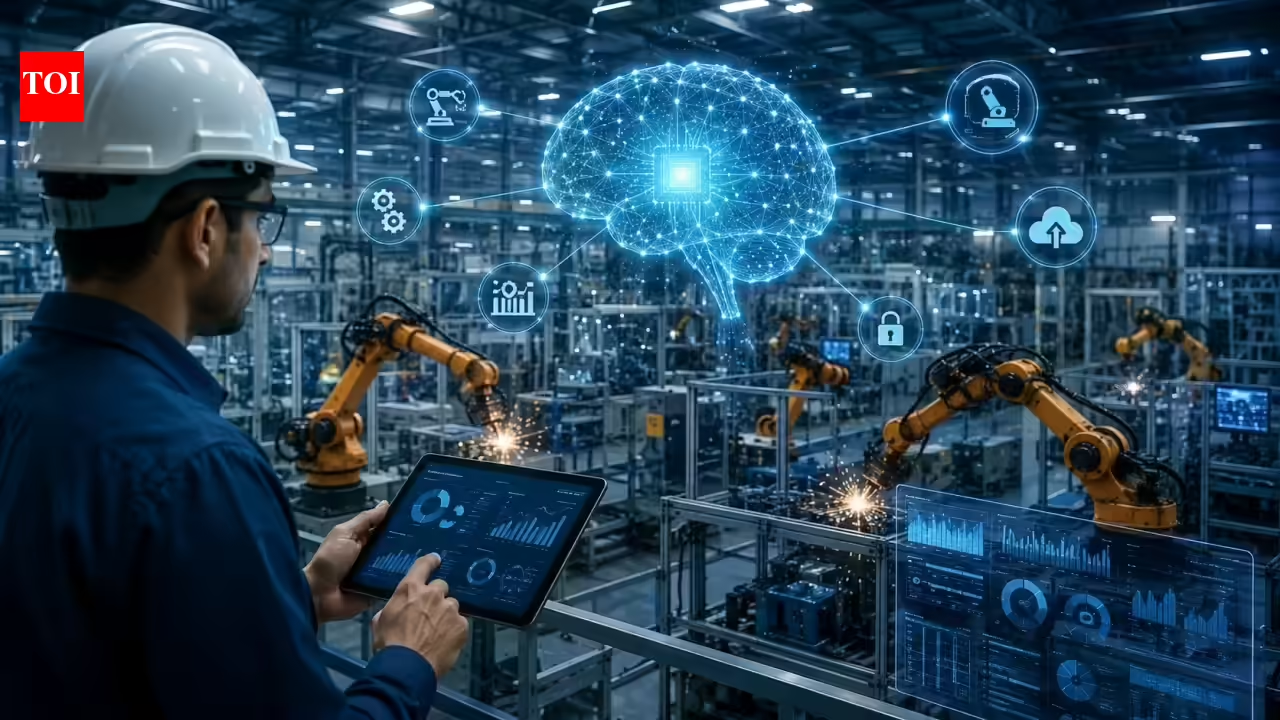
According to a NASSCOM and MeitY survey, 65 per cent of large Indian manufacturers had adopted some form of AI by 2024. (AI image)For most of its post-independence history, Indian manufacturing has competed on the basis of labour cost, scale, and geographic advantage. These remain important — but they are increasingly insufficient. Global competition in precision manufacturing, pharmaceuticals, automotive, and electronics is increasingly being won not on the factory floor but in the data layer above it: in the quality of demand forecasting, the sophistication of predictive maintenance, the precision of quality control, and the resilience of supply chain management.This is the terrain on which AI is reshaping Indian manufacturing. The India AI in Manufacturing market was valued at $860 million in 2025 and is projected to reach $4.89 billion by 2030, representing a compound annual growth rate of 41.5 per cent — one of the fastest growth rates of any sector in the Indian economy.Predictive Maintenance: The End of Unplanned DowntimeIn traditional manufacturing environments, machines are serviced on a schedule: every 500 hours, every 30 days, or after a breakdown. Each of these approaches has the same fundamental flaw — they either over-maintain equipment, creating unnecessary cost, or under-maintain it, creating unplanned downtime that disrupts production schedules and erodes margins.AI-powered predictive maintenance systems change this calculus entirely. By continuously monitoring sensor data from machinery — vibration, temperature, acoustic signatures, power consumption — these systems can identify the early signatures of component failure days or weeks before it occurs, allowing maintenance to be scheduled precisely when it is needed and not a moment before.According to a NASSCOM and MeitY survey, 65 per cent of large Indian manufacturers had adopted some form of AI by 2024, up from 45 per cent in 2022. Predictive maintenance is among the most widely deployed applications, with documented reductions in unplanned downtime of between 30 and 50 per cent in well-implemented deployments.Quality Control: Seeing What the Human Eye CannotComputer vision-based quality control is among the most immediately impactful AI applications in manufacturing. Traditional quality inspection relies on human visual inspection — a process that is accurate to approximately 80 per cent on a fresh inspector at the start of a shift, but degrades significantly over the course of a day as fatigue sets in. Defect rates that pass human inspection can reach 5 to 10 per cent in high-volume production environments.AI-powered vision systems inspect every product on the production line in real time, identifying defects with accuracy rates that consistently exceed 99 per cent. For sectors where quality non-compliance carries regulatory consequences — pharmaceuticals, food processing, automotive components — this is not a productivity tool. It is a risk management imperative.In October 2025, Siemens unveiled a new AI-based quality control system specifically designed for the Indian manufacturing sector, targeting product quality improvement and waste reduction. This followed a TCS partnership in December 2025 with a leading automotive manufacturer to deploy AI-driven predictive maintenance, and Wipro’s November 2025 launch of an AI platform for supply chain optimisation in manufacturing.Supply Chain Intelligence: From Reactive to PredictiveThe supply chain disruptions of the early 2020s revealed the fragility of manufacturing operations built on just-in-time inventory models and single-source supplier relationships. AI-driven supply chain management addresses this fragility by creating systems that can model and anticipate disruption before it occurs.The India AI in Supply Chain Market is projected to grow at a CAGR of 37.8 per cent through 2032. Manufacturers are deploying machine learning models that simultaneously incorporate demand signals, supplier performance data, logistics capacity, commodity price trends, and geopolitical risk indicators to produce supply chain recommendations that no human analyst could generate with equivalent speed or accuracy.For India’s pharmaceutical manufacturers, AI-driven supply chain intelligence is enabling compliance with increasingly stringent cold-chain requirements. For FMCG companies, it is reducing inventory carrying costs while improving service levels. For automotive manufacturers navigating the semiconductor supply complexity of an electric vehicle transition, it is becoming existential.The Make in India ImperativeThe Government of India’s Make in India campaign targets manufacturing’s share of GDP at 25 per cent. Achieving this in a global environment where competitors in Vietnam, Mexico, and China are also aggressively deploying AI in manufacturing requires Indian manufacturers to close the AIQ gap, and to do so quickly. In September 2025, IBM announced a strategic partnership with the Indian government under the IndiaAI Mission, specifically focused on deploying AI solutions across Indian manufacturing sectors to enhance productivity and competitiveness.What AI Quotient Means for Indian ManufacturersA high-AIQ manufacturing organisation is one that has moved from reactive to predictive across its core operations. Its maintenance is data-driven. Its quality control is AI-powered. Its supply chain is dynamically optimised. Its energy management is intelligent. And its leadership team treats operational data not as a reporting tool but as a strategic asset.The TOI AI Quotient Awards recognises Indian manufacturers who have made this transition — who have raised the intelligence of their operations to a level that creates durable competitive advantage. The award is not for the largest deployment or the most expensive system. It is for the most impactful one.
India’s factories are getting smarter. Companies that act now will own the next decade
For most of its post-independence history, Indian manufacturing has competed on the basis of labour cost, scale, and geographic advantage. These remain important — but they are increasingly insufficient.
TL;DRAI
India's manufacturing-AI sector grows 41.5% annually to $4.89B by 2030, with 65% of manufacturers deploying predictive maintenance and AI quality control. Labour-cost advantage ends: delayed AI in supply chain and operations erodes margins globally.
845 words~4 min read