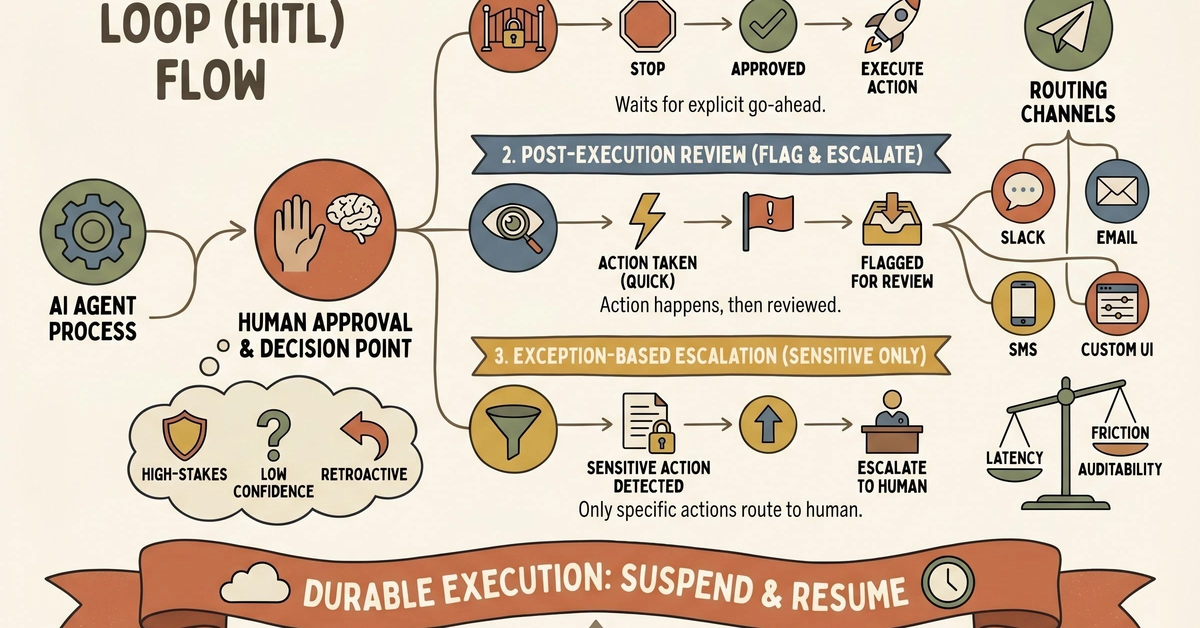
Human-in-the-loop (HITL) in AI means keeping a person involved in an automated system's decisions — approving, editing, or interrupting what an AI does — instead of letting it run fully on its own. For AI agents, human-in-the-loop is the practice of pausing the agent at chosen points so a human can review or steer an action before it takes effect. The hard part isn't adding a human; it's making sure that human can actually catch the mistakes that matter.
This guide explains what human-in-the-loop is, the three forms it takes in real AI agents, how it differs from full automation and human-on-the-loop, and — most importantly — why a review step is not the same as safety. Then it covers how to do HITL well, and when you should prevent a bad outcome instead of reviewing for it.
What human-in-the-loop actually means
The phrase comes from control systems and machine learning, where a "loop" is the cycle of an action, its result, and a correction. Putting a human in the loop means the cycle can't close without a person — the system stops and waits for input. Putting a human on the loop means the system runs autonomously while a person watches and can step in. Taking the human out of the loop means full automation.