This post originally appeared on tokenjam.dev/blog.
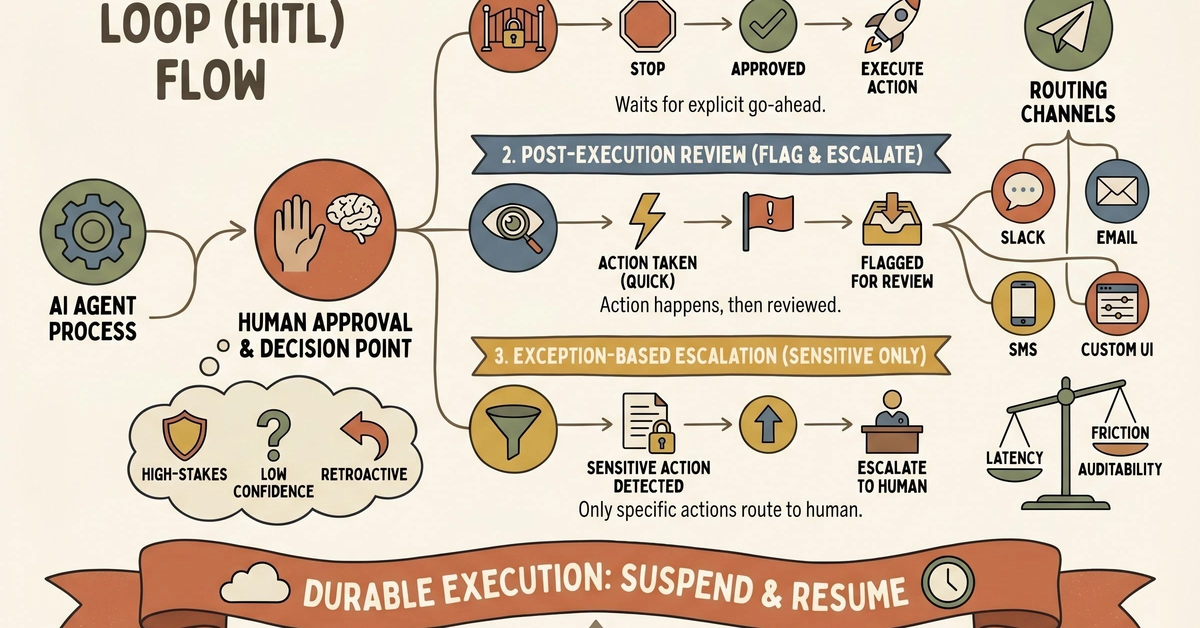
Human-in-the-loop (HITL) for AI agents means inserting human approval, review, or intervention into an agent's execution at specific decision points: before high-stakes actions, or when agent confidence is low. Rather than letting an agent act autonomously, HITL creates a checkpoint where a human must explicitly approve, review, or reject an action before or after it runs. For agents that act on the real world by sending emails, deleting data, or moving money, HITL is the difference between an agent you can trust in production and one you cannot.
Why HITL matters for production agents
Even well-tested agents make mistakes. A model might misinterpret a user request, hallucinate an action, or hit an edge case the training data never covered. In low-stakes contexts (generating a report, drafting an email), mistakes are annoying. In high-stakes contexts (sending customer communications, deleting database rows, initiating financial transfers), mistakes are costly.
Consider a customer-support agent that composes and sends email responses. The agent may be 99% accurate. That 1% error could send a rude or inaccurate message to a paying customer, damaging trust and creating extra work to undo. A financial agent may correctly categorize most transactions, and one misclassified refund could still throw off an audit. An administrative agent tasked with purging old files might delete something recent if its date parsing fails.