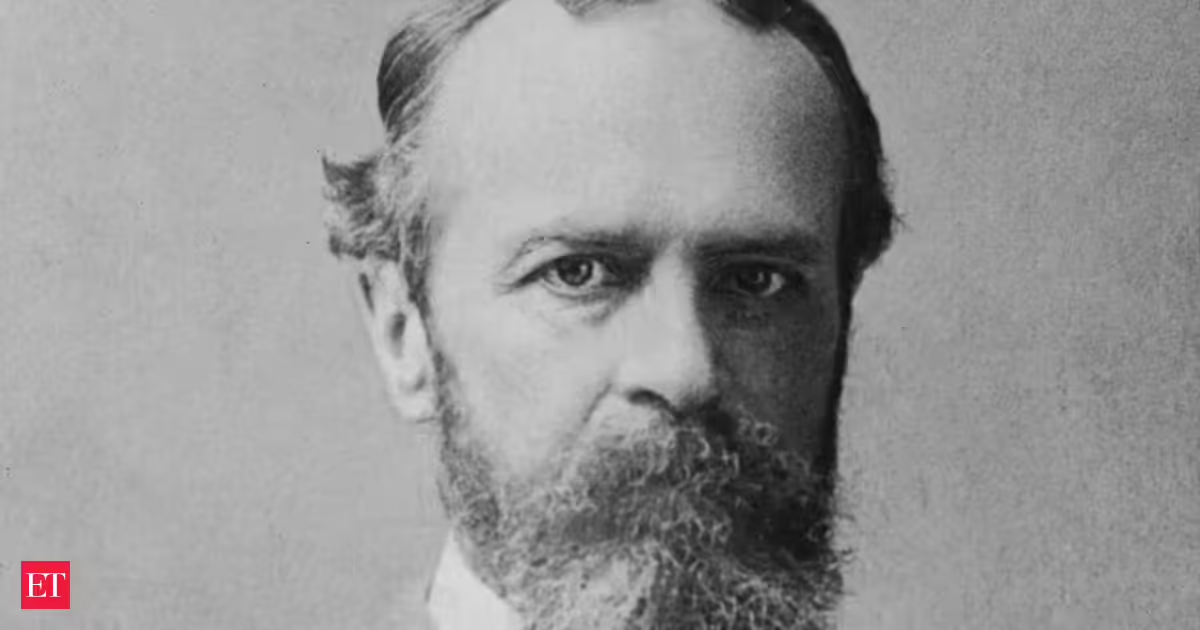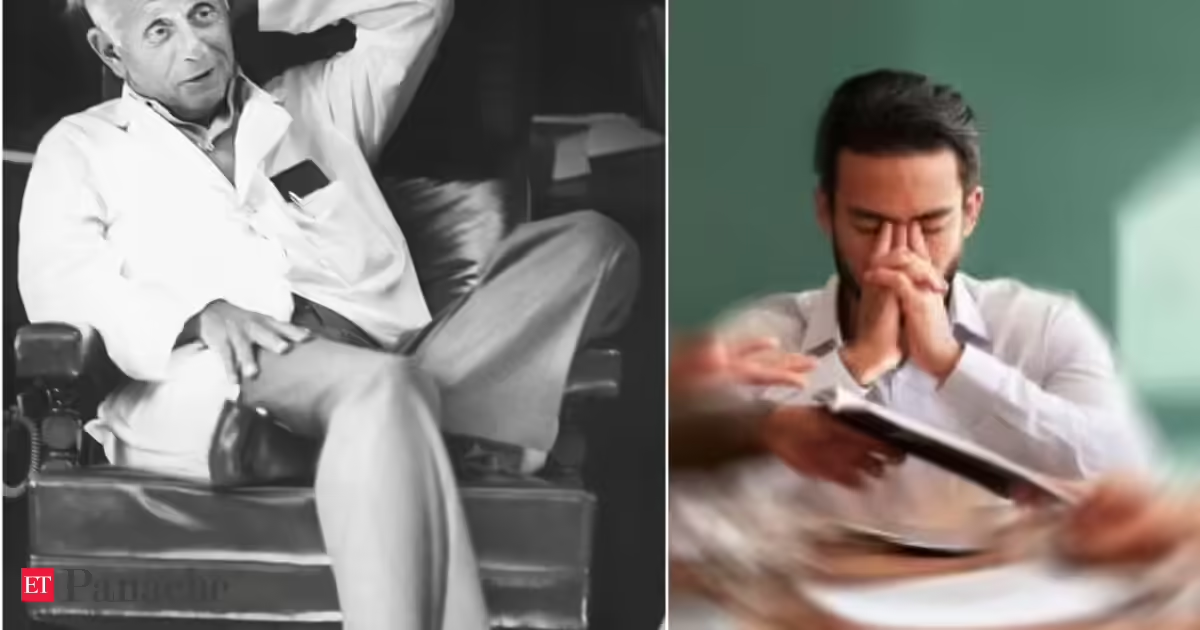
The very thought of being ‘stressed’ unsettles most of us. Not without reason. Stress causes a lot of mental anguish and sleepless nights. However, over 90 years ago, endocrinologist and psychologist Hans Seyle argued that stress was not something negative by default. In his article ‘Stress Without Distress’, he emphasised that stress was not simply nervous tension or the result of damage. In his seminal book ‘The Stress Of Life’ Seyle argued that stress was inevitable and should not be considered as a roadblock to success. He explained that stress takes us out of comfort zones and that is where learning takes place. The capacity to manage and adapt to stress is essential for survival and overall well-being. To help individuals deal with stressful situations, healthcare increasingly relies on a range of interventions, including medications, natural biological compounds, and psychological therapies. These approaches are designed to reduce the harmful impact of stress and strengthen an individual's ability to function effectively under pressure. Among the various options being explored, products containing cannabidiol (CBD) have gained considerable attention and popularity. As more countries and regions relax restrictions on cannabis use, scientific interest in its potential therapeutic applications has grown substantially. Researchers are increasingly examining the possible health benefits of CBD-based treatments, particularly their role in supporting stress management, promoting emotional balance, and helping people better cope with the physical and psychological challenges associated with stressful experiences.Quote Of The Day By Hans Seyle Will Change Your Mind About Stress!In his book Stress Without Distress, Seyle wrote: “Stress is not simply nervous tension, nor is it the result of damage. Above all, stress is not something to be necessarily avoided. It is associated with the expression of all of our innate drives. Stress ensues as long as a demand is made on any part of the body. Indeed, complete freedom from stress is death!’ AgenciesDeeper Meaning Of The QuoteSeyle’s words is a radical redefinition of the concept of stress. Instead of considering stress as inherently harmful, Seyle argues how stress is a part of being alive. Stress is not limited to anxiety, it is our natural response to challenges, Whether we are learning, creating, loving, competing, or striving toward a goal, stress accompanies our efforts.Growth is inextricably linked to stress. A life completely bereft of stress would inevitably be without accomplishments, ambition or purpose.Relevance Of The QuoteToday, many people strive to eliminate all stress from their lives, believing that complete relaxation is the key to happiness. However, the quote reminds us that stress is a natural consequence of living, growing, and pursuing meaningful goals.The quote asks us to manage stress and to try to channelise our stress into attempts of self-improvement. Stress can sharpen focus, galvanise us into action. It is stress that can make people more resilient, resourceful. Who Was Hans Seyle?Seyle was a celebrated Hungarian-Canadian endocrinologist whose area of expertise was the non specific response of organisms to stressors. He was born at Vienna, Austria. While working at the Dept of Biochemistry at McGill University, he observed that rats exposed to cold, drugs, exhibited a common pattern of responses to these stressors. At first he termed it as general adaptation syndrome, but later redefined it as ‘stress response’. He later adopted the term ‘stress’ which has been accepted into the lexicon of several languages. He argued that stress can be divided into two categories - negative stress is ‘distress’ and positive stress is ‘eustress’.The hypothalamic-pituitary-adrenal (HPA) axis, the body's central stress-response system, was also first identified and described by Selye. He is also credited with the discovery of the 'stress triad' (gastrointestinal ulceration, thymico-lymphatic atrophy and adrenal hypertrophy). He authored many popular books such as The Stress Of Life and Stress Without Distress. Selye received significant recognition from the scientific community for his pioneering work on stress and endocrinology. He was first nominated for the Nobel Prize in Physiology or Medicine in 1949. Over the course of his career, he accumulated an impressive total of 17 Nobel Prize nominations between 1949 and 1953, reflecting the profound influence of his research on medical science. He died in 1982, at the age of 75. Today, he is remembered as the ‘father of stress research’.While Dr Seyle never worked with patients, his general adaptation syndrome theory has helped countless psychologists observe how stress impacted patients in the form of heart attacks, high blood pressure and ulcers.
Quote of the day from 'father' of stress research Hans Seyle: 'Stress is not something to be avoided. Complete freedom from stress is...'; lessons on how to manage stress and anxiety from famous Canadian scholar
Over 90 years ago, Hans Selye challenged the notion that stress is inherently negative. He argued that stress is a natural part of life, essential for growth and accomplishment, and not something to be avoided. Selye's pioneering work identified the body's stress response system and distinguished between 'distress' and 'eustress'. His insights remain relevant today, encouraging us to manage and channel stress for self-improvement.
731 words~3 min read