AI scientists are emerging as a new interface for scientific computing. These agents can read papers, write code, generate hypotheses, call APIs, inspect files, and iterate on results. But science isn’t software engineering. There is no test suite that turns green when a hypothesis is correct; discovery is iterative, uncertain, and grounded in the physical world. You can’t take a general coding agent, point it at biology, and expect new medicines. In biomolecular research, the ceiling of an AI scientist’s capabilities is set by the scientific tools it can use reliably, correctly, and efficiently.
A general‑purpose agent may understand whether protein folding, molecular docking, molecular generation, sequence design, multiple sequence alignment, protein backbone generation, or genome modeling is relevant to a task. It needs help knowing which AI model to call, how to format the request, which input parameters matter, what artifact to expect, and how to interpret the result.
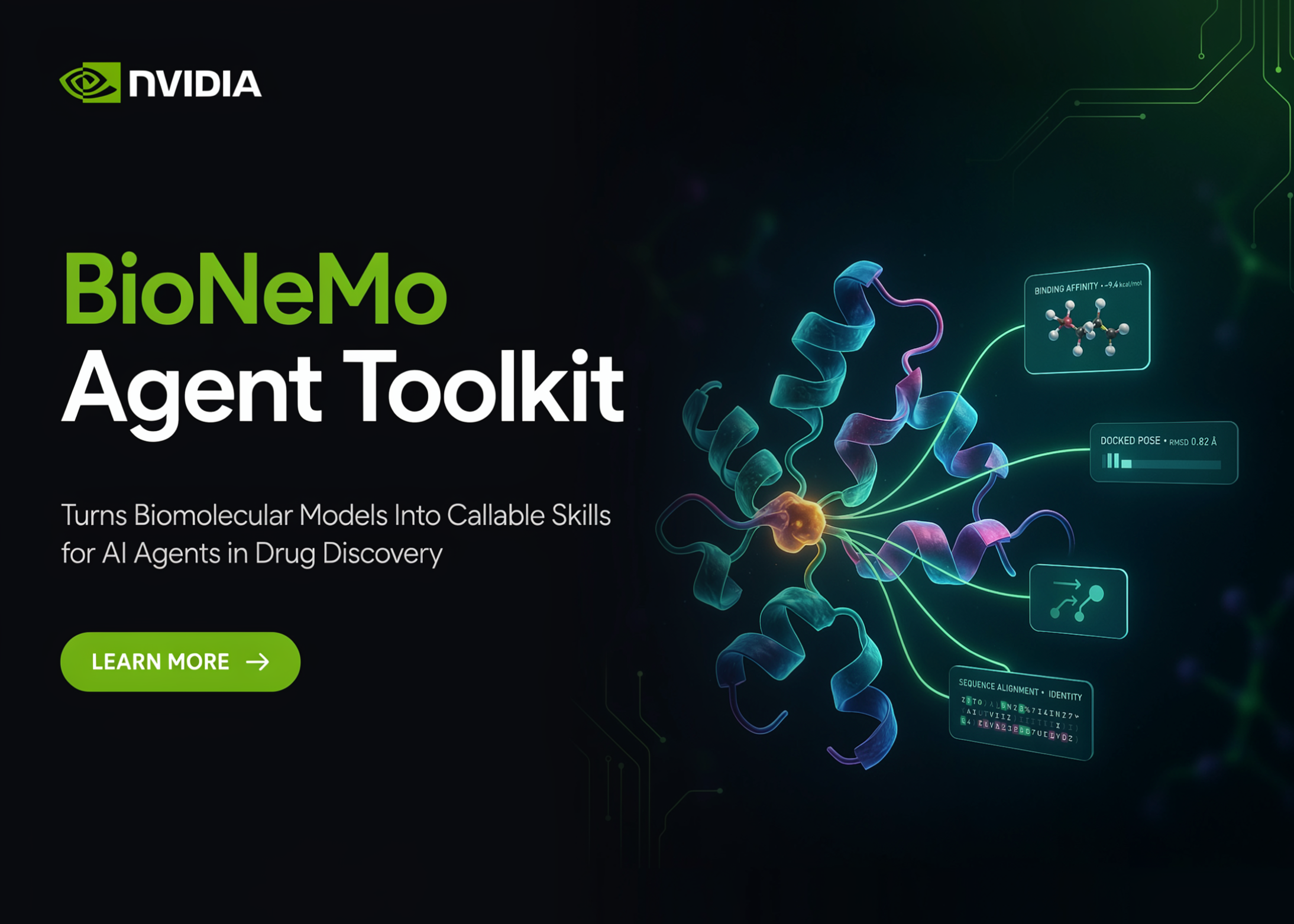
NVIDIA BioNeMo is the platform that closes that gap for any agent. It turns the NVIDIA accelerated digital‑biology stack into tools an AI scientist can use:
An accelerated tool layer: NVIDIA NIM and BioNeMo open models deliver core biomolecular capabilities as optimized, callable services, including structure prediction, docking, molecular generation, sequence design, alignment/search, and genomics. These capabilities are accelerated by NVIDIA libraries such as cuEquivariance (structure models) and Parabricks (genomics) rather than simply running on NVIDIA hardware.