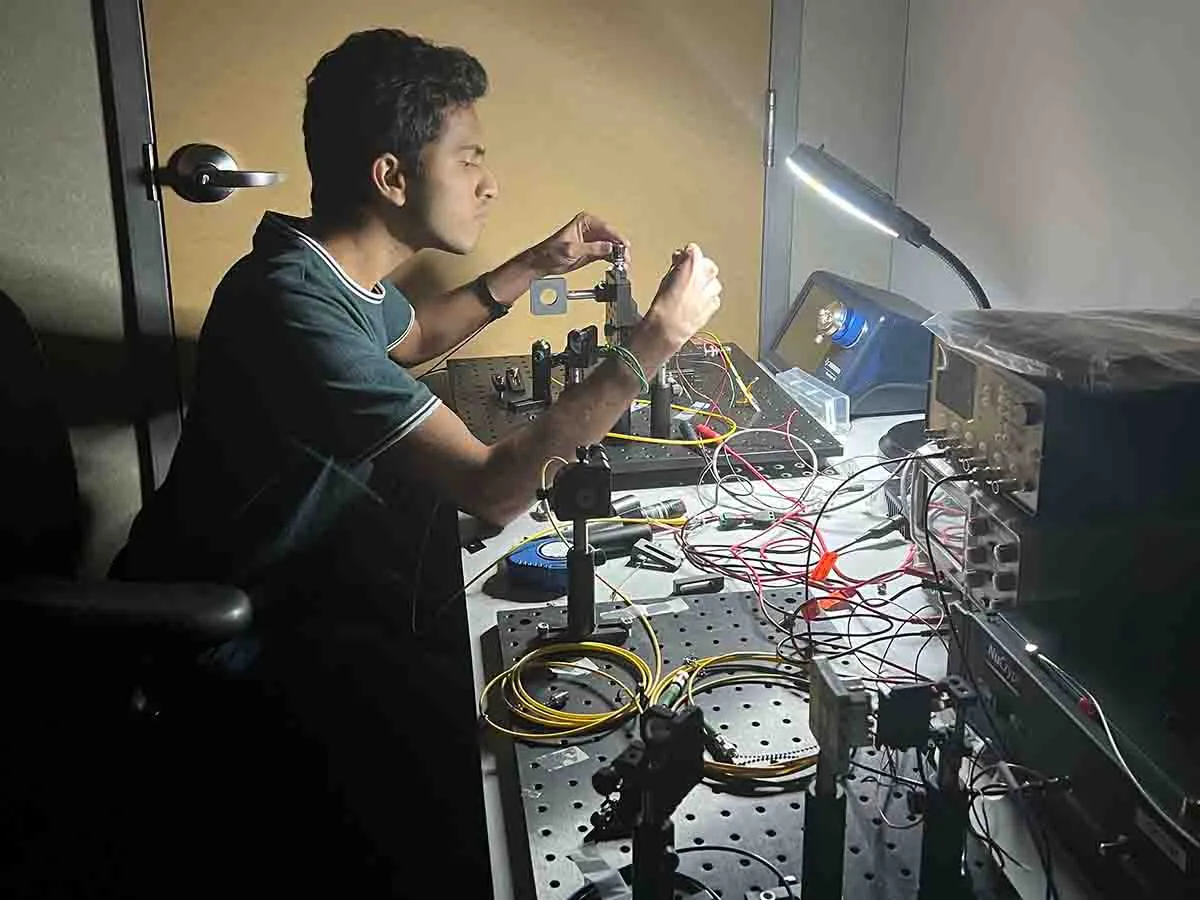
Skip to Content News Archives Economy Energy Oil & Gas Renewables Electric Vehicles Mining Commodities Agriculture Real Estate Mortgages Mortgage Rates Finance Banking Insurance Fintech Cryptocurrency Work Wealth Smart Money Wealth Management Investor Personal Finance Family Finance Retirement Taxes High Net Worth FP Comment Executive Women Puzzmo Newsletters Financial Times Business Essentials More Innovation Information Technology FP500 Podcasts Small Business Lives Told Tails Told Shopping Financial Post Store Obituaries Place a Notice Advertising Advertising With Us Advertising Solutions Postmedia Ad Manager Sponsorship Requests Classifieds Place a Classifieds ad Working Profile Settings My Subscriptions Saved Articles My Offers Newsletters Customer Service FAQ News Economy Energy Mining Real Estate Finance Work Wealth Investor FP Comment Executive Women Puzzmo Newsletters Financial Times Business Essentials HomeInnovationOntario startup aims to solve what may be the biggest threat to globally secure communicationQEYnet is developing a method to securely transmit encryption keys from space You can save this article by registering for free here. Or sign-in if you have an account.Kishore Nedumaran, a mechanical engineer at Maple, Ont.-based QEYnet, works on components for the company’s system to securely transmit communication encryption keys from space using quantum particles. Photo by Handout /QEYnetAn Ontario aerospace and defence startup is aiming to solve what may be the biggest threat to secure communications by using quantum technology based in space.Subscribe now to read the latest news in your city and across Canada.Exclusive articles from Barbara Shecter, Joe O'Connor, Gabriel Friedman, and others.Daily content from Financial Times, the world's leading global business publication.Unlimited online access to read articles from Financial Post, National Post and 15 news sites across Canada with one account.National Post ePaper, an electronic replica of the print edition to view on any device, share and comment on.Daily puzzles, including the New York Times Crossword.Subscribe now to read the latest news in your city and across Canada.Exclusive articles from Barbara Shecter, Joe O'Connor, Gabriel Friedman and others.Daily content from Financial Times, the world's leading global business publication.Unlimited online access to read articles from Financial Post, National Post and 15 news sites across Canada with one account.National Post ePaper, an electronic replica of the print edition to view on any device, share and comment on.Daily puzzles, including the New York Times Crossword.Create an account or sign in to continue with your reading experience.Access articles from across Canada with one account.Share your thoughts and join the conversation in the comments.Enjoy additional articles per month.Get email updates from your favourite authors.Create an account or sign in to continue with your reading experience.Access articles from across Canada with one accountShare your thoughts and join the conversation in the commentsEnjoy additional articles per monthGet email updates from your favourite authorsSign In or Create an AccountorMany fear quantum computers will be able to decrypt today’s encrypted data within the next decade or less, but Maple, Ont.-based QEYnet wants to use the laws of quantum physics to turn the table.“It’s really about future-proofing communications and the security around them,” said chief executive and co-founder Cordell Grant.Current methods use mathematical encryption formulas, or keys, to secure communications ranging from personal emails and online banking to business and government data to utility and health-care infrastructure. Though generally complex enough now to stop decryption by current computers, these mathematical keys are vulnerable to interception and decryption with quantum computing.Get the latest headlines, breaking news and columns.By signing up you consent to receive the above newsletter from Postmedia Network Inc.A welcome email is on its way. If you don't see it, please check your junk folder.The next issue of Top Stories will soon be in your inbox.We encountered an issue signing you up. Please try again“Quantum computers are coming. When they come, they’re going to overturn the apple cart, and all of the encryption that we do today is going to be thrown out the window and will need to be replaced,” said Grant.“People take secure communication for granted because it’s invisible to most people. When they log onto their banking website, they don’t realize that they are relying on encryption technology that’s at risk of being compromised in the future. They don’t realize that their banks are also relying on encryption internally,” he said.One of the methods to secure communications against vulnerability to quantum computing is through the use of quantum physics. QEYnet is developing a method to securely transmit encryption keys from space between two parties using quantum particles, such as photons of light.Quantum key distribution (QKD) is a method developed in the 1980s to use quantum physics to create encryption keys that are sensitive to “eavesdropping.”QKD uses the quantum characteristics of two particles, such as photons, to allow two parties to share a secret key, according to American cybersecurity company Palo Alto Networks Inc.On a quantum level, the photons exist in a state of uncertainty where the act of measuring them (locking them into a state of certainty) alters them, making an effort to intercept the key evident, according to International Business Machines Corp.The QKD technology is currently transmitted by terrestrial-fibre networks, the underground systems of cables that carry data using light particles.The problem with terrestrial-fibre networks is that photon signals degrade over large distances, so new sets of secret codes need to be generated when it travels more than 100 kilometres. This means higher system costs, possibility of fibre-tapping or physical damage to the cables.“As good as optical fibres are, the losses add up when you’re at the single-photon level, and beyond a couple of hundred kilometres at most, it just becomes impractical. That’s where satellites come in,” Grant said.QEY is developing a global QKD network using lower-cost microsatellites that generate photons that carry secret codes, or keys. These codes are sent down to secure receivers on Earth using highly precise lasers, said Grant.“You can use the satellite as a trusted node to bridge any two locations in Canada or within the world using that single satellite,” said Grant.Anyone who tries to intercept the communication will disturb the particles, producing a broken code that the sender and receiver can discard, the company said.According to the company website, “Neither QEYnet, nor anybody else, has the means to decrypt the keys since only the customer, who generated them in the first place, has the information needed to do so.”The company, which says it has 11 employees, was founded in 2016 by a team of researchers in quantum computing as well as spacecraft engineers from the Institute for Quantum Computing at the University of Waterloo.Research and development at QEYnet is led by co-founder Thomas Jennewein, a physicist at the University of Waterloo and a faculty member at the Institute for Quantum Computing. His team was awarded more than $7 million in funding, primarily by the Canadian government, to make advancements in satellite technology possible, the company said.“We’re at the stage of developing the technology, testing it in space and advancing towards operational implementation,” said Grant.The company has received funding from the Canadian Space Agency (CSA) and Department of National Defence. In 2025, the CSA awarded QEYnet $1.4 million to test the QKD technology in orbit.A satellite is expected to launch in 2027 and will be a year-long demonstration, Grant said.In the race to develop quantum secure technology, Grant said there is a push within Canada to develop domestic capabilities in space.“We’re growing more dependent on space infrastructure, meaning we’re more at risk if something goes wrong with it. There’s a lot of interest right now in finding ways to secure satellites and space infrastructure against cybersecurity threats.”He added, “I do see a world in which quantum communication is used by critical government infrastructure, like power plants and defence operations. In the future, systems that are being used to run the economy and the county are going to be relying heavily on quantum communication.” Join the Conversation This website uses cookies to personalize your content (including ads), and allows us to analyze our traffic. Read more about cookies here. By continuing to use our site, you agree to our Terms of Use and Privacy Policy.
Ontario startup aims to solve what may be the biggest threat to globally secure communication
Ontario aerospace and defence startup QEYnet is developing a method to securely transmit encryption keys from space. Find out more here.
1,334 words~6 min read