Prof. Negar Kiyavash has been awarded a prestigious European Research Council (ERC) Advanced Grant for her project Causal Inference for Exploration and Learning (CIEL), further strengthening EPFL’s presence among Europe’s leading research institutions.The European Research Council has awarded the ERC Advanced Grant 2025, one of Europe's most competitive research awards, to Prof. Negar Kiyavash for her project Causal Inference for Exploration and Learning (CIEL). The project was selected as part of the latest ERC Advanced Grant competition, which funded 319 researchers across Europe from a record 3,329 submitted proposals.Bringing causal reasoning to machine learningModern artificial intelligence systems have achieved remarkable success across a wide range of applications. However, most current machine learning methods remain largely incapable of performing causal reasoning—the ability to understand cause-and-effect relationships that underpins human decision-making.CIEL seeks to bridge this gap by systematically incorporating tools and principles from causal inference into modern learning systems. The project focuses particularly on sequential decision-making settings, including multi-armed bandits, reinforcement learning (RL), and large language models (LLMs).“We know that a true AI revolution can occur only when man-made systems acquire the ability to perform causal reasoning. Yet most machine learning algorithms are agnostic to causal reasoning,” says PI Prof. Kiyavash.She further explains: “This is partly due to the fact that historically, the two fields of machine learning and causality developed separately, but also because causal inference is inherently a hard problem.”Towards more reliable and efficient AI systemsThe project combines fundamental theoretical research with the development of practical algorithms that are both computationally efficient and data efficient. CIEL aims to enable machine learning systems to perform causal identification and exploration more effectively in complex and uncertain environments.By integrating causal reasoning into learning and decision-making, the research has the potential to significantly advance the capabilities, reliability, and interpretability of future AI systems. The project is expected to open new avenues at the intersection of machine learning, causality, and sequential decision-making, further strengthening Europe's leadership in frontier AI research.About the ERC Advanced GrantsERC Advanced Grants support established research leaders with a recognized track record of significant research achievements. The grants enable leading scientists to pursue ambitious, high-risk, high-gain projects that have the potential to lead to major scientific breakthroughs.The ERC, set up by the European Union in 2007, is the premier European funding organisation for excellent frontier research. It funds creative researchers of any nationality and age, to run projects based across Europe. The ERC offers four core grant schemes: Starting Grants, Consolidator Grants, Advanced Grants and Synergy Grants. With its additional Proof of Concept Grant scheme, the ERC helps grantees to bridge the gap between their pioneering research and early phases of its commercialisation. The ERC is led by an independent governing body, the Scientific Council. The overall ERC budget from 2021 to 2027 is more than €16 billion, as part of the Horizon Europe programme, which is under the responsibility of Ekaterina Zaharieva, European Commissioner for Startups, Research and Innovation.
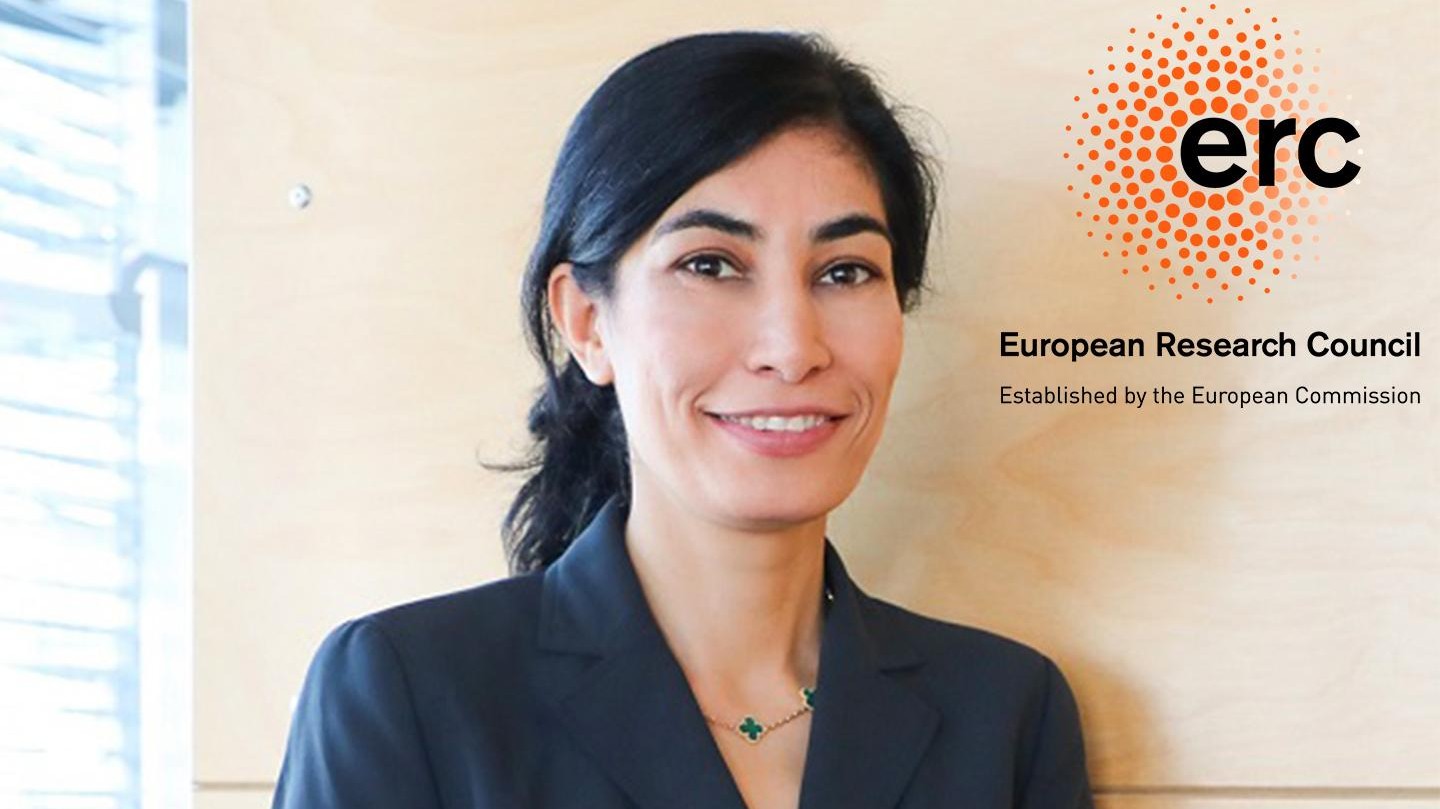
Professor Negar Kiyavash awarded an ERC Advanced Grant
Prof. Negar Kiyavash has been awarded a prestigious European Research Council (ERC) Advanced Grant for her project Causal Inference for Exploration and Learning (CIEL), further strengthening EPFL’s presence among Europe’s leading research institutions.
488 words~2 min read