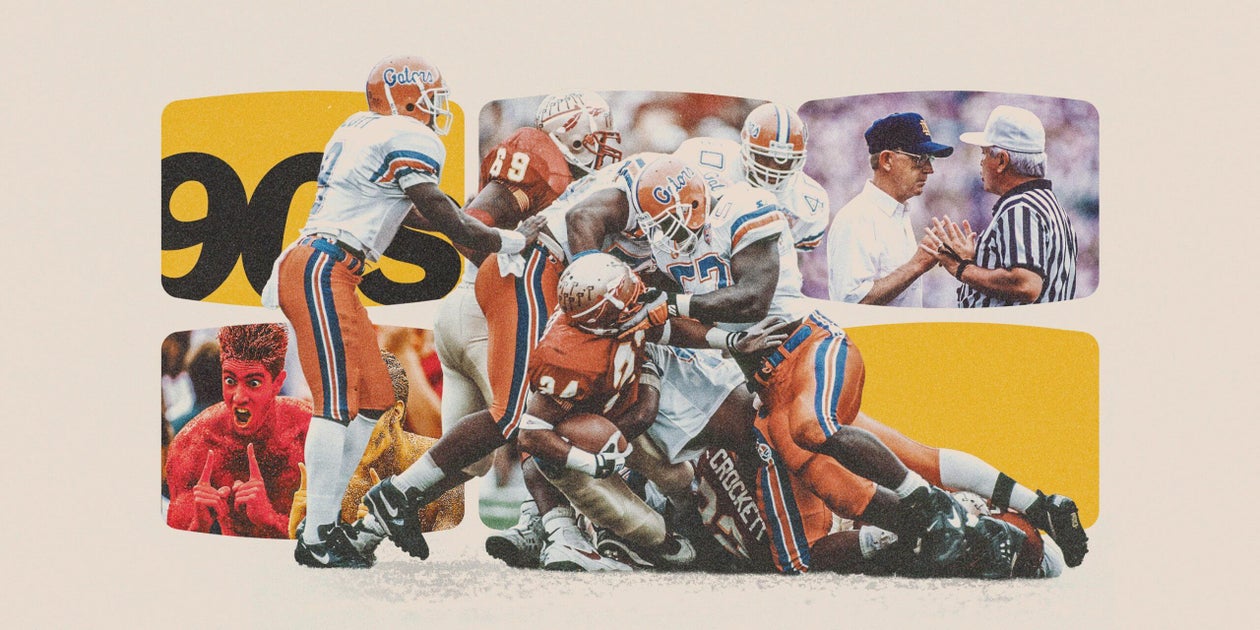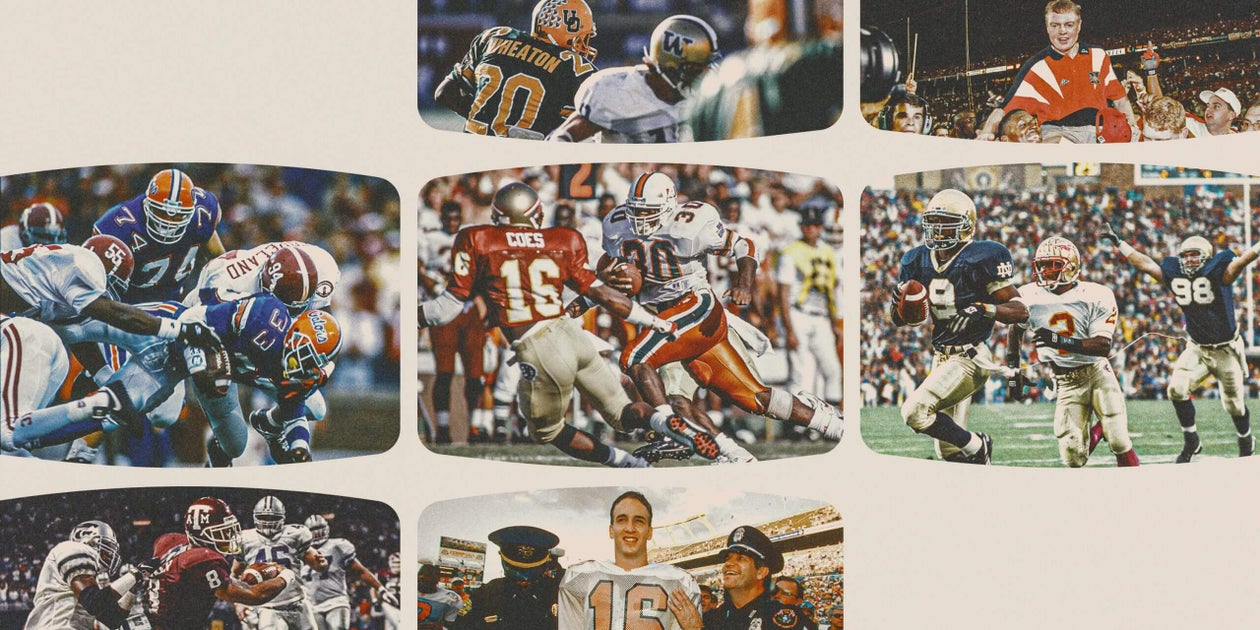
Editor’s note: As the World Cup continues in the United States for the first time since 1994, The Athletic is looking back at college sports in the 1990s and how much has changed since then. Join us for a couple of weeks of offseason football and basketball nostalgia.It was New Year’s night, 1992. Undefeated Miami had just blanked No. 11 Nebraska 22-0 in the Orange Bowl and would wait until the next day to learn whether it finished No. 1 in the AP poll. Its competition? The No. 1 team in the coaches poll, undefeated Washington, had demolished No. 4 Michigan 34-14 in the Rose Bowl.It just so happened that the Cornhuskers had also played the Huskies earlier that season, losing 36-21. In a forlorn Nebraska locker room, fullback Lance Lewis assessed his team’s 9-2-1 season.“We really have nothing to hang our heads about,” he told reporters. “We’ve lost to the two No. 1 teams in the nation.”If you happen to be reading this story under the age of about 35, yes, this is really how college football worked through most of the 1990s. You could reach the end of the season, after everyone had played their final games, and still have two No. 1 teams. Both Miami and Washington remained where they were in the final polls that season. To this day, both are considered the 1991 national champions.What you might find even crazier is that the participants themselves were fine with never definitively knowing which team was better.“I think two champions was the fair way to do it,” Washington center Ed Cunningham said at the time. “Leaving either team with nothing would have been wrong.”“Believe me, I’m not complaining,” Miami coach Dennis Erickson said. “We don’t want to take anything away from Washington. We both had great seasons.”The rest of the public, on the other hand, was very much complaining. Just as they were the year before when Colorado (AP) and Georgia Tech (coaches) shared the crown, or in 1997 when it was Michigan (AP) and Nebraska (coaches).“Just decide, if you had one game to play with your job on the line, who would you rather play, us or Michigan?” Huskers quarterback Scott Frost said after his team’s Orange Bowl win over Tennessee when asked what he’d tell the voters.By the time of that split decision, the sport’s power brokers had already agreed to form the Bowl Championship Series, which began with the 1998 season. For the first time, the No. 1 and No. 2 teams were guaranteed to face each other in a major bowl game. Problem was, most of the time people couldn’t agree on who should be the No. 2 team. There was even one more split title in 2003, when USC finished No. 3 in the BCS standings but No. 1 in the AP poll.But that system still hung around for 16 years, until the dawn of the four-team College Football Playoff in 2014. Surely now there would be no more controversies, right?Wrong. As recently as 2023 — a full 25 years after the first BCS season — many folks were outraged when the selection committee left out 13-0 Florida State due to the fact its starting quarterback, Jordan Travis, got hurt late in the season.No worries. A year later, the CFP tripled in size to 12 teams. Surely now there would be no concerns whatsoever that a potential national champion might be squeezed out.Nope. In 2025, a Notre Dame team that started 0-2 but then dominated its last 10 games, moving to as high as No. 3 in various computer ratings, fell out of the committee’s field at the 11th hour while a three-loss Alabama team that got waxed by Georgia in its conference championship game held at No. 9.“You ask anybody in college football, we’re one of the best teams in the country,” Notre Dame AD Pete Bevacqua said after the Irish’s snub. “We’re one of those handful of teams that can absolutely win the national championship this year.”Now, only a few months later, Bevacqua and three of the four P4 commissioners suddenly support doubling the size of the CFP to 24. With which there will inevitably be more discontent and angst, at which point they’ll move to a World Cup-sized 48.All of which got me to thinking: Were split national championships really so bad?Unbeaten Michigan won the Rose Bowl against Washington State but split the 1997 national title with Nebraska. (Brian Bahr / Allsport via Getty Images)College football is such an amazing sport for so many reasons, but every season, starting in early November, it also makes people completely miserable. Lord knows how many years of a college football fan’s life have been spent bemoaning whatever system was in place that year to determine the national champion.With the BCS, it was the overly complicated computer formula — which seemed to change every year — and the fact there were only two teams that drove people mad.Then came the CFP selection committee, with the endless conspiracy theories about SEC favoritism and seemingly ever-shifting criteria.Now, 12 teams have only exacerbated criticism of the committee — see the five-week meltdown last season over their ignoring the Miami-Notre Dame head-to-head result — with a side serving of G5 backlash and complaints about the scheduleLooking back now, the pre-BCS controversies of the ’90s seem quaint. Folks around the sport weren’t tearing their hair out trying to invent the perfect system to crown a champion. Quite the opposite, actually: They weren’t even trying.The Big Ten and Pac-10 champs went to the Rose Bowl. Big Eight champ and, usually, Florida State, Miami or Notre Dame, to the Orange Bowl. SEC champ to the Sugar Bowl. Hold a vote afterward. If the coaches and the sportswriters disagreed, oh well, two title-holders.“I’ve never had a problem with a split national championship,” the legendary college football writer Dan Jenkins liked to say. “It just means more people get to buy bumper stickers.”The most divisive controversy of the ’90s involved a team that didn’t split a national championship: 1994 Penn State. The Nittany Lions went 12-0 that season, but Nebraska went 13-0. (It played an extra game in the long-defunct Kickoff Classic.) The Huskers made their closing statement by beating No. 3 Miami in the Orange Bowl, while Big Ten champion Penn State was obligated to face 11th-ranked Oregon in the Rose Bowl.Nebraska finished No. 1 in both major polls. Thirty-two years later, many analytics suggest Penn State was actually the better team.“It just seems like a major shortcoming in college football,” Penn State QB Kerry Collins said at the time. “(No. 1) is decided by people who have nothing to do with what goes on. That’s a real shame.”Today, the national champion is in theory decided on the field, but we’ve yet to find a suitable alternative to “people who have nothing to do with what goes on” choosing the participants.So, if we agree that at least some element of subjectivity is unavoidable in college football, perhaps naming more than one champion was actually a form of self-awareness. As in, we can’t possibly be sure which of these two teams that played completely different schedules is better than the other, so why try?Of course, one could also posit that the sport wasted 60 years sending its two-to-four best teams off to random bowl games rather than just pitting them against each other.Whichever your preference, you’re really just picking your more-tolerable form of angst.Personally, I’m split.
Split national titles tore college football apart in the 1990s. Were they really so bad?
For most of college football history, teams could split national titles. Was it really so bad?
1,244 words~6 min read