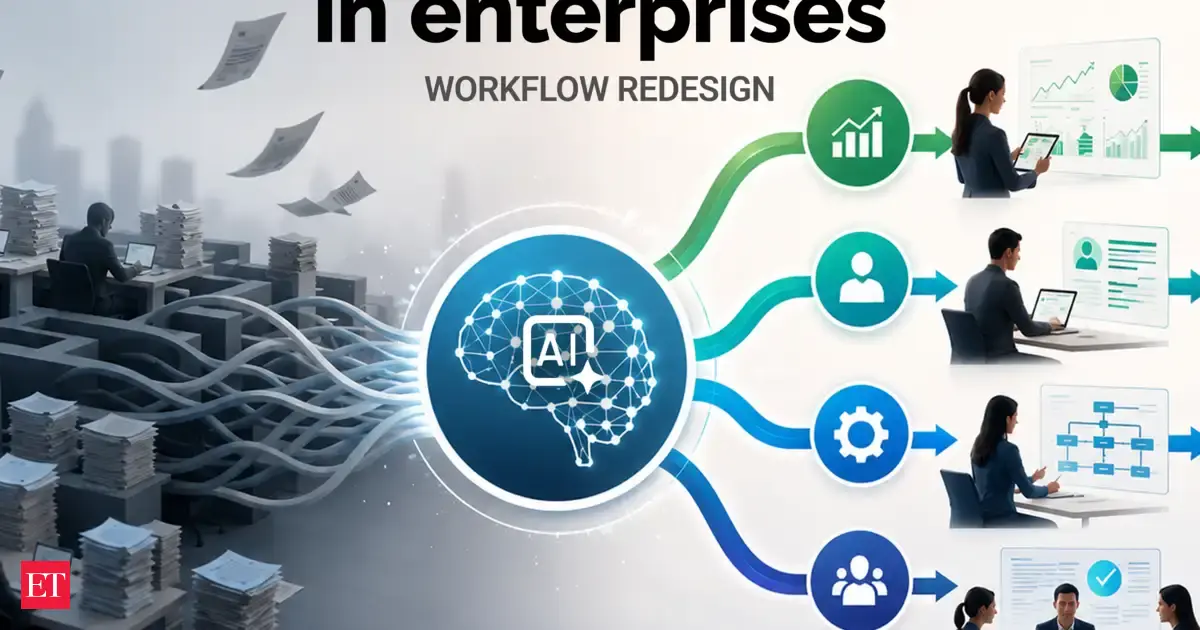
For the last two years, the dominant story about AI has been straightforward: It can help people work faster, automate repetitive tasks, generate content, improve productivity, and lower costs. AI (iStock)What many companies still underestimate is that AI is not simply another enterprise tool. It is a new layer of scalable intelligence. And once intelligence becomes abundant, affordable, and increasingly on demand, the question is no longer, “Where can AI help my teams save time?” It becomes, “How does AI change how work is designed, how decisions get made, and how value is created across the business?”According to McKinsey, nearly all companies are investing in AI and 92% plan to increase those investments over the next three years. Yet only 1% of business leaders consider their organizations mature in AI deployment, meaning AI is fully integrated into workflows and driving substantial business outcomes.AI is everywhere, but repeatable enterprise value is not.First, AI presence is not the same as AI advantage. A company may have thousands of employees using AI tools and still fail to change any material business outcome if those tools remain disconnected from core workflows and enterprise data.Second, the value gap is widening. A relatively small group of firms is generating outsize gains because they have progressed from experimentation to capability building. They invest in leadership alignment, process redesign, data architecture, and governance as seriously as they invest in models. These firms are not using AI only to lower effort; they are using it to reconfigure how decisions are made and how value flows across the enterprise.Third, organisations are finding that their biggest limitation is not process inefficiency, but the finite capacity of skilled talent. Knowledge workers are overloaded, interrupted, and stretched across too many low-value cognitive tasks. AI, therefore, matters not simply as an automation tool, but to redistribute work, so humans spend more time where judgment, creativity, empathy, and domain expertise matter most.Fourth, governance has become inseparable from value realisation. As AI moves into customer-facing, regulated, and high-stakes decision-making, trustworthiness, transparency, oversight, and security are no longer afterthoughts. Companies that embed governance into the design and development of AI systems, rather than treating it as a compliance requirement later in the process, will be better positioned to scale with confidence and speed.Fifth, model quality is improving, costs are falling, and capabilities are becoming more accessible. This means competitive differentiation shifts away from simple access to models and toward the enterprise disciplines that turn models into measurable outcomes.Thinking differently begins with changing the unit of analysis. Instead of asking, “Which use cases should we try?” leaders should ask, “Which value pools can we materially change?” Revenue growth, service quality, cost-to-serve, risk posture, speed-to-market, and knowledge reuse are better anchors than generic lists of possible applications.It also means moving from AI as assistant to AI in the workflow. Enterprise value emerges when AI is embedded in how decisions move, how work gets routed, how exceptions are handled, and how cross-functional processes are executed from end to end.A third shift is from general AI to domain-specific intelligence. Value at scale comes when models understand the enterprise context: policies, terminology, customer segments, operating rules, product structures, historical decisions, and risk constraints. A fourth shift is from technology deployment to operating model redesign. Decision rights, accountability, metrics, escalation paths, and human oversight all need to evolve when AI becomes part of how work gets done. Treating AI as a technical implementation without corresponding organisational change is one of the clearest ways to cap value.Finally, companies must move from experimentation to capability building. Successful enterprises create repeatable patterns for intake, prioritisation, governance, model management, deployment, adoption, and benefits tracking. To begin with, establish a single enterprise AI thesis tied to strategy. Avoid a fragmented portfolio of pilots with no common value architecture.In addition, choose a small number of high-value workflows to redesign end to end. Do not measure success only in minutes saved; measure throughput, customer outcomes, and financial impact.Equally important, strengthen governance and trust foundations early. Embed human oversight, security, auditability, and policy controls into the lifecycle.Further, invest in workforce readiness with the same seriousness as technology readiness. Managers are a critical multiplier in scaling adoption and trust.Finally, create a repeatable value realization engine: intake, prioritisation, delivery, adoption, controls, and benefits tracking that can be reused across business domains.The market has already heard the benefit narrative: AI can make work faster, cheaper, and easier. That remains true, but it is no longer decisive. The more important reality is that AI is reshaping how intelligence is accessed, how work is organised, and how enterprise value is created. The next winners will not be the ones using AI to do the same work faster. They will be the ones redesigning work altogether.Thinking differently about AI is no longer optional. It is now the difference between incremental improvement and strategic advantage.(The views expressed are personal)This article is authored by David P. Spencer, head, Sales Enablement & Growth, Sonata Software.
Why companies need to think differently about AI
This article is authored by David P. Spencer, head, Sales Enablement & Growth, Sonata Software.
825 words~4 min read