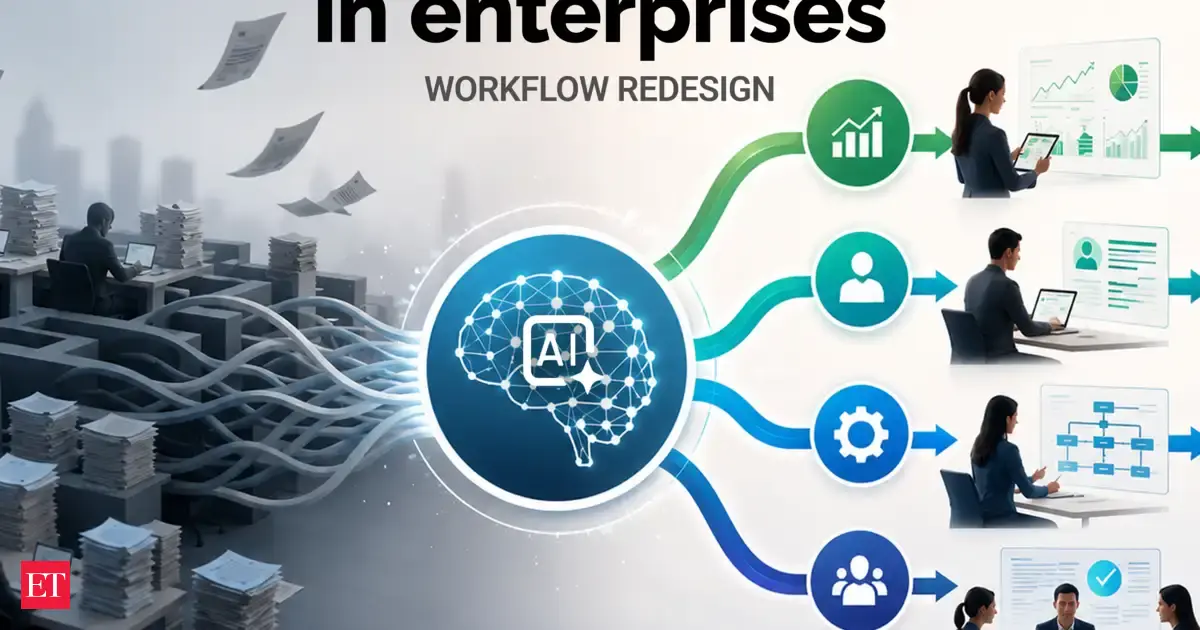
SynopsisAI adoption is moving from tools to transformation. Real value now depends on redesigning workflows, decisions, and skills around AI. The challenge is aligning people and legacy systems with intelligent operations. As automation expands, enterprises are shifting from efficiency to system-level redesign, reshaping how they work and compete.ET OnlineAI adoption across enterprises is no longer a question of experimentation. It has entered a phase where impact is determined less by technology deployment and more by how effectively organisations reshape work, skills, and leadership around it.A recent perspective highlighted in industry discussions around AI transformation reinforces a critical shift: most AI initiatives do not fail due to model limitations, but because of human and organisational alignment gaps. In other words, the challenge is not artificial intelligence itself, it is the operating environment into which it is introduced.Across large enterprises, AI is being embedded into workflows ranging from customer operations and finance to HR and product development. Yet, while tools are becoming more advanced, value realisation often remains uneven. The reason is increasingly clear: AI is frequently layered onto legacy systems that were never designed for intelligent automation or rapid decision-making.This is prompting a rethink of how work is structured. Instead of focusing purely on efficiency gains, organisations are beginning to redesign workflows end-to-end. Routine tasks are being automated, but more importantly, decision flows are becoming more streamlined, data-driven, and less hierarchical. This shift is allowing enterprises to move from task optimisation to system-level optimisation.At the same time, the workforce equation is evolving. The conversation is moving beyond traditional reskilling programmes toward continuous capability building. As AI takes over repetitive and rule-based work, employees are increasingly expected to operate in hybrid roles that combine domain expertise with the ability to work alongside intelligent systems. This is not only changing job descriptions but also redefining career progression models.Human resources functions are playing a more strategic role in this transition. Rather than focusing solely on talent management, HR is becoming central to designing AI-enabled operating models. This includes shaping governance frameworks, enabling adoption, and ensuring that trust between employees and AI systems is actively built rather than assumed.Culturally, organisations are also shifting their approach. The most effective AI adopters are not those that enforce usage mandates, but those that encourage experimentation and participation. Employees are increasingly being positioned as active contributors in shaping how AI is integrated into their workflows, leading to higher engagement and faster adoption cycles.The broader implication is that AI transformation is not simply a technology rollout. It is an organisational redesign exercise. Enterprises that succeed will be those that treat AI not as a tool to be implemented, but as a capability to be embedded across systems, people, and processes.As adoption deepens, one reality is becoming evident that AI is not replacing organisations it is reshaping how they function. The competitive advantage will belong to those that can align technology with talent and redesign work at the same pace as intelligence evolves.Also Read:Why AI-driven enterprises are moving beyond meeting-heavy work culturesWhy recruitment is moving beyond resumes and into real-time buildingAI’s next leap is proactivity, says Anthropic’s Claude Code Chief Cat Wu Disclaimer Statement: This content is authored by a 3rd party. The views expressed here are that of the respective authors/ entities and do not represent the views of Economic Times (ET). ET does not guarantee, vouch for or endorse any of its contents nor is responsible for them in any manner whatsoever. Please take all steps necessary to ascertain that any information and content provided is correct, updated, and verified. ET hereby disclaims any and all warranties, express or implied, relating to the report and any content therein.Read More News onRead More News on
AI Adoption in Enterprises: The Real AI Transformation Challenge Is Workflow Redesign, Not Technology
Enterprise AI adoption is accelerating, but success now depends on workflow redesign, intelligent automation, workforce transformation, and leadership alignment to unlock AI’s full value.
615 words~3 min read