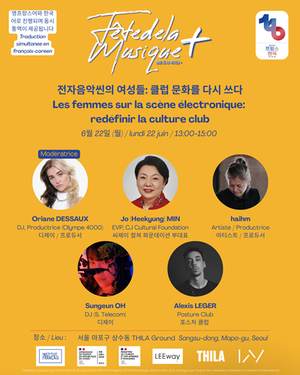
Women in the electronic music scene: Redefining club culture (Embassy of France in Korea) Sustainability remains a major challenge for women seeking long-term careers in electronic music, speakers said during a panel discussion Monday as part of Fete de la Musique+, a monthlong event hosted by the French Embassy.Moderated by French musician Oriane Dessaux, the discussion examined the role of women in contemporary culture and the obstacles they face in sustaining music careers.Panelists included artists Oh Sung-eun, known as S.Telecom, and Haihm; Alexis Leger, founder of Posture Club; and Min Hee-kyung, executive vice president of CJ Cultural Foundation.Leger, a music events promoter in Korea, said women play important roles in the country's club culture as both organizers and audience members."There are still clubs where only male musicians perform. At the same time, efforts are being made to include more women in lineups," Leger said. "Behind the scenes, more women are organizing parties and producing events. However, there is currently no woman who owns an underground club."Oh, who began her DJ career in France before moving to Korea 14 years ago, shared a similar view."The presence of female artists is no longer seen as unusual," Oh said. "While preparing for today's discussion, I found myself asking where women stand in this culture."She noted that men continue to dominate many areas of the industry, including club management, DJ residencies, curation, record labels and sound engineering."It's not about feeling uncomfortable with having more men," Oh said. "It provides insight into where women stand today." Oriane Dessaux (left), Haihm, Min Hee-kyung, Oh Sung-eun and Alexis Leger speak at Fete de la Musique+ on Monday. (Cha Min-jung/The Korea Herald) Breaking into the Korean music industry is not necessarily a major hurdle for female artists at the start of their careers. Sustaining a career as an independent musician, however, is often far more difficult.Haihm left the K-pop industry and moved into electronic music a decade ago. She recalls many female artists starting out alongside her, but says few remain active today."There is no discrimination against or exclusion of female artists on stage, but maintaining a long-term career while achieving financial stability remains difficult," she said."Income is not always guaranteed," she added. "Especially for artists like me who make experimental music and remain in the underground scene, it's not easy. I rely heavily on my boyfriend's support."Haihm said such career interruptions are not unique to the music industry, drawing parallels with the challenges many women face in maintaining careers after marriage or childbirth.Oh works a part-time job to support her music career. In France, she was signed to Pedro Booking, an agency that provided opportunities to perform and earn income. In Korea, where a similar agency system is less common for DJs, she said she must rely on part-time work to support herself while studying music production."If there were a more flexible system in Korea and DJs had more opportunities to earn a stable income, I wouldn't have to take on a part-time job," she said. Min Hee-kyung (left), Haihm, Oriane Dessaux, Oh Sung-eun and Alexis Leger participate in Fete de la Musique+ on Monday. (Cha Min-jung/The Korea Herald) Min, the executive vice president of CJ Cultural Foundation, says programs such as theirs could help support emerging artists."There are so many talented artists. We hope to provide them with more opportunities to grow by giving them more chances to perform, lending them stages and providing financial support," Min said. "The truth is that, for women, there are a lot more breaks in their career.""Many male artists are able to rely on dedicated (moral) support from their spouses. Female artists rarely have that luxury," she said. "(That kind of) support from those around seems to be crucial to the stage where a livelihood can be sustained."CJ Cultural Foundation supports indie artists of various genres by funding their albums and live performances. Since 2010, the Tune Up growth program has supported 218 artists including Hanroro, Redoor and MRCH.
Women in electronic music face long-term career hurdles, panelists say
Sustainability remains a major challenge for women seeking long-term careers in electronic music, speakers said during a panel discussion Monday as part of Fete
660 words~3 min read