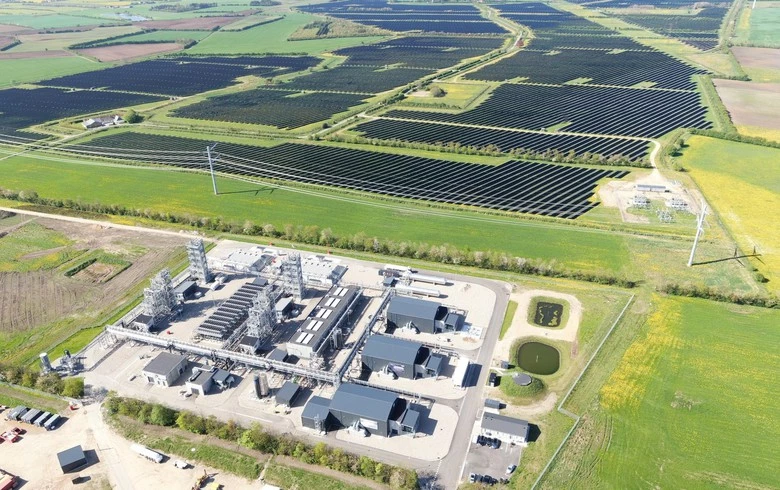
For the past few years, hydrogen has suffered from a credibility problem.Not because the technology itself stopped making sense, but because expectations ran too far ahead of reality. Governments announced hydrogen strategies worth hundreds of billions of euros. Companies unveiled ambitious projects stretching from Portugal to Poland. Analysts forecast a future hydrogen economy that would decarbonize everything from steel and chemicals to shipping and aviation.Then came the inevitable correction.Costs remained higher than expected. Financing became more difficult as interest rates increased. Several flagship projects were delayed, downsized, or quietly abandoned. Investors began asking uncomfortable questions about whether hydrogen would ever become commercially viable without permanent government support.As a result, hydrogen gradually became one of the energy transition's most questioned technologies. Not because it lacked potential, but because many people began wondering whether the market would ever move beyond announcements and PowerPoint presentations.That is precisely why the latest development between Denmark and Germany matters.Three Danish hydrogen projects have secured a combined €1.3 billion in German subsidies, with Everfuel receiving €244.9 million, European Energy €228 million, and Copenhagen Infrastructure Partners (CIP) securing approximately €777 million. The projects will ultimately supply green hydrogen to Germany through the planned Danish Hydrogen Backbone, which is expected to become operational before the end of this decade.At first glance, this may appear to be another subsidy announcement in a sector that has seen plenty of those already.In reality, it represents something much more significant: Europe's first serious attempt to build a functioning international hydrogen market.Solving Hydrogen's Chicken-and-Egg ProblemThe greatest challenge facing hydrogen was never the electrolyzer.Nor was it the availability of renewable electricity.The real problem was that nobody wanted to move first.Hydrogen producers hesitated because there was insufficient demand certainty. Industrial consumers hesitated because they could not be sure reliable supplies would exist. Infrastructure developers waited for production projects, while project developers waited for pipelines.The result was a classic chicken-and-egg problem that has slowed countless industrial transitions throughout history.What Germany has effectively done through this funding mechanism is reduce that uncertainty across the entire value chain.Suddenly, producers can see a market. Industrial users can see future supply. Infrastructure developers can see future volumes. Investors can see future cash flows. That is why Hydrogen Denmark CEO Tejs Laustsen Jensen described the announcement as fundamentally changing the investment landscape. Once production support and demand support start appearing simultaneously, projects become less speculative and more bankable.That shift may sound technical, but it is precisely how industrial revolutions begin.Denmark's Next Energy Success StoryWhat makes the announcement particularly interesting is the role Denmark is carving out for itself.For decades, Denmark has consistently punched above its weight in energy markets. The country helped pioneer modern wind power long before offshore wind became one of Europe's most important energy industries. Today, Danish expertise, companies, and supply chains can be found across the global renewable energy sector.Hydrogen increasingly looks like the next chapter in that story.The projects receiving support are substantial. Everfuel's Frigg project begins with a 200 MW electrolyzer facility but could eventually reach 2 GW. European Energy is expanding its existing Kassø facility, which already produces hydrogen for e-methanol production. Meanwhile, CIP's Høst project in Esbjerg secured the largest share of support, reflecting both its scale and strategic importance.These are not pilot projects designed to test a technology.They are industrial facilities designed to supply one of Europe's largest economies.That distinction matters enormously because it signals a transition from experimentation to deployment.Germany's Industrial RealityGermany's motivation is equally revealing.The country has become increasingly aware that electrification alone will not fully decarbonize its industrial base. Renewable electricity can solve many problems, but sectors such as steel, chemicals, refining, fertilizers, and other high-temperature industrial processes require something more than electrons.They require molecules.Hydrogen is increasingly viewed as one of the few realistic pathways for decarbonizing these sectors while preserving industrial competitiveness. Yet Germany also recognizes that domestic production alone will likely be insufficient to satisfy future demand.The solution increasingly resembles Europe's historical approach to natural gas: import energy from neighboring countries through dedicated infrastructure.Only this time the molecules are green.In many ways, the emerging Denmark-Germany hydrogen corridor resembles the early development of Europe's gas network several decades ago. The difference is that instead of connecting gas fields to industrial centers, the infrastructure will connect renewable energy resources to industrial demand.The Pipeline Matters More Than the ElectrolyzersPerhaps the most important aspect of the entire announcement is not the production facilities themselves but the infrastructure connecting them.Energy history repeatedly demonstrates that technologies become transformative only when infrastructure scales alongside them.Oil became dominant because pipelines, ports, refineries, and distribution networks emerged around it. Natural gas expanded because transmission systems connected producers and consumers across national borders.Hydrogen will be no different.The Danish Hydrogen Backbone may ultimately prove more important than any individual project connected to it. Once a pipeline exists, future projects become easier to finance. New industrial customers gain confidence to convert operations. Additional production facilities become less risky to develop.Infrastructure creates optionality, and optionality attracts investment.That is why this announcement should be viewed as more than support for three hydrogen projects. It is effectively support for an entirely new industrial energy system.Europe's Hydrogen Revival?Over the past two years, many observers have questioned whether Europe's hydrogen ambitions were unrealistic. Some skepticism was justified. Timelines proved overly optimistic, costs remained stubbornly high, and the market needed a reality check after years of exuberance.But corrections are not the same as failures.The strongest energy transitions rarely follow a straight line. They move through cycles of hype, disappointment, consolidation, and eventual maturity. Offshore wind followed exactly that trajectory. Solar power did as well.Hydrogen increasingly appears to be entering that final phase.The latest Danish-German agreement does not mean Europe suddenly has a thriving hydrogen economy. Costs remain challenging, infrastructure still needs to be built, and demand must continue developing.What it does mean is that Europe is finally beginning to solve the practical challenges that have held the sector back.For years, hydrogen was largely a vision of the future. With €1.3 billion now committed, industrial projects moving forward, and cross-border infrastructure taking shape, it is starting to look much more like an industry.And once industries become investable, they tend to move much faster than anyone expects.By Leon Stille for Oilprice.comMore Top Reads From Oilprice.comIndia Receives First Post-Deal LNG Cargo Through Strait Of HormuzBeijing Steps Up Scrutiny of Indium Exports as AI Chip Demand SoarsHormuz Traffic Stalls as U.S.-Iran Talks Collapse
Denmark and Germany Launch Europe’s First Hydrogen Superhighway | OilPrice.com
Denmark and Germany have taken a major step toward creating Europe's first real hydrogen market, with €1.3 billion in subsidies backing three large-scale green hydrogen projects and a future cross-border supply corridor.
1,063 words~5 min read