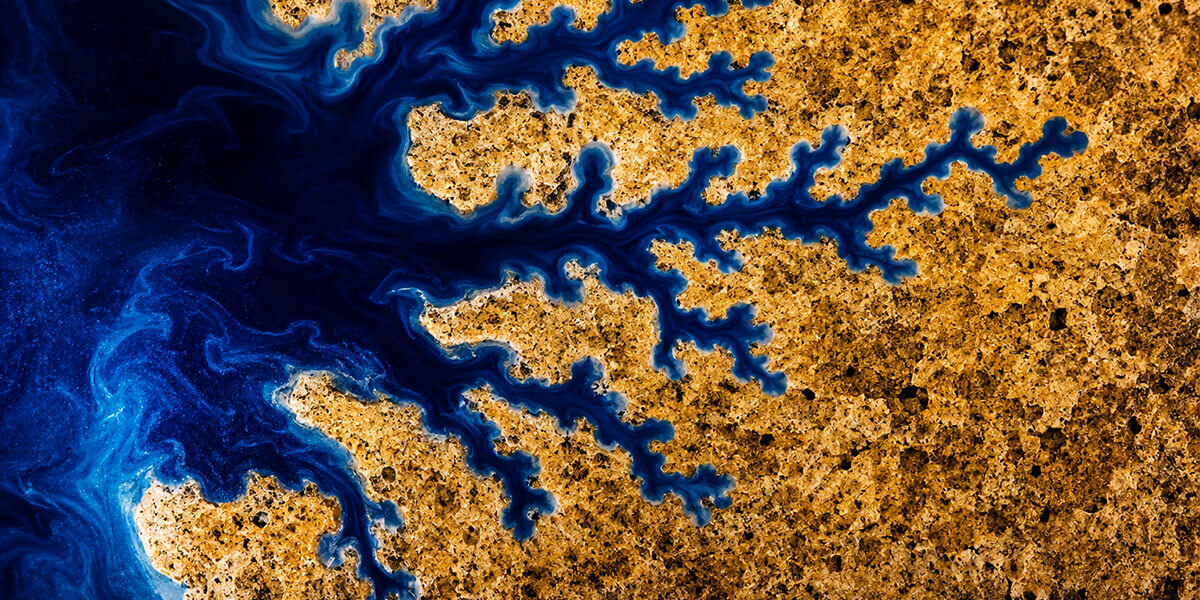
Concept visualization of the phenomenon of viscous fingering: displacement of a more viscous fluid (ochre) by a less viscous fluid (blue).
For the team at the USC Geosystems Engineering and Multiphysics Laboratory (GEM Lab), understanding how fluids move through complex geological systems is the key to solving critical energy and environmental challenges.
Working within USC Viterbi’s Mork Family Department of Chemical Engineering & Materials Science, the lab studies the processes that govern subsurface systems, where fluid flow, transport, rock properties, geomechanics and chemical reactions interact across multiple scales. The ability to predict and control these interactions determines the effectiveness of current technologies for groundwater remediation, geothermal energy production, geologic carbon sequestration, underground hydrogen storage, and a wide range of chemical and pharmaceutical processes.
In a numerical study published in Proceedings of the Royal Society A, Birendra Jha, director of GEM Lab and associate professor of chemical engineering and materials science, and doctoral researcher Faeze Ghazvini, report a new way to influence how fluids spread and mix through porous rock.