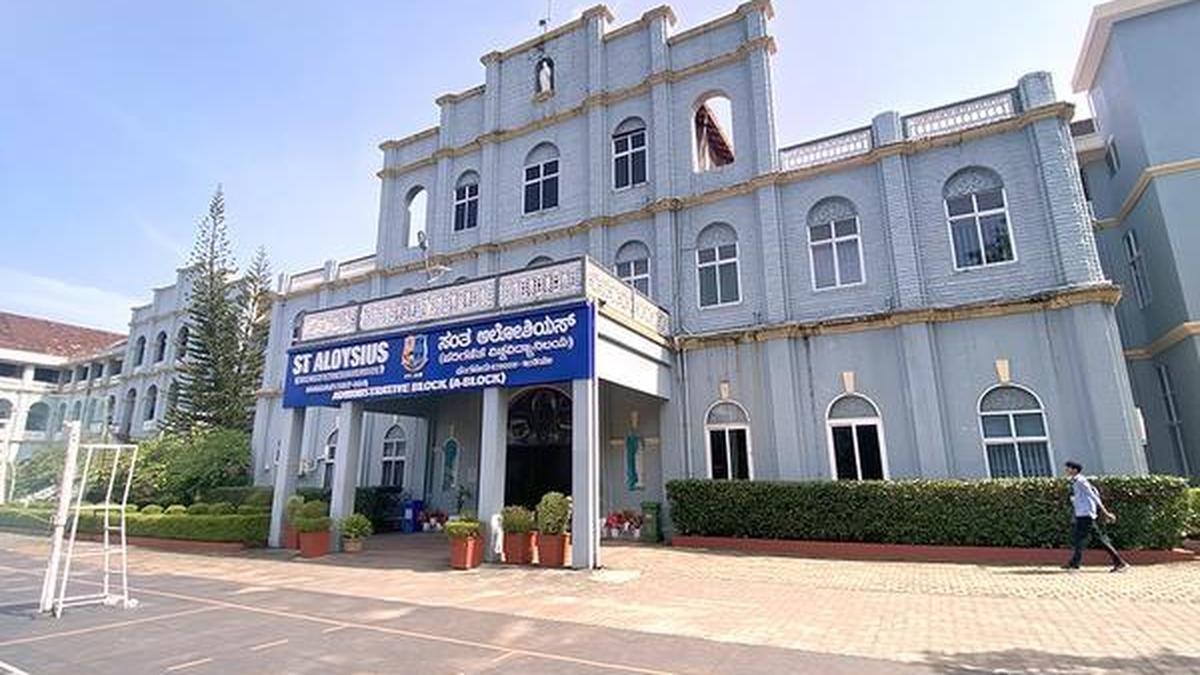
Praveen Martis, Vice Chancellor of St Aloysius (deemed-to-be university), addresses a media conference in Mangaluru on Monday.
The Mangaluru-based St Aloysius (deemed-to-be university) has secured the ‘Category-I’ status under the University Grants Commission (UGC) Graded Autonomy Regulations.India currently has 1,292 universities, comprising 57 Central universities, 521 State universities, 157 deemed-to-be universities, and 557 State private universities. Among the 157 deemed-to-be universities in the country, only 26 institutions have earned ‘Category-I’ status and among 1292 universities in the country only about 45 universities have earned ‘Category -I’ status.Addressing media persons in Mangaluru on Monday, Praveen Martis, Vice Chancellor of St Aloysius, said the ‘Category-I’ recognition has been conferred based on the university’s exceptional performance in quality assessment and accreditation. St Aloysius (deemed-to-be university) holds the NAAC A++ Grade with a CGPA of 3.67 on a four-point scale, reflecting excellence across all dimensions of higher education, including curriculum design, teaching-learning processes, research productivity, governance, infrastructure, innovation, student support, community engagement, and institutional values.He said that ‘Category-I’ universities enjoy substantial freedom in academic decision-making and institutional development under the UGC regulations. The university can introduce new academic programmes, departments, schools, centres, diploma courses, certificate programmes, and interdisciplinary initiatives without requiring prior approval from the UGC. This flexibility will allow St Aloysius to rapidly respond to emerging disciplines, industry requirements, technological advancements, and societal needs, he said.One of the aspect of ‘Category-I’ autonomy is the freedom to establish research parks, incubation centres, innovation hubs, entrepreneurship ecosystems, and university-society linkage centres. These initiatives will strengthen the university’s efforts to promote innovation, start-up culture, technology transfer, and industry-academia collaboration. Such provisions align perfectly with the university’s vision of nurturing creative thinkers, entrepreneurs, and socially responsible innovators capable of addressing contemporary global challenges, he said.This recognition marks a defining moment in the university’s illustrious 146-year journey of academic excellence, innovation, research, and nation-building, Martis added.Published on June 22, 2026