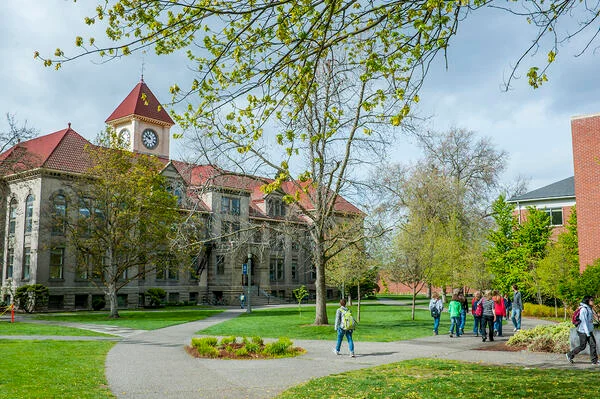
Whitman College has launched its "10% Promise," guaranteeing students that annual tuition will not exceed 10% of a family's adjusted gross income,gettyFrustrated with trying to figure out what your child’s college tuition will really cost? Confused by sticker price, tuition discounts, financial aid offers and complicated cost calculators? Fret no more. Whitman College has launched what it claims is a “first-of-its-kind financial commitment designed to take the guesswork out of paying for college.” It’s an eye-catching package with plenty of curb appeal.Whitman’s 10% Promise guarantees that students will never pay more than 10% of their family’s income for tuition. It’s a simple, transparent calculation based solely on a family’s adjusted gross income as reported on the Free Application for Federal Student Aid (FAFSA) or on line 11 of a federal tax 1040 form.“You’ll know what Whitman costs your family before you apply and the number won’t change as long as your financial situation doesn’t,” touts the website of the private liberal arts college in Walla Walla, Washington.The streamlined process and its guarantee will apply to students from every economic background. There are no income limits, and no tiers of differentiated tuition costs.“The current financial aid system is a hassle for families. It can be really confusing and opaque, and many families feel left out,” said Adam Miller, Whitman’s Vice President for Admission and Financial Aid, in a news release. “Understanding the cost of college should not take months or create additional stress, and we are committed to doing everything we can to make it simpler and easier for students and families to engage with financial aid from the first moment they encounter Whitman.”How the 10% Promise WorksUnlike most school’s financial aid formulas, which consider several variables and can be laborious to complete, Whitman’s 10% Promise is based solely on a family’s adjusted gross income. MORE FOR YOUEven before students formally apply, they can use the college’s online calculator to learn what their maximum tuition cost will be (the 10% limit applies only to tuition costs; room and board and other charges are additional). The calculator allows families to see the numbers early on, they don’t need to wait to know the true price until late in the application process. Here’s an example. Assume your family’s current adjusted gross income is $125,000. Your tuition cost will be $12,500, meaning that you are receiving $56,192 in institutional financial aid against Whitman’s sticker tuition price of $68,692 for 2026-27. The offer applies for up to four years of attendance at Whitman, according to a FAQ webpage. Students will need to re-certify their family income through the FAFSA each year, and as that number changes, their tuition price will also. “At Whitman, we believe students should be able to focus on finding the college that will be the best fit for them without the obstacle of financial uncertainty,” said Miller. “By providing families with clear, up-front tuition and financial aid information, we hope to make it easier for students to imagine themselves here, pursue the opportunities that will help them thrive and move forward with confidence when applying to Whitman.” Other Examples of Cost TransparencyWhitman is not the first college to try to demystify the real costs of college attendance. Last year, Cornell College, a private liberal arts college in Mount Vernon, Iowa, unveiled its Save Your Seat program, giving students an early indication of how much financial aid they would be eligible for even without having to first complete an application for admission or complete the FAFSA. Cornell derives its individualized aid estimates from information in a third-party data base, along with data from aid packages that it’s awarded to students over the decades.“When talking with students, we realized that misconceptions about how much college will cost have made many families hesitant to even consider college,” said Wendy Beckemeyer, Cornell’s vice president for enrollment management, in a press release announcing the program.This year Brandeis University rolled out Faye, a new calculator that gives students an individualized notion of the price they will pay, before they ever apply.These developments come as institutions are learning that the traditional "high tuition-high aid” model — where published tuition prices bear little relation to what many students end up paying for college — may be contributing to the public’s increasing distrust of higher education, according to the Strada Foundation’s recent report, The Price Transparency Imperative: Rebuilding Confidence in Higher Education.In April, a Yale University faculty committee issued a report urging the university to revise its high tuition-high aid system. While that model has lowered the expense of attending Yale for the relatively few low-income students it admits, the committee concluded that the process was “complicated, unpredictable, secretive, and highly variable,” and that applying for aid is “laborious” and “frustrating.”A major revision in how colleges communicate their pricing and financial aid is not likely to occur as long as they remain wedded to a system where high sticker prices are substantially discounted through generous institutional aid. Too many institutions remain committed to that business model, and too many students and families are flattered by the prestige of being awarded a big-dollar scholarship. A by-product of that approach is the spate of recent breathless headlines about the number of colleges whose total sticker price now tops $100,000 annually, despite the fact that only a small percentage of students pay that figure. One avenue for reform is the College Cost Transparency Initiative, sponsored in part by Strada, through which hundreds of colleges nationwide have committed to make their offer letters more clear and accurate. That effort could help students and families better understand college costs, but most schools have not joined the voluntary initiative. A recent Senate bill would require institutions to use uniform definitions of key components like loans, grants, and total costs in their financial aid offer letters so that families can make better-informed decisions. Even though that legislation, and a similar effort in the House, enjoys bipartisan support, it has yet to become law. Higher education associations have successfully lobbied against its requirement of uniformly worded letters, arguing that such a mandate interferes with their efforts to woo students and that a one-size-fits-all approach is unworkable. Students, families, and the general public would all benefit from colleges and universities providing up-front, accurate and standardized, information about the costs of education and financial aid offers. Whitman College, Cornell College and Brandeis University seem to have gotten that message. It’s time for other colleges and universities to get it too.
Demystifying The Cost Of Tuition: Whitman College Offers A 10% Promise
Whitman College has unveiled its 10% Promise, a guarantee that students will never pay more than 10% of their family’s adjusted gross income for annual tuition.
1,080 words~5 min read