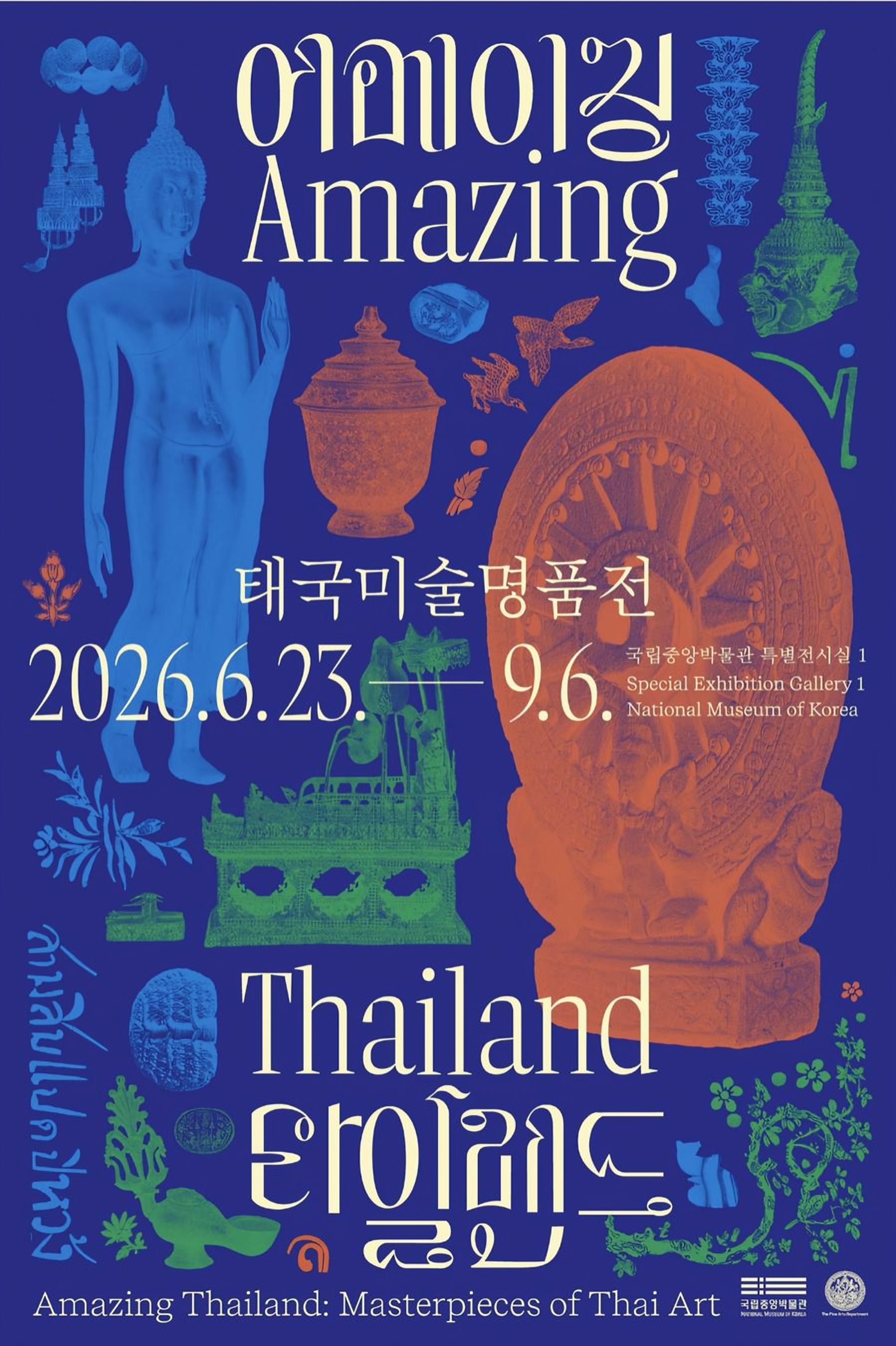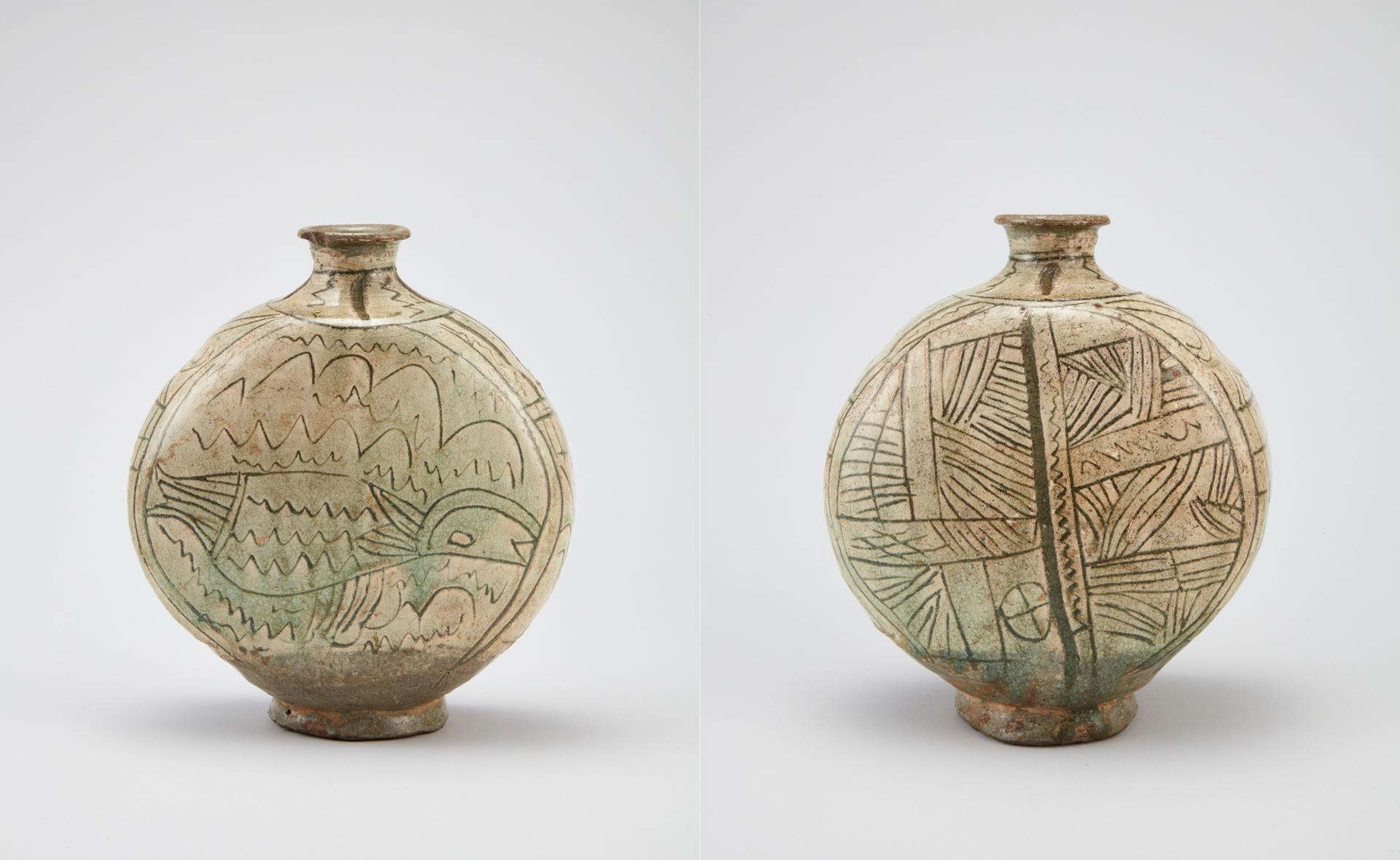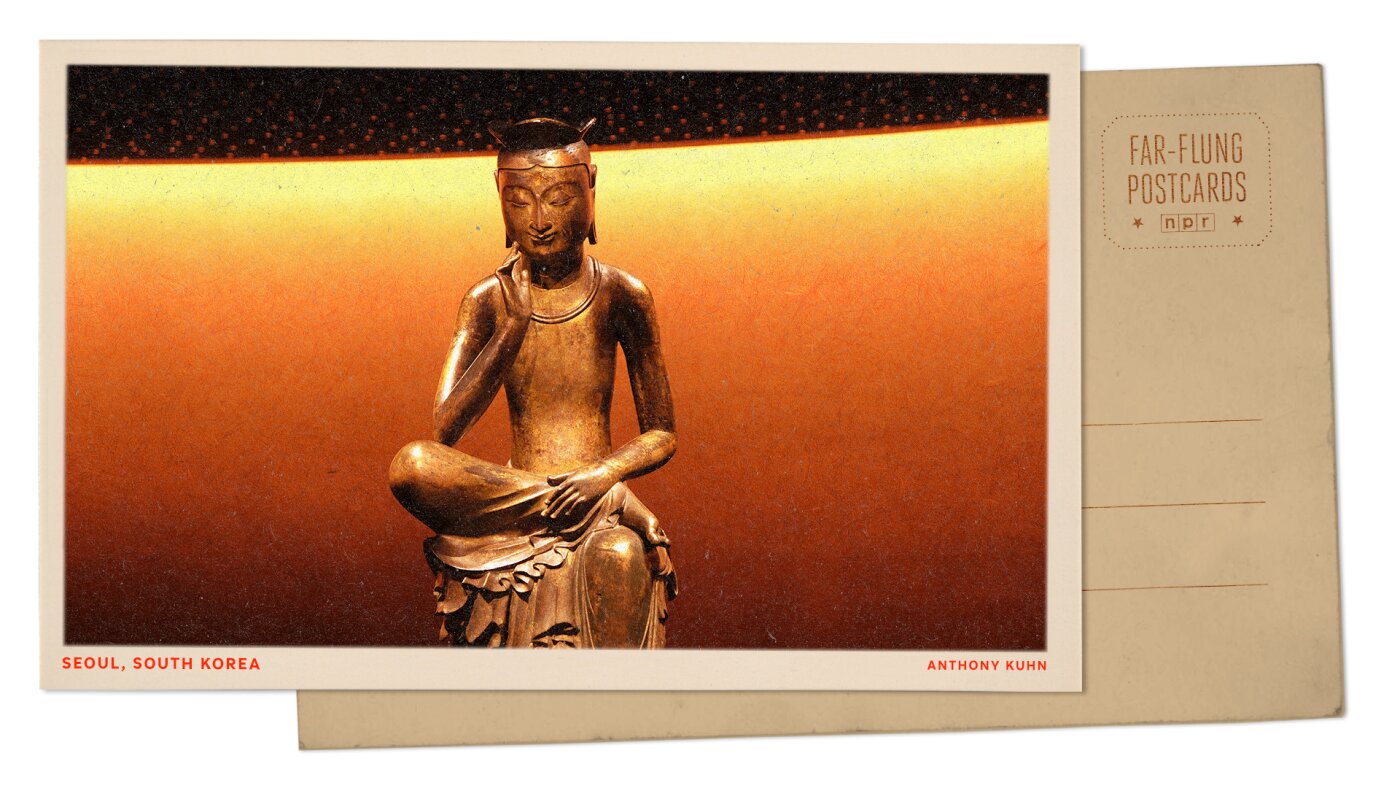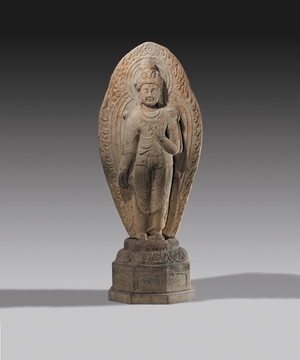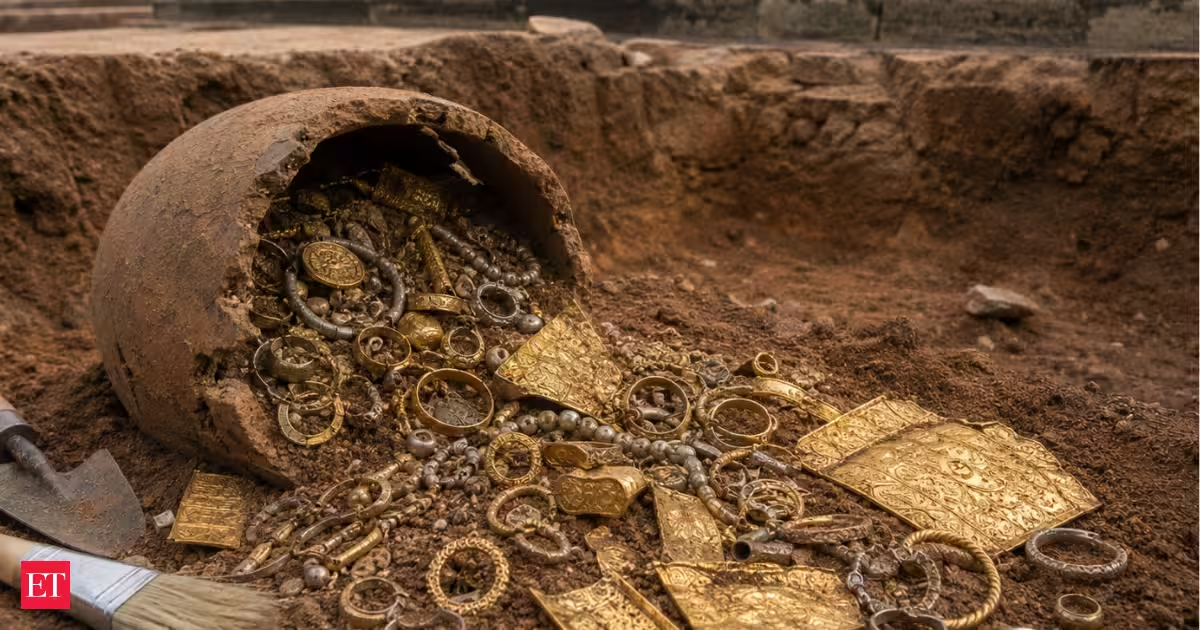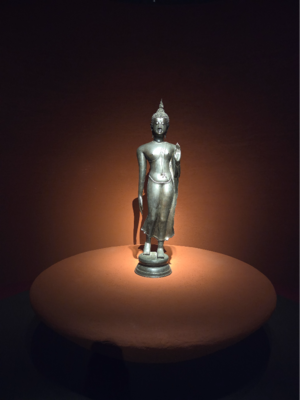
"Walking Buddha" from the 14th century is shown as part of the exhibition "Amazing Thailand: Masterpieces of Thai Art" at the National Museum of Korea on Monday. (Park Yuna/The Korea Herald) A Buddha stands upon a lotus pedestal, stepping forward with the left foot while the right heel is slightly raised. His left hand is lifted near the chest with the palm facing forward. The bronze sculpture from the 14th century in Thailand is named “pang-li-la,” meaning graceful posture."If I had to pick one work in the exhibition that captures Thailand's unique artistic identity, it is the ‘Walking Buddha.’ For Koreans, it may be comparable to the iconic Pensive Bodhisattva shown at the ‘room of quiet contemplation,’” said You Hong-june, director of the National Museum of Korea, on Monday.Noh Nam-hee, NMK associate curator, referred to the sculpture as a "representative work that exemplifies the elegance of classical Thai art, distinguished by its remarkable sense of balance." A view of "Amazing Thailand: Masterpieces of Thai Art" at the National Museum of Korea on Monday (Park Yuna/The Korea Herald) "Yet rather than a Buddha absorbed in contemplation, the Walking Buddha presents a Buddha in motion, stepping toward to offer salvation. Its importance lies not only in its religious symbolism but also in its remarkable sculptural innovation."The exhibition “Amazing Thailand: Masterpieces of Thai Art” will open Tuesday with 239 pieces from 21 museums across Thailand, including the National Museum Bangkok. "Pottery with Geometric Designs" (Ban Chiang National Museum, National Museum of Korea) Walking through “Thailand Before Thailand,” “The Glory of the Thai Kingdoms,” and “The Thai Monarchy and Buddhism,” the exhibition traces the development of Thai art from prehistoric times through the classical kingdoms of Sukhothai (1238-1348), Lanna (1292-1775), and Ayutthaya (1351-1767).It continues through the art of the Rattanakosin Kingdom, the dynasty founded in 1782 that remains in power today. "Former Inner Gate from Wat Phra Kaeo" ( National Museum Bangkok, National Museum of Korea) Bringing together works spanning more than two millennia, the exhibition illustrates how Hinduism and Buddhism became deeply embedded in Thailand's cultural and artistic traditions, shaping the country's culture, beliefs and artistic expression across centuries.The director said Thailand's cultural identity was shaped by both continental and maritime influences, making it a uniquely hybrid civilization. Visitors look at artifacts during the press preview of "Amazing Thailand: Masterpieces of Thai Art" at the National Museum of Korea in Seoul on Monday. (Yonhap) “Thailand was never colonized by a foreign power. It entered the modern era while preserving a strong sense of national identity, which I find remarkable," he said.Referring to the film "The King and I," Kim said the story offers a glimpse into Thailand's modernization process and the role of the monarchy in navigating encounters with the West. Visitors look at artifacts during the press preview of "Amazing Thailand: Masterpieces of Thai Art" at the National Museum of Korea in Seoul on Monday. (Yonhap) Tossaporn Srisamamn, deputy director-general of the Thai Culture Ministry's Fine Arts Department, stressed that this exhibition would be the first time some of the works had been shown abroad.He described a statue of “Eight-armed Avalokiteshvara” unearthed in Thailand's Chaiya as "one of the masterpieces of Mahayana Buddhist art in Southeast Asia.""Beyond its outstanding craftsmanship, the sculpture serves as important evidence of the historical role of southern Thailand as a hub of maritime trade and cultural exchange more than a thousand years ago," he said.The exhibition runs through Sept. 6.
Craftsmanship, elegance of Thai masterpieces on show at National Museum of Korea
A Buddha stands upon a lotus pedestal, stepping forward with the left foot while the right heel is slightly raised. His left hand is lifted near the chest with
574 words~3 min read