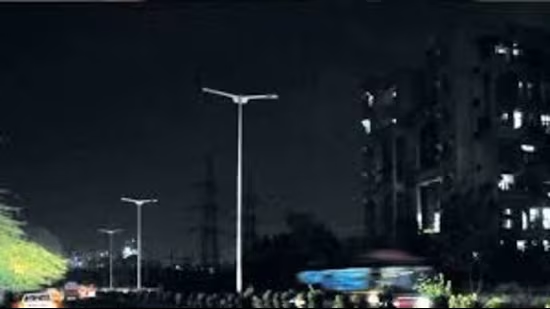
The Delhi government will pay for its upcoming projects of modernising the streetlight network and expanding the CCTV camera network through a monthly instalment-based payment model based on performance, instead of its usual upfront payments.The government has planned to convert around 93,000 streetlights on main roads at a cost of ₹473 crores (HT)The government has planned to convert around 93,000 streetlights on main roads at a cost of ₹473 crores. Public works department (PWD) minister Parvesh Verma said that the payment for this project will be divided in 60 instalments over five years.“Every month, the company will have to provide a report on the functionality of lights, removal of darkspots. Instead of keeping the maintenance provision separately, the installing agency will be responsible for keeping them functional. If the operator fails to repair the lights in a fixed time, a penalty of ₹2,000 per day would be imposed,” said Verma.While the streetlights, operating at 10-15 LUX(luminous flux per unit area) will be doubled to almost 40LUX, “the system will be remotely controlled and monitored from a central control room and we will be able to dim them during the low use hours to reduce power consumption. The overall saving over a five-year period is likely to be around ₹300 crore,” the minister added.A control-and-command centre will be set up at the PWD headquarters at ITO to monitor the status of all the streetlights in real time . Verma said that the project also envisages dimmable and individually-controlled streetlights. “We would also be able to blink them in synchronous manner to mark special occasions,” the minister said.The minister said that a similar EMI based model will be followed in case of CCTV camera expansion and replacement programme. “We will replace the CCTV cameras in phases starting with 50,000 cameras in the first years and per year quota in subsequent years. This will also be implemented based on the EMI model,” he added.According to the department, around 280,000 CCTV cameras have been installed across the city by PWD over the past several years. Nearly half of these cameras are expected to reach the end of their operational life by next year. Additionally, 50,000 new cameras will be installed besides replacement of the old ones.Verma said that “model tenders” are being prepared for each type of work to improve accountability and ensure only reputed firms take part in Delhi’s infrastructure projects. “The basic tender document is central to the smooth implementation of any project. Under the current system, we have separate divisions floating tenders with different conditions. This arbitrariness is being removed. We would make model tenders with similar and stringent conditions so that only reputed firms come to bid for the project. It will also be able to improve accountability,” he added. In coming days, departments like PWD, irrigation and flood control department, and Delhi Jal Board will float tenders for entire zones rather than using a piecemeal approach.
Delhi to modernise streetlights on a monthly instalment-based payment model
Delhi will fund streetlight and CCTV upgrades via a performance-based EMI model, aiming for improved functionality and accountability over five years. | Latest News Delhi
487 words~2 min read