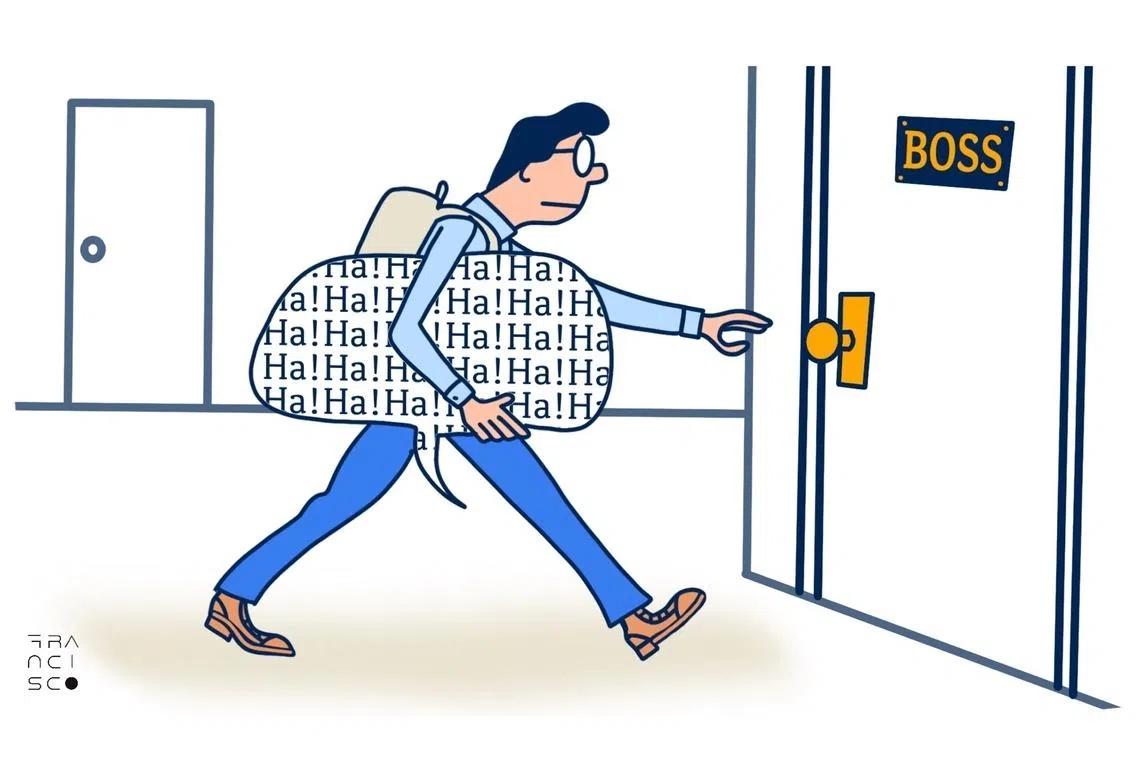
In this series, business journalist Timothy Goh offers practical answers to candid questions on navigating workplace challenges and getting ahead in your career. Get more tips by signing up to The Straits Times’ Headstart newsletter.Laugh if it feels natural, but employees do not need to laugh at every joke their boss makes.A genuine, light laugh can help build warmth and rapport, especially when the joke is appropriate and the mood relaxed, says clinical psychologist Lisa Tang.Shared humour can also make the workplace feel more human and less tense.“But there is an important power dynamic here. Because bosses influence appraisals, opportunities and workplace culture, employees may feel pressure to laugh even when they do not find the joke funny,” says Tang.When there is a repeated mismatch between one’s “outside face” and “inside feelings”, it can become emotionally tiring over time. Employees may start to feel that they are not being fully authentic, which can affect their sense of comfort at work.“Will laughing at your boss’ jokes affect how your boss perceives you? Possibly, but usually in small ways,” says Tang.“We tend to respond positively to people who seem warm, friendly and engaged, so a natural smile or laugh may make someone come across as approachable and pleasant to work with.”That said, forced laughter can backfire if it feels exaggerated or insincere. It may also come across as flattery, or trying too hard.“A good rule of thumb is to be polite but authentic,” adds Tang.“A smile, a light acknowledgement or simply staying engaged in the conversation is often enough. And if a joke is inappropriate, discriminatory or makes people uncomfortable, employees should not feel obliged to laugh.”Leaders also need to remember that their jokes carry extra weight because of their position.“Ultimately, humour should create connection, not pressure. The best kind of workplace humour is inclusive, respectful and used in moderation,” says Tang.Counselling psychologist Padma Jairam says the constant effort of pretending to appreciate a boss’ jokes can eventually lead to emotional exhaustion and disconnection, as employees may feel “unsafe” being their authentic selves.Over time, this can result in lower job satisfaction.“What may have started as a survival mechanism, or even an attempt to accelerate one’s promotion at work, might eventually lead to increased dissatisfaction,” Padma says.Another consequence of employees appearing to laugh along is that bosses may feel encouraged to tell even more jokes.“This can create pressure on the employee to increase the fake laughter, accelerating the exhaustion and disconnection,” says Padma.The solution, she adds, is moderation.Employees should be realistic about what they can sustain, which means not every joke needs to be met with roaring laughter.“Sometimes a quiet chuckle or a smile is enough to acknowledge that the boss has told a good joke,” says Padma.“More varied responses – sometimes a smile, sometimes a chuckle and other times a genuine laugh – come across as more authentic, while helping employees feel more connected to both the conversation and the boss,” she adds.
askST Jobs: How important is it to laugh at my boss’ jokes?
Employees need not laugh at every joke, as authenticity matters for workplace well-being. Read more at straitstimes.com. Read more at straitstimes.com.
TL;DRAI
Psicologi evidenziano che risate forzate riducono autenticità e aumentano exhaustion; risposte naturali preservano rapport. Per CTO e tech lead, humor inclusivo in team culture è driver di retention, opposto a pressione che accelera burnout engineer.
491 words~2 min read