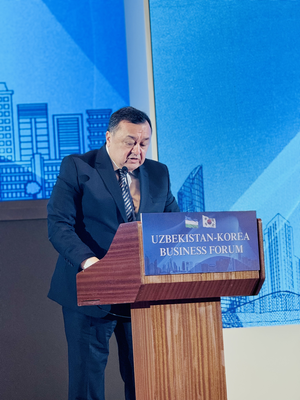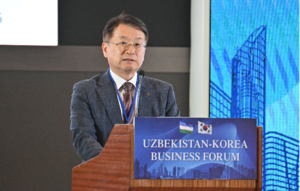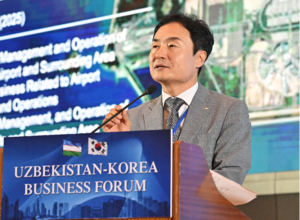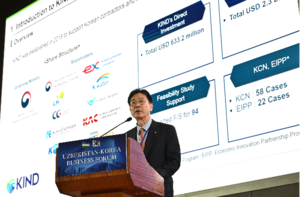
Kim Bok-hwan, CEO of the Korea Overseas Infrastructure and Urban Development Corp., speaks at the Korea-Uzbekistan Business Forum in Tashkent, Uzbekistan, Tuesday. (Im Se-jun/The Korea Herald) TASHKENT, Uzbekistan -- Korea Overseas Infrastructure and Urban Development Corp. (KIND) said it was pushing ahead with airport, bio-cluster and smart city projects in Uzbekistan, as the Korean state-backed infrastructure investor seeks to expand its role in the fast-growing Central Asian market.Speaking at the Korea-Uzbekistan Business Forum 2026 on Tuesday, KIND CEO Kim Bok-hwan said Uzbekistan’s strategic location — at the heart of Central Asia and along the Silk Road — meant that infrastructure would be increasingly important for the next stage of the country’s growth."Uzbekistan is located at the center of Central Asia and the Silk Road, giving it great geopolitical importance," Kim said. "In that sense, airport projects are highly important."KIND is involved in projects for a new Tashkent airport and another in Urgench, Kim said.Founded in 2018, KIND supports Korean builders and investors participating in overseas infrastructure, plant and public-private partnership projects. Kim said the global infrastructure market was increasingly shifting toward PPP and investment-development models as governments face tighter fiscal conditions and wider funding gaps.KIND provides support across project development, planning and operation, as well as equity investment and financing.Kim said the company was also working on the Tashkent Smart Bio Cluster, a planned complex for the pharmaceutical, biotech and medical device industries.For the bio-cluster project, KIND completed a master plan last year under the Korean government’s K-City Network program and plans to conduct a feasibility study this year. The project is aiming to break ground in the second half of 2027, according to Kim.KIND is also reviewing the Tashkent Smart Aerocity project, which would be linked to the new airport, Kim said. According to the CEO, the project aims to develop a 750-hectare complex around the airport, combining logistics and related industries with an integrated airport-linked urban development model. A master plan is expected to be drawn up in 2026 through the K-City Network program, followed by a feasibility study.Since its establishment, KIND has directly invested about $600 million in 28 projects across 15 countries. Including policy funds it manages, the company has invested around $3 billion in 85 projects across 20 countries, Kim said.Major projects include the Upper Trishuli-1 hydropower project in Nepal, the Trumbull combined-cycle power plant in the US, the Hung Yen industrial park in Vietnam and the Nakkas-Basaksehir motorway in Turkey. In 2025, the company won the Facility E independent water and power project in Qatar, a gas-fired combined-cycle power and desalination plant. This year, it signed a contract for a floating liquefied natural gas production facility, or FLNG, offshore plant project in Louisiana, Kim said.Kim said KIND mainly invests through equity participation, allowing it to share project risks with sponsors more actively than lenders. The company also invests through funds and bonds, using both its own capital and policy funds to support overseas infrastructure projects.KIND manages a 2.6 trillion won fund that supports overseas plant, infrastructure and smart city projects, as well as a green infrastructure export support fund, he added.“KIND will work to successfully carry out these projects based on Korea-Uzbekistan cooperation, while actively discovering new projects to further strengthen bilateral cooperation,” Kim said.
KIND eyes airport, smart city projects in Uzbekistan
TASHKENT, Uzbekistan -- Korea Overseas Infrastructure and Urban Development Corp. (KIND) said it was pushing ahead with airport, bio-cluster and smart city proj
TL;DRAI
KIND launches airport, pharma-biotech, and smart aerocity projects in Uzbekistan, expanding Korea's Central Asia infrastructure footprint. Smart infrastructure models create demand for digital backbone—cloud, IoT, connectivity—reshaping tech investment decisions in emerging Asian markets.
542 words~2 min read