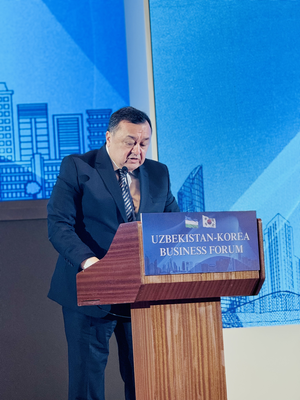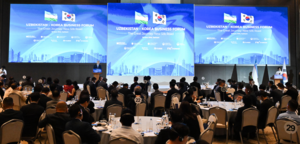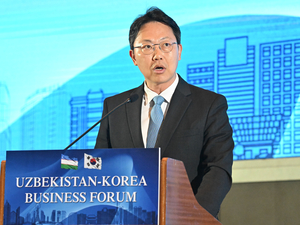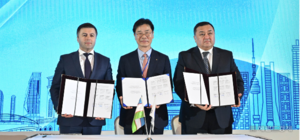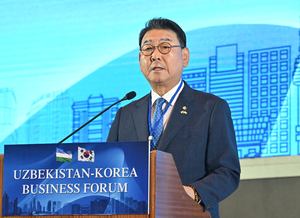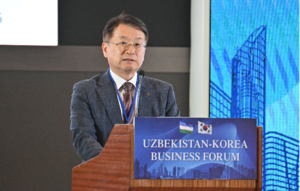
Seo Jung-hwa, senior executive director of the Export-Import Bank of Korea, speaks at the Korea-Uzbekistan Business Forum in Tashkent, Uzbekistan, Tuesday. (Im Se-jun/The Korea Herald) TASHKENT, Uzbekistan — South Korea's state export lender said it was ready to finance a new wave of Korea-Uzbekistan projects, as Tashkent seeks to draw more Korean capital into infrastructure, supply chains and technology-driven industries on the back of economic reforms.Speaking at the Korea-Uzbekistan Business Forum 2026 in Tashkent, Seo Jung-hwa, senior executive director of the Export-Import Bank of Korea, said Eximbank aimed to help convert government-level cooperation between the two countries into real business projects and investment."Eximbank wants to go beyond simple financial support and serve as a bridge that connects government cooperation to real projects and investment," Seo said.The remarks came as Uzbekistan used the forum to pitch itself as a fast-growing and increasingly investor-friendly market for Korean companies seeking a foothold in Central Asia.Seo said Uzbekistan remained one of Korea’s core partners in the region, with cooperation expanding from traditional energy infrastructure such as gas and power into artificial intelligence, digital transformation and new industries.Eximbank uses a range of financing tools for such projects, including the Economic Development Cooperation Fund, export credit agency financing and supply chain cooperation funds, he said.EDCF, Korea’s concessional loan program for government-to-government development cooperation, has supported 20 projects in Uzbekistan worth about $1.4 billion, according to Seo.Major examples include the Tashkent Medical Cluster, a flagship development cooperation project that includes a children’s hospital, cancer center, general hospital and medical university, as well as the Pharmaceutical Cluster, also known as Pharma Park, which is designed to strengthen Uzbekistan’s pharmaceutical industry.Seo said Eximbank has also participated in large-scale gas chemical and natural gas processing projects in Uzbekistan, each with project costs exceeding $3 billion, and is reviewing cooperation for the New Tashkent Airport project.The bank is also looking to support Korean companies expanding in Uzbekistan, including in the automotive supply chain. Seo said Eximbank operates credit lines with Uzbek financial institutions so local companies can receive financing through partner banks.Seo also pointed to Korea’s supply chain cooperation fund, created by the Korean government in September 2024, as a tool that could support projects involving critical minerals, advanced industrial materials and logistics assets. The fund provided 7 trillion won ($4.6 billion) in support last year and plans to provide another 7 trillion won this year, he said.Reforms for investor-friendly economy Ilzat Kasimov, Uzbekistan's deputy minister of investment, industry and trade, delivers congratulatory remarks at the Korea-Uzbekistan Business Forum in Tashkent, Uzbekistan, Tuesday. (Im Se-jun/The Korea Herald) Ilzat Kasimov, Uzbekistan's deputy minister of investment, industry and trade, said the forum could help deepen bilateral trade, economic and investment cooperation.Kasimov said more than 700 joint ventures were currently operating in Uzbekistan, with Korean companies including Posco, Daewoo, Samsung and Lotte active in the market. He cited local production of Kia-brand vehicles and BoMI E&C’s building projects as examples of concrete bilateral cooperation.He said Uzbekistan had pursued major reforms under President Shavkat Mirziyoyev to build an export-oriented and investor-friendly economy.According to Kasimov, the country has abolished more than 200 regulations, reduced the number of tax categories from 13 to nine, and cut the value-added tax rate from 20 percent to 12 percent."We have also liberalized the foreign exchange market, removed restrictions on overseas transfers of dividends and investment income, simplified business registration procedures and moved land acquisition to an electronic system," Kasimov said.Kasimov also highlighted Uzbekistan’s preferential access to the European market, saying the country has been able to export more than 6,000 items to Europe duty-free since 2021. He added that negotiations for Uzbekistan’s accession to the World Trade Organization have entered a substantive stage.Uzbekistan’s gross domestic product has more than doubled in recent years and reached $147 billion at the end of 2025, Kasimov said. The country aims to expand its economy to $240 billion by 2030.He said Uzbekistan is offering incentives in areas including land tax, corporate tax, data centers, crypto-related industries, renewable energy, long-term power supply and digital infrastructure.With the first Korea-Central Asia Summit set to take place in Seoul in September, Seo said cooperation is expected to expand further into technology-driven industries, public-sector projects and private investment."The upcoming Korea-Central Asia Summit in September is expected to take our cooperation to another level," Seo said.
Eximbank Korea eyes bigger role as Uzbekistan seeks Korean capital
TASHKENT, Uzbekistan — South Korea's state export lender said it was ready to finance a new wave of Korea-Uzbekistan projects, as Tashkent seeks to draw more Ko
TL;DRAI
Eximbank Korea scales Uzbekistan financing toward AI and supply chains: $1.4B in 20 projects, $7B annual cooperation fund. Signal for IT managers: Uzbekistan with GDP doubling to $240B (2030) and reforms (200+ regs abolished, VAT cut) attracts Korean supply chain tech.
717 words~3 min read