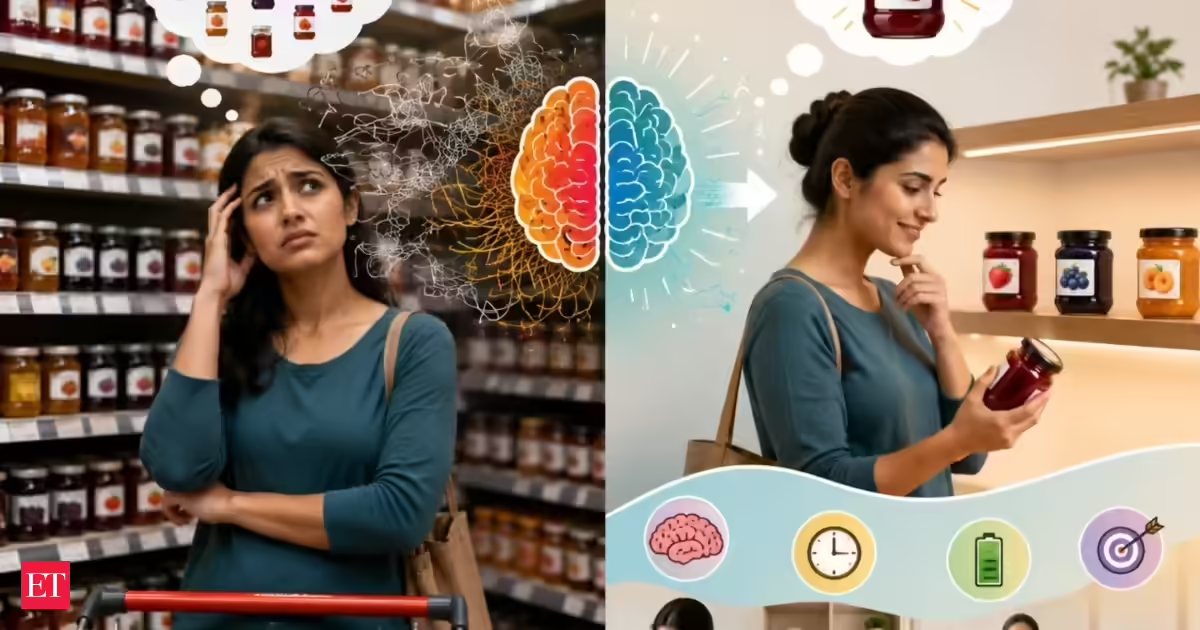
You are standing in a supermarket aisle, trying to buy something as simple as jam. But instead of three options, there are thirty. Strawberry, mixed berry, low sugar, organic, imported, crunchy, smooth. Minutes pass, and you are still staring at the shelf. Sound familiar? Why do simple decisions sometimes feel exhausting? And why does having more options often make choosing harder rather than easier?Psychology explains this phenomenon through “Hick's Law,” a principle stating that the time required to make a decision increases as the number of available choices grows. In simple terms, the more options a person has, the more mental effort is needed to compare them, process information, and decide.How does the brain respond to too many options?Hick’s Law is grounded in the understanding that the human brain has a limited capacity to process information at any given moment, according to online platform The Decision Lab. When individuals are presented with too many options, the brain must work harder to evaluate, compare, and eliminate each choice, increasing cognitive load.This mental overload can contribute to decision fatigue, slower decision-making, information overload, and, in some cases, complete indecisiveness. The brain must evaluate each option, weigh possible outcomes, and eliminate alternatives before arriving at a final choice. Even when the differences between options are small, this extra processing can slow decision-making and increase mental fatigue.Since its introduction, Hick's Law has found wide application across multiple disciplines, particularly in psychology, human-computer interaction, and user experience (UX) design, where it helps explain and improve how people process choices and make decisions.Deeper meaning and relevance in everyday lifeThe deeper message behind Hick’s Law is not that choices are bad, but that unlimited choices can become overwhelming. While freedom to choose is valuable, too many options can create hesitation, self-doubt, and decision fatigue. Hick’s Law appears in everyday life more often than people realize. It affects online shopping, restaurant menus, workplace decisions, and even daily routines like choosing what to wear.That is why many successful apps, stores, and services simplify options to make decision-making easier for users. The same principle can improve personal productivity. Creating routines, limiting options, or setting clear priorities can reduce mental overload and help decisions feel quicker and less stressful. Small systems often preserve mental energy for bigger choices.ALSO READ: Spanish Proverb of the Day: 'No hay mal que por bien no venga' - Every cloud has a silver lining; check meaning and relevance in everyday life
Do you take too much time making day-to-day decisions? Psychology says when people have more choices, it takes them longer to decide
Ever feel overwhelmed by too many choices. Psychology's Hick's Law explains this, stating more options mean longer decision times and increased mental effort. Our brains struggle with information overload, leading to fatigue and indecision. This principle impacts everything from online shopping to daily routines, highlighting how simplifying choices can boost productivity and reduce stress.
TL;DRAI
Hick's Law demonstrates that decision time grows with option volume, creating cognitive overload and decision fatigue. For engineering leaders and product teams, limiting choices in workflows, interfaces, and processes reduces mental friction and improves decision velocity.
405 words~2 min read