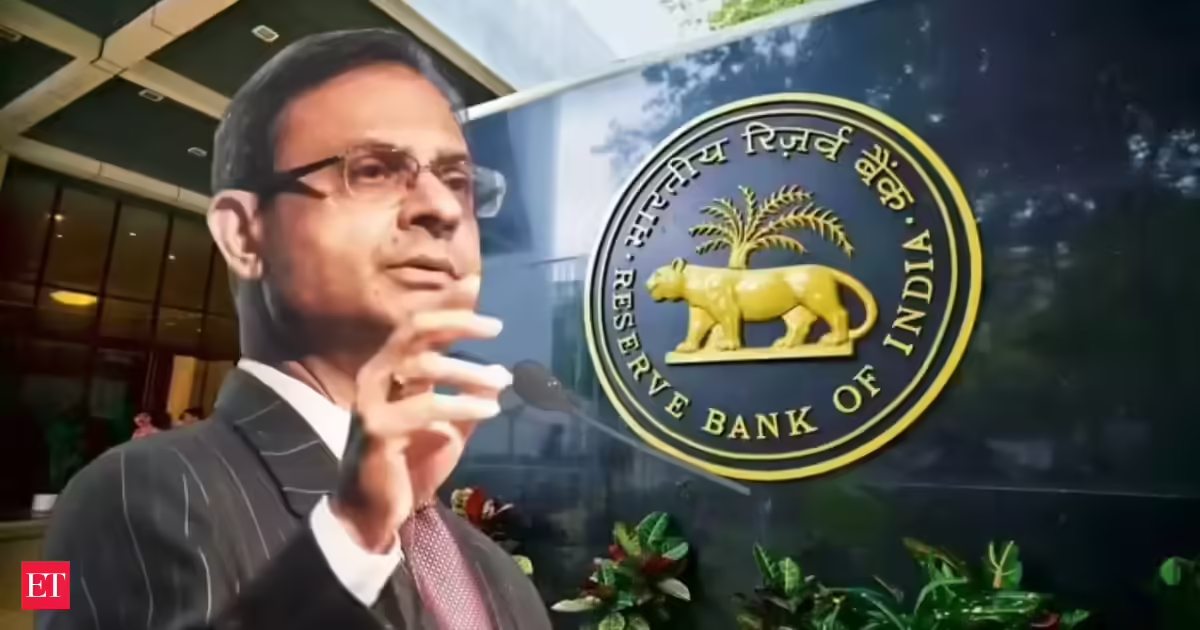
The Monetary Policy Committee (MPC) members at their last meeting broadly agreed that the prolonged conflict in West Asia has emerged as the most significant risk to India’s economic outlook, the minutes of the meeting which was release on Friday indicate.The disruption of energy supplies, higher crude oil prices, elevated shipping and insurance costs, and uncertainty surrounding the Strait of Hormuz have increased concerns about inflation, growth, external balances, and financial market stability, the minutes showed.Consequently, all members supported maintaining the policy repo rate at 5.25 per cent and retaining the neutral stance, emphasizing a cautious “wait-and-watch” approach.A common theme across the statements of various members was that India enters the current crisis from a position of relative strength. Members highlighted robust macroeconomic fundamentals, including strong GDP growth, healthy foreign exchange reserves, fiscal consolidation, resilient services exports, stable financial conditions, and strong credit growth. “On the whole, our economic situation is quite strong and healthy vis-à-vis many of our peers. We are in a much better position today not only in terms of the current shock but also with respect to all earlier shocks. We are one of the fastest growing major economies and our inflation has been benign in the past year,” MPC chairman and RBI Governor Sanjay Malhotra stated in his statement.These strengths are expected to help cushion the economy against external shocks, members maintained.However, members acknowledged that the conflict has worsened the growth-inflation trade-off. GDP growth for 2026-27 has been revised down to 6.6 per cent, reflecting weaker global demand, supply chain disruptions, higher input costs, and risks from a potentially deficient monsoon associated with El Niño conditions. While growth remains the highest among major economies, there are concerns about slowing momentum in industrial activity, private investment, and exports.“The West Asia conflict and the blockade of the Strait of Hormuz have created a challenging situation for the global economy,” said Nagesh Kumar, external member of the MPC.“The crude prices have shot through the roof, and supplies have been disrupted. The Indian economy has also been affected, given its heavy dependence on imports of hydrocarbons and fertilisers, substantial proportion of which are routed through the Strait,” Dr Kumar said.“The rising crude prices raise concerns about consumer prices directly and indirectly, given the dependence of many sectors of manufacturing on petroleum products as fuels and feedstock, even though the government has allowed only a limited pass-through, so far,” he stated in his statement.“The Gulf region is also an important destination for India’s exports and a major source of remittances. In addition, there are concerns on the agricultural front arising from El Niño affecting the monsoons,” he said.“The global uncertainty has also led to outflows of foreign portfolio investments from India, bringing the exchange rate of the rupee under pressure, besides concerns about the balance of payments impact of rising crude prices. Therefore, the West Asia conflict is an important shock for India’s economic outlook in the near term,” he maintained.Inflation risks dominated the discussion. The projected CPI inflation of 5.1 per cent for 2026-27, compared with 2.1 per cent in the previous year, reflects higher crude oil prices, rising food and fuel costs, and possible second-round effects from elevated wholesale prices. Several members pointed to the sharp increase in WPI inflation and growing inflation expectations as warning signs. Nevertheless, they noted that headline inflation remains below target at present, while core inflation—especially excluding precious metals—remains subdued, suggesting that broad-based demand pressures have not yet emerged.There were differing assessments regarding inflation persistence. Some members expressed concern that prolonged energy shocks could become embedded in consumer prices and inflation expectations. Others argued that government measures, including limited pass-through of fuel prices, stable fertiliser prices, and diversification of energy sources, would moderate second-round effects and keep inflation expectations anchored.Given these uncertainties, members stressed the importance of policy flexibility. Since inflationary pressures are largely supply-driven rather than demand-driven, premature monetary tightening could unnecessarily weaken growth. At the same time, easing policy would be inappropriate amid rising inflation risks. Therefore, maintaining the repo rate and a neutral stance was viewed as the most prudent course until greater clarity emerges on the duration of the conflict, inflation dynamics, and monsoon outcomes.Overall, the MPC adopted a risk-management approach, prioritizing vigilance, data dependence, and flexibility in responding to evolving economic conditions.
West Asia conflict impact dominated MPC meeting discourse
The Monetary Policy Committee (MPC) members at their last meeting broadly agreed that the prolonged conflict in West Asia has emerged as the most significant risk to India’s economic outlook, the minutes of the meeting which was release on Friday indicate.
TL;DRAI
MPC holds repo rate 5.25% with West Asia conflict as primary risk: crude oil surge, energy disruption, growth revised to 6.6%. CPI inflation forecast jumps to 5.1% on oil shocks; IT managers face pressure on datacenter capex and infrastructure costs.
714 words~3 min read